


Choosing the right kitchen countertop really comes down to three things: your lifestyle, your budget, and your style. The secret is to think about how you actually live your life first. How often do you cook? How much cleaning are you willing to do? Once you’re honest about that, you can find a material that fits your wallet and looks great. This way, you won't get paralyzed by all the choices out there.
Starting Your Countertop Search With Confidence
Picking a countertop is one of the biggest moments in a kitchen remodel. It's not just a work surface; it's where you'll prep countless meals, where kids will do their homework, and where friends will gather. It truly sets the tone for the entire room.
Instead of just diving into a sea of granite, quartz, and marble samples, it’s best to start with a clear game plan. This first step is about turning what feels like a huge decision into a genuinely exciting part of designing your dream kitchen.
Think about your daily reality. Are you a busy parent who needs a countertop that can survive grape juice spills and stray marker drawings? Or are you a serious home chef who needs a surface that won't scorch when a hot pan lands on it? Being upfront about your needs is the best tool you have for making the right choice.
A Quick Overview of Your Options
Before you get lost in the details of every single material, a simple side-by-side comparison can help you spot the top contenders right away. Seeing the big picture on cost, toughness, and upkeep provides instant clarity. To make it even easier, you can play around with kitchen design software to see how different countertops would actually look in your space with your cabinets and lighting.
The perfect countertop is one that supports how you already live, not one that makes you change your habits. The goal is to find a beautiful surface that works for you, not the other way around.
To get you started, here’s a quick-glance table comparing the most popular options. Use it to build a shortlist of materials that really make sense for your home and your budget.
Quick Comparison of Popular Countertop Materials
Here's a cheat sheet designed to give you a snapshot of what's out there. This table will help you quickly compare the most common choices based on what matters most.
| Material | Average Cost (per sq. ft.) | Durability | Maintenance Level | Best For |
|---|---|---|---|---|
| Quartz | $50 - $150 | Very High | Low | Busy families and modern kitchens |
| Granite | $40 - $100 | High | Medium | Heat resistance and natural beauty |
| Marble | $60 - $200 | Low-Medium | High | Luxury looks and baking prep |
| Porcelain | $55 - $120 | Very High | Low | High-traffic areas and UV resistance |
| Laminate | $20 - $50 | Low | Low | Budget-friendly updates and DIY projects |
Think of this table as your starting point. It helps narrow the field so you can focus your energy on sampling and pricing the materials that are the best fit for your kitchen remodel.
A Realistic Look at Popular Countertop Materials
Let's move beyond the glossy brochures and get real about what it's like to live with different countertop materials. The perfect surface for a magazine shoot might be a total nightmare in a busy family kitchen. Understanding the day-to-day reality of each option is the key to choosing a countertop you'll love for years, not just on installation day.
This quick chart gives you a bird's-eye view of how cost, durability, and maintenance balance out across the most common materials.
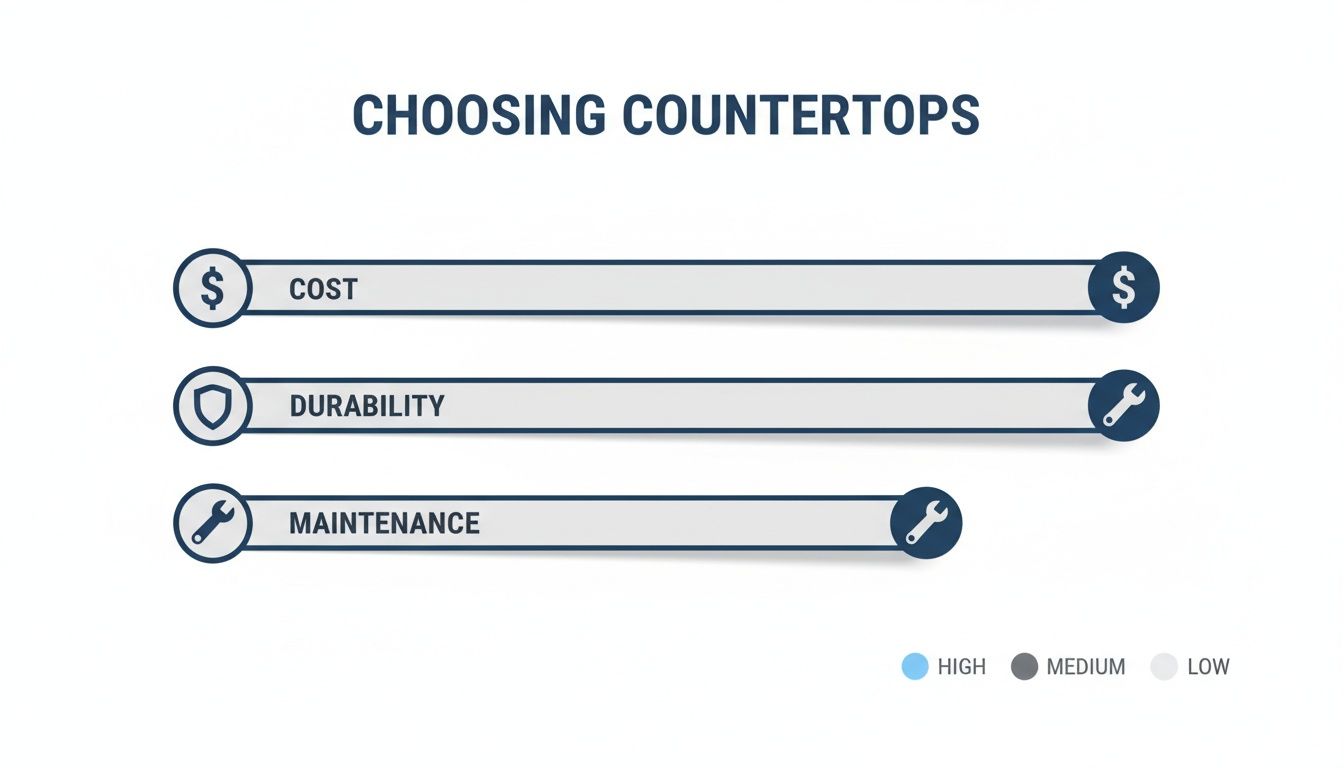
As you can see, while durability and cost often rise together, the maintenance needs can vary wildly. That third factor is often the most critical one in your long-term happiness.
Engineered Quartz: The Low-Maintenance Champion
There’s a good reason engineered quartz has become a homeowner favorite. It’s a manufactured product, made from about 90% ground natural quartz that’s bonded together with resins and pigments. This process creates an incredibly dense, non-porous surface that shrugs off stains from coffee, wine, and oil without ever needing to be sealed.
For a family with young kids or anyone who just doesn’t want to stress about every little spill, this is a game-changer. Imagine a splash of tomato sauce left overnight—on quartz, it simply wipes away clean the next morning. It's also exceptionally durable and scratch-resistant, holding up beautifully to daily life.
The one thing to watch out for is extreme heat. The resins can be damaged by temperatures above 300°F, so you’ll always need to use trivets for hot pans. And while it offers wonderfully consistent patterns, some people miss the unique, one-of-a-kind veining you only find in natural stone. Still, it's a fantastic, reliable choice.
Granite: The Timeless Natural Stone
Granite brings the raw, unmatched beauty of nature right into your kitchen. Each and every slab is unique, with its own distinct mineral patterns, colors, and personality. Since it's formed by cooled magma, it's an incredibly hard and durable stone that handles scratches and daily use with ease.
One of granite's biggest selling points is its superior heat resistance. You can set a hot pan directly on the surface without panicking about scorching or melting it—a huge plus for anyone who loves to cook.
The real magic of granite is its individuality. Two kitchens can have the same "named" granite, yet the slabs will be entirely different, ensuring your space is truly one-of-a-kind.
The main trade-off is that granite is porous. This means it must be sealed upon installation and typically re-sealed every year or so to prevent stains from seeping in. It’s a simple wipe-on, wipe-off process, but it's a maintenance step you can't skip. If that seal wears down, liquids like oil or red wine can penetrate the stone and leave a permanent mark.
Marble: The Luxurious Classic
There's just no denying the elegant, sophisticated beauty of marble. It has a soft, luminous quality that other materials just can't replicate, making it a timeless choice for high-end kitchens and baking stations. Its naturally cool surface is an absolute dream for anyone who works with pastry and dough.
But that luxury comes with some serious strings attached. Marble is a relatively soft, porous stone, which makes it highly susceptible to scratching, chipping, and staining. More importantly, it is extremely vulnerable to etching.
Etching is what happens when acidic substances—like lemon juice, vinegar, or even tomatoes—react with the stone and leave a dull, whitish mark on the surface. Sealing helps guard against stains, but it does not prevent etching. Living with marble means you have to be ready to embrace its "patina" of use over time. Some people find this evolving character beautiful; others find it incredibly stressful.
Porcelain: The Modern Powerhouse
Porcelain slabs are a newer player in the countertop game, but they are quickly earning a reputation for being nearly indestructible. Made from clay fired at scorching-hot temperatures, porcelain is incredibly dense, non-porous, and resistant to almost everything you can throw at it.
- Extreme Durability: It resists scratches, stains, heat, and even UV rays, so it won't fade or yellow in a sunny spot.
- Hygienic Surface: The non-porous nature means it's a breeze to clean and won't harbor bacteria, a huge plus for food safety.
- Design Versatility: Thanks to high-definition printing, porcelain can mimic the look of marble, granite, or wood with stunning realism.
The main drawback? While the surface is incredibly tough, the edges can be prone to chipping from a sharp, heavy impact. Getting those chips repaired can also be more difficult and noticeable than with natural stone.
To help you get a clearer picture of these differences, here's a detailed breakdown of how each material performs under pressure.
Detailed Material Performance Ratings
| Material | Stain Resistance | Heat Resistance | Scratch Resistance | Impact Resistance |
|---|---|---|---|---|
| Quartz | 9 | 5 | 8 | 8 |
| Granite | 7 (Sealed) | 10 | 9 | 9 |
| Marble | 4 (Sealed) | 7 | 4 | 5 |
| Porcelain | 10 | 10 | 9 | 7 |
These ratings can really help you match a material to your lifestyle, not just your color palette.
Beyond just looks, the health aspects of your kitchen surfaces are critical. For a deeper dive into selecting materials that promote a clean cooking environment, this is a great guide on the best kitchen surface materials for health and hygiene.
Other Notable Materials
While quartz, granite, and marble often steal the spotlight, several other materials offer fantastic benefits depending on your specific needs and budget.
- Laminate: Forget the laminate of the past. Today's options are worlds away, offering the most budget-friendly path to a new look. It's available in countless designs and is easy to clean, but it can be scratched and won't stand up to a hot pan.
- Solid Surface: Materials like Corian give you a seamless, non-porous surface and can even have the sink integrated for a smooth, continuous look. Scratches can actually be buffed out, but it's not as heat-resistant as stone.
- Butcher Block: Wood countertops bring a warm, natural, and inviting feel to any kitchen. They're great for food prep but require regular oiling to prevent drying and cracking, and they can be scratched or scorched if you're not careful.
Each of these has its own unique personality and care routine. To see how all these materials stack up against one another in a side-by-side format, check out our comprehensive kitchen countertop materials comparison.
Matching Your Countertop to Your Lifestyle and Budget
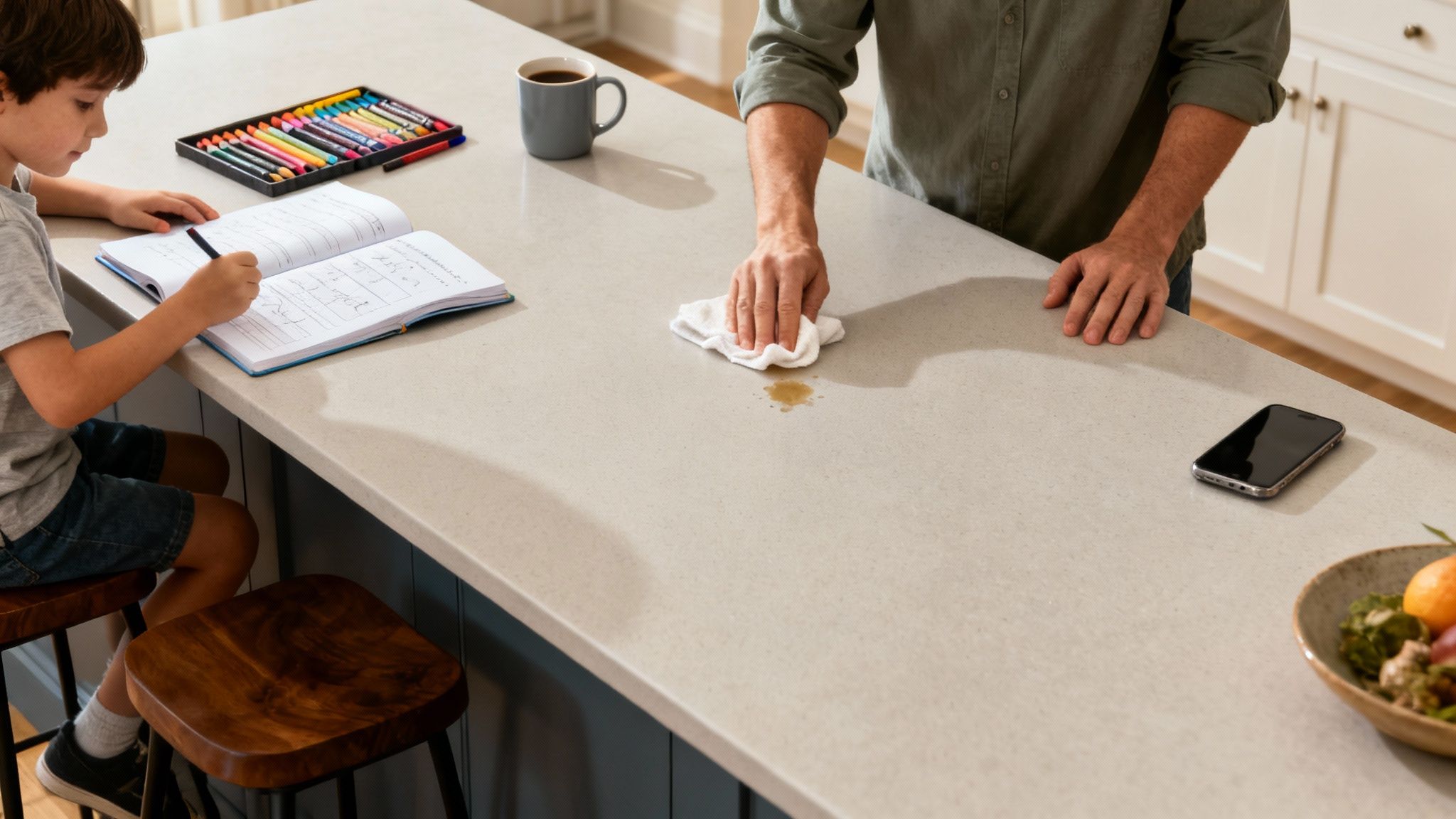
Before you even think about colors and patterns, the most important question to ask has nothing to do with aesthetics—it’s about you. How do you actually live in your kitchen? The most stunning marble countertop on the planet can quickly become a source of daily stress if you have three young kids and a habit of leaving coffee rings behind.
A truly successful choice starts with an honest look at your daily life. This isn’t just about how you use your kitchen now, but how you envision using it for years to come. Getting this right means you’ll end up with a surface that serves you, not the other way around.
Your Kitchen Countertop Lifestyle Checklist
It's easy to fall in love with a look at a showroom. But before you get too attached, mentally walk through these real-world scenarios. Your answers will immediately steer you toward certain materials and away from others.
- Spill Response Time: Are you the type to wipe up a red wine spill in seconds flat? Or is there a chance it might sit for an hour... or until the next morning? If you're not a lightning-fast cleaner, a non-porous material like quartz or porcelain will be your best friend. Porous stones like marble, on the other hand, will punish procrastination.
- Cooking Habits: Do you cook from scratch every day, constantly sliding hot pots and heavy pans around? Or is your kitchen more of a hub for reheating and assembling meals? Avid home chefs really benefit from high heat resistance (think granite) and serious scratch durability (quartzite and granite are champs here).
- The "Drop Zone" Factor: Is your counter a pristine workspace, or is it the landing strip for mail, keys, and backpacks? If you're nodding along with the second one, you need a surface that can resist scratching from everyday objects being dragged across it.
- Family Life: Will kids be doing homework, art projects, or messy science experiments at the kitchen island? A countertop in a busy family home has to stand up to everything from permanent markers to glitter glue, making stain-proof options pretty much essential.
Being real about these things creates a practical profile of your needs. A busy family that loves to cook but hates high-maintenance chores is a perfect match for quartz. A meticulous couple who wants a show-stopping, one-of-a-kind statement piece might be perfectly happy with the extra care a stunning marble slab requires.
Unpacking the True Cost of Your Countertop
That price tag you see per square foot? It’s just the opening act. To build a realistic budget, you have to think in terms of the total cost of ownership, which includes several factors that can dramatically change the final price. Don't let hidden expenses catch you by surprise.
Long-term maintenance is a huge part of this equation. Take granite, for instance—a timeless choice that beautifully balances natural artistry with resilience. The kitchen countertop market is projected to swell from USD 86.51 billion in 2024 to USD 146.76 billion by 2035, and granite is a major driver of that growth. Its Mohs hardness score of 6-7 makes it far tougher than laminate, but it needs to be sealed annually to keep its stain resistance. That’s a recurring cost, both in time and money. You can find more insights about the kitchen countertops market trends and material performance online.
Pro Tip: When budgeting, always ask for an "all-in" quote. This should include the material, fabrication, delivery, installation, sink cutouts, edge finishing, and the tear-out and disposal of your old countertops. That's the real number you need to work with.
Beyond the sticker price and sealing, keep these other potential costs on your radar:
- Fabrication: This is where the magic happens—cutting the slab to your kitchen’s exact measurements, including holes for the sink and faucet. The more complex your layout or the fancier your edge profile, the more this will cost.
- Installation: For heavy materials like stone and quartz, professional installation isn't optional. Labor costs can vary quite a bit based on how complicated the job is.
- Structural Support: This is an easy one to forget. Extremely heavy materials, like extra-thick slabs of granite or concrete, might require reinforcing your cabinets. That’s an unexpected construction cost you’ll want to plan for.
- Seam Placement: In most kitchens, you'll need at least one seam where two slabs meet. A skilled fabricator can make these nearly invisible, but a poorly placed or executed seam can ruin the entire look of your new counters.
By looking at both your lifestyle and the full financial picture, you move beyond just admiring pretty samples and start making a smart, long-term investment. This practical approach is the absolute key to choosing a kitchen countertop that brings you joy—not buyer’s remorse—for years to come.
Finalizing the Look: Finishes and Edge Details
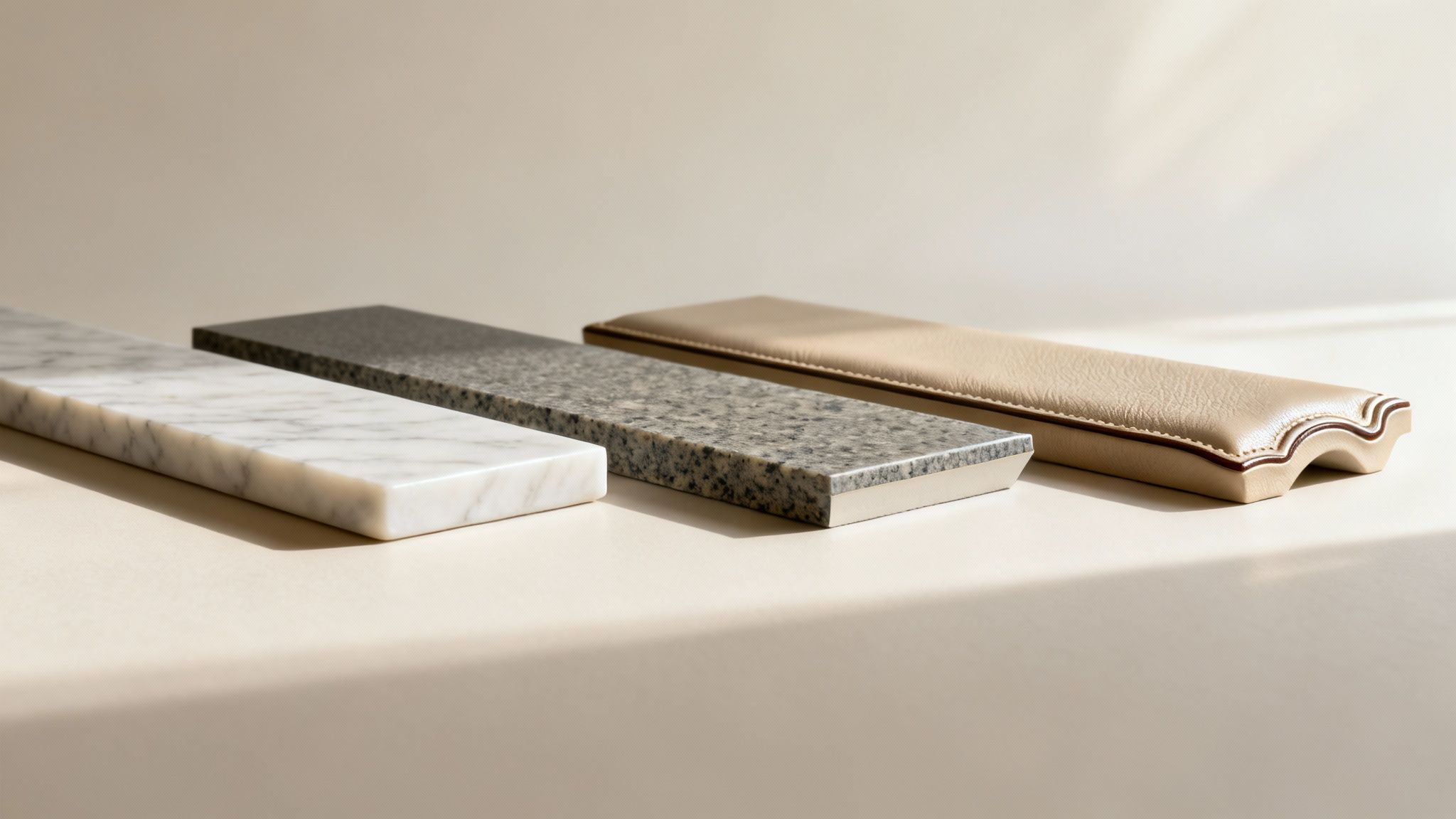
Okay, so you’ve landed on the perfect material. Now for the fun part—the details that take a simple slab and turn it into a true centerpiece of your kitchen. This is where your personal style really shines through, moving from the big picture to the specific textures and shapes that will define your space.
The first, and most obvious, choice is the color and pattern. Ask yourself: do you want the countertops to be the star of the show with dramatic veining, or should they be a quiet supporting actor that lets your cabinets or backsplash shine? There's no wrong answer, but it's a decision that sets the tone for the whole room.
A pro tip I always share with clients: never choose a color in a vacuum. Grab a sample of your cabinet door, a piece of flooring, and your paint swatches, and take them to the showroom. Seeing everything together under proper lighting is the only way to be sure it all works. A color that looks great under harsh showroom fluorescents can look totally different in the warm, natural light of your own kitchen.
Selecting the Perfect Countertop Finish
The finish you pick does more than just affect the look; it completely changes the countertop's feel and its daily maintenance needs. This isn’t a minor detail. It dictates how light plays across the surface and how forgiving it will be with fingerprints and spills.
Polished: This is the classic, high-gloss look that most people picture. It’s shiny, reflective, and makes colors pop. The polishing process seals the stone’s pores, which gives it great stain resistance. The downside? That mirror-like surface is a magnet for fingerprints and smudges, and it will show every little scratch.
Honed (Matte): If you want something more understated and modern, a honed finish is your answer. It’s perfectly smooth but has a soft, matte appearance that doesn’t reflect light. It’s fantastic at hiding scratches and smudges, but because the pores are a bit more open, it can be slightly more prone to staining if you don’t wipe up spills quickly.
Leathered: This finish is a game-changer for busy kitchens. It has a soft sheen and a unique, pebbly texture that feels a bit like worn leather. It’s created by brushing the stone with diamond-tipped bristles. The result is a surface that is incredibly forgiving—it hides fingerprints, water spots, and crumbs like a champ.
I’m a huge fan of leathered finishes, especially on a kitchen island. The texture not only conceals the chaos of daily life but also cuts down on glare, making it a super practical and stylish choice for the busiest spot in the house.
Ultimately, the right finish is a trade-off between the look you love and how much daily upkeep you can tolerate. A polished surface needs constant wiping to look pristine, while honed and leathered finishes are much lower maintenance.
Defining Your Style with Edge Profiles
The edge profile is that final, finishing touch. It might seem small, but the shape of the edge has a huge impact on your kitchen’s overall style, guiding it toward modern, traditional, or something in between.
Keep in mind that the edge you choose affects the final price. A simple, squared-off eased edge is usually included in the base cost of fabrication. But more decorative profiles, like a curvy ogee or rounded bullnose, will add to the cost per linear foot.
Here are a few of the most popular edge options you’ll encounter:
- Eased Edge: Clean, simple, and modern. It’s basically a square edge with slightly softened corners to prevent it from being too sharp or prone to chipping.
- Half Bullnose: The top edge is rounded, but the bottom is square. It’s a classic look that has a practical benefit: spills tend to drip straight down instead of running back under the counter and onto your cabinets.
- Full Bullnose: A completely rounded edge that gives a soft, timeless feel. You’ll see this a lot in more traditional kitchen designs.
- Ogee Edge: This is an elegant S-shaped curve that brings a formal, decorative flair to the counter. It’s a perfect fit for classic or upscale kitchens.
- Mitered Edge (Waterfall): This is more of a fabrication technique than a profile, but it’s a very popular modern look. The countertop and edge piece are cut at 45-degree angles and joined to create the illusion of a much thicker slab. This is how you achieve that stunning "waterfall" effect where the counter flows seamlessly down the side of an island.
Choosing your edge is a key final step in creating a countertop that feels custom, complete, and perfectly integrated into your home.
Bringing Your Countertop Vision to Life
You’ve done the heavy lifting—weighing the pros and cons of different materials, setting a budget, and narrowing down your style. Now for the fun part: turning those plans into a beautiful, functional reality.
This last stretch, from picking your exact slab to installation day, is where all the details come together. A little foresight here goes a long way in making sure the countertop you fell for in the showroom looks just as good (or better) in your home.
Why You Can't Judge a Countertop by its Sample
Trusting a small, 4x4-inch sample is one of the riskiest moves you can make, especially when you're working with natural stone like granite or marble. That little square simply can't capture the personality of a full slab—the sweeping veins, unique mineral deposits, and subtle color shifts that make each piece one-of-a-kind.
A tiny gray fleck on a sample might be part of a massive, dramatic black vein on the actual stone. To avoid any "That's not what I expected!" moments, you absolutely must visit the stone yard to hand-pick your specific slab. This is your chance to see the stone's true character and even tell the fabricator which parts you'd love to feature on your kitchen island versus less visible areas.
I tell every client this: viewing your slab in person isn't just a good idea, it's non-negotiable for natural stone. You wouldn't buy a car from a tiny photo, right? Don't choose a unique, centerpiece material from a tiny sample.
Test Drive Your Samples in Your Own Kitchen
Once you’ve got it down to two or three favorites, take the samples home with you. The lighting in a showroom is designed to make everything look perfect; your kitchen's lighting is, well, real life.
Place the samples on your current counters and watch how they change throughout the day.
- In the morning: How does it feel in the bright, cool light of a new day?
- With afternoon sun: Does the color get washed out, or do new details pop?
- Under evening lights: How does it pair with the artificial lighting you use most when cooking?
This is also your chance to do a little real-world stress testing. With the supplier's blessing, of course, see how the samples handle everyday life. Let a drop of coffee, red wine, or olive oil sit for a bit. See what it takes to clean it up. This hands-on experience gives you the final piece of confidence you need.
The Timeline: From Template to Installation
After you’ve committed and put down a deposit, the process officially kicks off with templating. A pro will come to your home to create an incredibly precise digital or physical pattern of your cabinets. This map accounts for every nook, cranny, and cutout needed for your sink, faucet, and cooktop.
Once the template is made, here's what the next couple of weeks look like:
- Templating: The actual appointment is pretty quick, usually 1-2 hours.
- Fabrication: The template goes to the shop, where your slab is custom-cut and finished. This typically takes 5 to 10 business days, though it can vary based on the job's complexity.
- Installation: The big day! The crew arrives to fit your new countertops into place. This can take anywhere from a few hours to a full day, depending on the size of your kitchen.
Knowing this timeline is crucial for planning. If you're doing a complete overhaul, understanding the kitchen renovation timeline helps you coordinate everything, from when the cabinets need to be in place to when the backsplash can be tiled.
Getting Ready for Installation Day
A smooth installation starts with a prepared space. Your old countertops need to be gone, and the new cabinets must be fully installed, perfectly level, and secured.
The crew needs a clear path to carry in what are often very heavy pieces of stone. Make sure you clear any furniture or obstacles from the entryway, hallways, and kitchen. It’s also wise to empty the cabinet under the sink so they have easy access. A bit of dust is inevitable, so covering nearby furniture isn't a bad idea.
Understanding Your Warranty and Long-Term Care
Before you sign off on the finished job, make sure you're clear on the warranties. You'll usually get two: one from the material manufacturer (covering defects in the slab) and one from the fabricator (covering the quality of their work, like seams and cutouts).
From day one, a simple care routine will keep your new countertops looking incredible. Stick to pH-neutral cleaners for natural stone, always use a cutting board, and wipe up spills as soon as they happen. With just a little attention, the countertops you so carefully chose will be a point of pride in your kitchen for years to come.
Lingering Questions Before You Commit
After all the research, you've likely narrowed it down to a few top contenders. But sometimes, a few practical, real-world questions pop up right before you're ready to pull the trigger. Let's tackle some of the most common ones I hear from homeowners, so you can move forward with total confidence.
Which Countertop Will Give Me the Best Resale Value?
This is a smart question to ask, especially if you're thinking about your home's long-term value. Hands down, quartz and granite are the perennial favorites among homebuyers. They just have that premium feel that makes a kitchen stand out.
Quartz tends to catch the eye of buyers looking for a sleek, modern, and low-maintenance kitchen. It signals a move-in-ready space without any fuss. Granite, on the other hand, appeals to those who love the timeless, one-of-a-kind character that only a slab of natural stone can offer.
A pro tip? The specific material is only half the battle. To really maximize your return, stick with a neutral color and a versatile pattern. That bold, dramatic slab might be your dream, but a more subtle and classic choice will appeal to the widest audience when it's time to sell.
Can I Really Set a Hot Pan Directly on the Counter?
Ah, the hot pan test! This is probably one of the most practical concerns, and the answer truly depends on what your counter is made of.
- Granite: Generally, yes. This stone was literally forged by fire and pressure deep within the earth, so it can handle the heat from a pan right off the stove.
- Quartz: This is a big no. The resins that bind the crushed quartz together can be damaged by anything over 300°F. You risk leaving a permanent scorch mark or discolored ring.
- Marble, Solid Surface & Laminate: Absolutely not. Sudden, intense heat can cause thermal shock and crack marble. For solid surface and laminate, you're looking at melting or scorching the material almost instantly.
My honest advice? Just get in the habit of using a trivet. It takes two seconds and completely eliminates the risk of an "oops" moment that could permanently damage your beautiful new investment, no matter what material you choose.
What’s Involved in Caring for My New Countertops?
Your cleaning routine will look very different depending on the surface you pick. It's a crucial piece of the puzzle because you have to live with it every day.
For low-maintenance champs like quartz and porcelain, daily upkeep is a breeze. A soft cloth with a little mild soap and warm water is all you need. These non-porous surfaces are built for the realities of a busy kitchen.
Natural stone is a different story. With granite and marble, you have to be mindful. Always use a pH-neutral cleaner made for stone. Common household cleaners with vinegar or citrus are far too acidic and can etch the surface or eat away at the sealant. And speaking of sealant, you’ll likely need to re-seal your granite every year or so to keep it protected from stains. For a deeper dive, check out this guide on how to clean natural stone countertops to get the technique just right.
And for the warm, natural appeal of butcher block, you'll want to regularly oil it with a food-safe mineral oil. This simple step keeps the wood from drying out and cracking, ensuring it stays both beautiful and hygienic for years to come.
Ready to transform your kitchen with the perfect countertops? The team at Kitchen Renovations Perfected has the expertise to guide you from selection to flawless installation. Schedule your complimentary design consultation today!