

The secret to a truly organized kitchen isn't about buying a bunch of new bins and containers. It's about starting with a completely clean slate. That means pulling everything out, seeing what you actually have, and making a solid plan before you even think about putting things back. This is the bedrock of a system that’s built for how you really live, not just how you think you should.
Your Blueprint for a Clutter-Free Kitchen
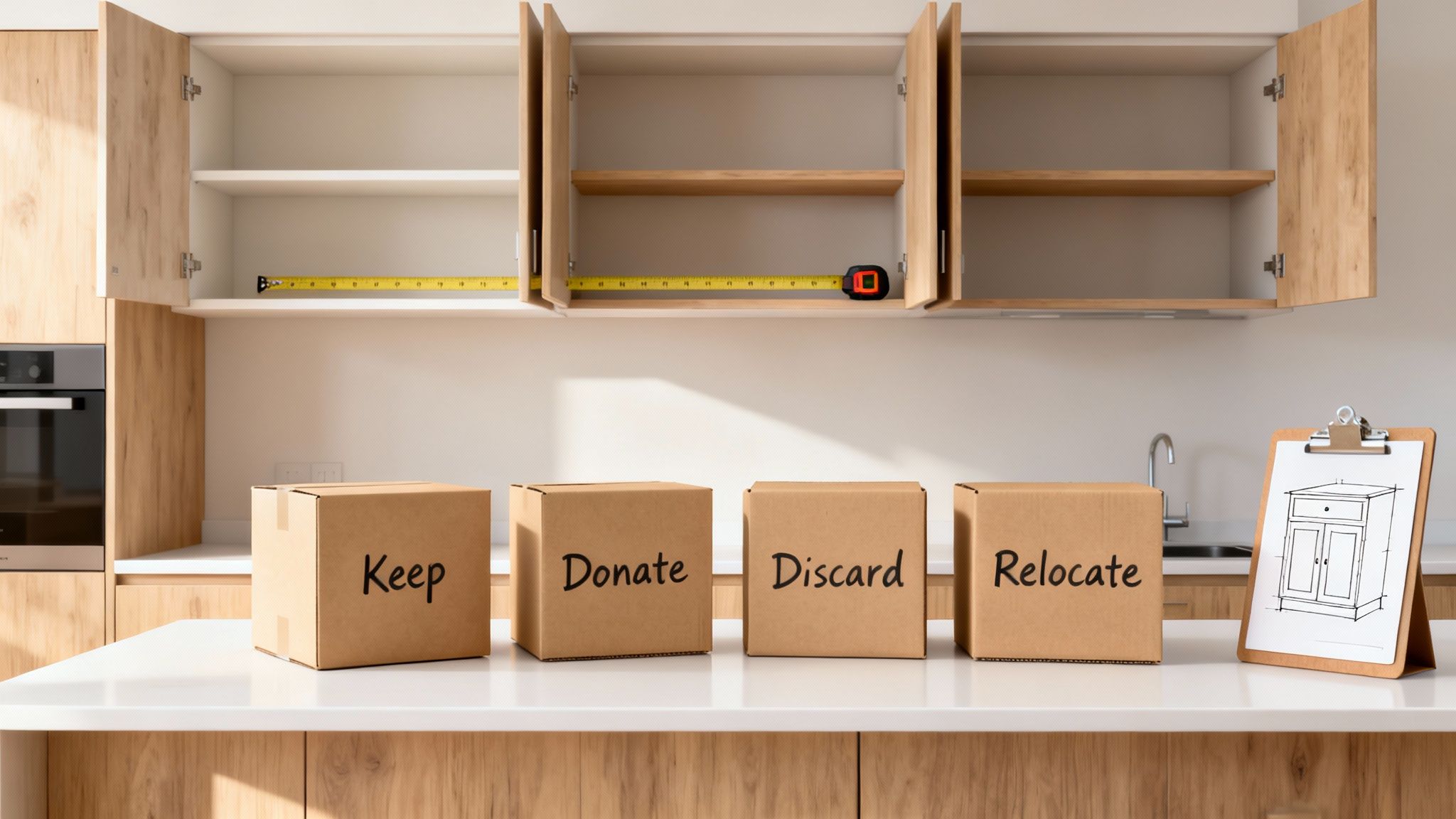
Before you can build an organized kitchen that actually works, you need a blueprint. This first phase has nothing to do with shopping for pretty containers—it's all about strategic planning. Skip this, and you’ll just end up with the same old clutter, but in new boxes.
The most important first step? Empty every single cabinet. I know, it sounds like a massive chore, but it's the only way to get a real, honest look at what you own.
Spread everything out on your countertops or drag the dining table in for extra space. Having it all laid out visually is a real eye-opener. You’ll be surprised by the duplicate can openers, the spices that expired two years ago, and the gadgets you completely forgot you even had. This moment of clarity is crucial for making smart choices about what truly deserves to stay.
The Four-Box Sorting Method
Now, with everything out in the open, it's time to get decisive. Grab four boxes or just designate four clear areas on your floor. As you pick up each item, it goes into one of these piles. The key is to avoid a "maybe" pile—that’s just procrastination.
- Keep: This is for the stuff you love and use all the time. Your daily coffee mugs, your favorite pan, the go-to utensils. These are the non-negotiables.
- Donate: Perfect for functional items that you just don't need anymore. That bread maker you used once? The extra set of holiday plates taking up prime real estate? Let them go.
- Discard: Be ruthless. Anything that's broken, chipped, or expired has to go. An organized kitchen has no room for stale spices or cracked mixing bowls.
- Relocate: You’d be amazed at what ends up in a kitchen cabinet. This pile is for all the random things that don't belong—batteries, mail, screwdrivers, you name it. Move them to their proper homes.
Trust me, this purge is liberating. You're not just freeing up physical cabinet space; you're clearing out the mental clutter that comes from living in a chaotic environment.
Identifying Pain Points and Measuring for Success
Take a look at your "keep" pile and think about your old setup. What drove you crazy? Was it that deep corner cabinet where pots went to die? Or the drawer where the food container lids were a constant, jumbled mess? Naming these specific pain points is how you'll find solutions that actually fix the problem.
Next, and this is non-negotiable, grab a tape measure. Before you even browse online for organizers, you have to measure the inside of your cabinets and drawers. Get the width, depth, and height for each one and write it down. This simple step will save you the headache of buying organizers that are too big, too small, or just plain wrong for your space.
An organized kitchen starts with a plan, not a purchase. By understanding your inventory, identifying functional flaws, and taking precise measurements, you create a strategic blueprint that guarantees a successful and lasting transformation.
This planning stage is also the perfect opportunity to think bigger about your kitchen's layout. For a deeper dive into smart design and renovations that can unlock hidden potential, our guide on maximizing space in your kitchen with practical renovation ideas has some fantastic insights that work hand-in-hand with any organization project.
Think of this whole process as drawing a functional map for your kitchen. By knowing what you have, understanding how you use it, and measuring your space, you're laying the groundwork for a system that genuinely makes your daily life easier.
Creating Smart Zones for an Effortless Workflow
Alright, with your cabinets empty and your "keep" pile waiting, you're staring at a blank slate. This is the moment to stop thinking about just putting things back and start designing a kitchen that actually works with you. The secret? The "zone method." It’s a beautifully simple way to map out your kitchen based on how you actually use it.
Think of it like a pro’s workshop. You wouldn't keep your hammer across the room from your nails, would you? The same logic is gold in the kitchen. We're aiming to cut down on all those wasted steps back and forth, creating a natural flow that makes everything from grabbing coffee to cooking a feast feel seamless.
The Five Core Kitchen Zones
Most kitchens, regardless of size, can be broken down into five fundamental activity centers. When you group your gear within these zones, you create little efficiency hubs that make your daily routines so much smoother. It's a foundational concept in smart kitchen planning.
You can dive deeper into this philosophy in our guide on kitchen layout design ideas.
Prep Zone: This is command central for chopping, mixing, and measuring. It's usually the main stretch of counter space, ideally near the sink and trash. Stock the cabinets and drawers here with your mixing bowls, measuring cups, cutting boards, and knives.
Cooking Zone: Everything you need when the heat is on should live right around your stove and oven. This means pots, pans, baking sheets, spatulas, tongs, and your go-to spices and oils are all within arm's reach.
Dishware Zone: Want to make unloading the dishwasher less of a chore? Keep your everyday plates, bowls, and glasses in the cabinet closest to it. Your silverware should be in a drawer right nearby. Simple.
Food Storage Zone: This covers your pantry and fridge. In the cabinets, group like with like—canned goods together, grains in one spot, snacks in another. I always recommend keeping food storage containers and wraps in this zone, too, so packing up leftovers is a one-stop-shop.
Cleaning Zone: The cabinet under the sink is the undisputed home for this zone. It's the perfect spot to tuck away dish soap, sponges, trash bags, and cleaners to keep messes contained and cleanup quick.
Making Every Cabinet Work Smarter
Once you've mapped out your zones, you can get into the details of optimizing the space. Let's be honest, some cabinets are just awkward. But even deep corners and narrow gaps can become some of your most valuable storage real estate.
That cavernous corner cabinet where things go to die? It can be completely revitalized with a Lazy Susan. These spinning shelves bring everything from the back right to the front, making them brilliant for pots, small appliances, or even bulky pantry items.
Another classic headache is storing things like baking sheets and cutting boards. When they're stacked flat, you always need the one on the bottom. The easy fix is installing vertical tray dividers. They create slots, almost like a file folder system, so you can just slide each item in and out.
A well-zoned kitchen doesn't just look organized—it feels intuitive. By placing items exactly where you need them for a specific task, you eliminate wasted motion and create a seamless workflow that makes daily kitchen activities faster and more enjoyable.
This "zone method" isn't just a trend; it's a cornerstone of modern, efficient kitchen design. The impact is real, and it's a key driver in the global cabinet market, which is projected to hit USD 180.25 billion by 2030. In fact, 65% of U.S. kitchens renovated since 2020 have focused on this zoning strategy, with homeowners happily reporting a 15-20% reduction in their meal prep time. A layout like this truly adds tangible value to your home.
Choosing the Right Cabinet Storage Solutions
Now that you have your zones mapped out, it's time for the fun part: equipping them with the right tools. We're moving from a blueprint to the real deal, picking storage solutions that solve specific problems and make every single inch of your cabinet space work for you. The goal here isn't just to buy a bunch of containers; it's to invest in systems that truly support your kitchen's new, efficient workflow.
This flowchart can help you visualize where your core activity centers should go, all based on your kitchen's unique layout.
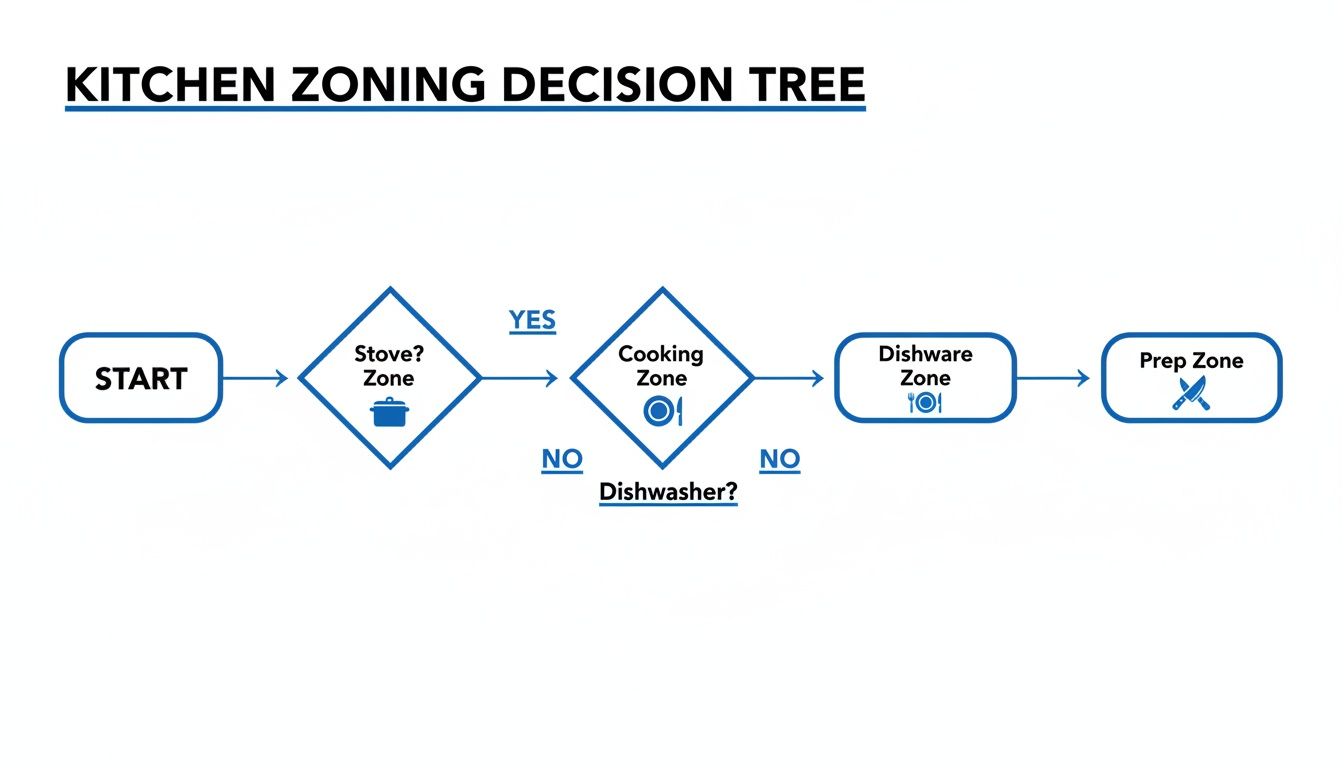
As you can see, the decision tree shows how the stove and dishwasher act as anchors for your primary zones, which is the secret to streamlining your day-to-day tasks.
Maximize That Vertical Space
One of the most criminally underused assets in any kitchen is vertical space. We've all done it—stacking baking sheets, cutting boards, and platters flat. Then, when you need the one at the bottom, you have to heave the whole pile out. Simple organizers can completely eliminate this headache.
- Vertical Tray Dividers: These are an absolute game-changer for your cooking and baking zones. They create upright slots, turning your cabinet into a filing system for flat items. Just slide a single baking sheet out without disturbing anything else. Problem solved.
- Tiered Risers: Perfect for pantries or spice cabinets, these little "stadium seating" shelves elevate everything in the back. You can finally see what you have at a glance, which means no more buying a third can of diced tomatoes you didn't know you had.
Conquer Deep and Awkward Cabinets
Deep base cabinets and those dreaded blind corners are notorious black holes for clutter. Reaching for something in the back can feel like a spelunking expedition. Fortunately, modern organizers are designed to bring the back of the cabinet right to you.
Pull-out shelves and drawers are a fantastic upgrade for deep cabinets. Instead of getting on your hands and knees to find that one pot, you can slide the entire contents of the cabinet out for effortless access. I’ve seen this single modification completely change how people feel about their kitchen.
By picking organizers that solve specific problems—like that impossible-to-reach corner or the wobbly stack of pans—you transform frustrating cabinets into highly efficient, user-friendly storage. Smart solutions should solve a problem, not just fill a space.
Before you buy anything, though, you have to measure. A standard base cabinet is typically 24 inches deep, giving you plenty of room for these smart solutions. The impact is huge—studies on modular kitchens show that using vertical dividers for pots can save up to 30% of your space. And installing a lazy Susan in a corner? That can slash item search time by 40%. These ergonomic principles are so effective that they’ve been adopted in 70% of new European homes since 2020.
Cabinet Organizer Comparison Guide
With so many options out there, it helps to see a direct comparison. This table breaks down some of the most common organizers to help you decide which is right for each zone.
| Organizer Type | Best For | Common Materials | Space-Saving Impact |
|---|---|---|---|
| Pull-Out Shelves | Deep base cabinets, pots, pans, small appliances | Steel, solid wood, wire mesh | High (Improves accessibility) |
| Lazy Susans | Blind corner cabinets, canned goods, spices | Plastic, wood, wire | High (Makes corners usable) |
| Vertical Dividers | Storing baking sheets, cutting boards, platters | Coated metal, wood, heavy-duty plastic | Medium (Improves organization) |
| Tiered Risers | Pantries, spice cabinets, canned goods | Plastic, acrylic, bamboo | Medium (Improves visibility) |
| Drawer Inserts | Utensils, cutlery, junk drawers, spice drawers | Bamboo, plastic, acrylic | Low to Medium (Compartmentalizes) |
Each of these solutions plays a role in creating a fully functional kitchen. The key is to match the organizer to the specific items and the cabinet you're working with for the best results.
Selecting the Right Materials for the Job
The material of your organizer is just as important as its design. Your choice will come down to a mix of durability, looks, and exactly what you plan to store in it.
For the heavy hitters—cast iron skillets, Dutch ovens, and stacks of ceramic plates—metal organizers are the only way to go. Their solid construction means they won't bow or crack under pressure. It's why all the best heavy-duty pull-out shelves and pot racks are made from steel.
On the other hand, versatile plastic or acrylic bins are perfect for lighter-duty tasks. I use them in my pantry to group snack bags, in drawers to separate utensils, and under the sink to keep cleaning supplies from becoming a jumbled mess. Clear acrylic is especially great because you can see what’s inside without having to pull the bin out. When you're thinking about materials, it's also smart to consider how they'll look with your existing cabinets. You can explore our guide on the best kitchen cabinet materials to see how different finishes and textures can work together.
Putting Your New System into Action
You’ve done the hard work of planning, purging, and picking the perfect organizers. Now for the fun part: seeing your vision for a streamlined kitchen come to life. This is where the strategy on paper becomes a functional, beautiful space you’ll love to use every day. The goal is to create a system so intuitive it practically runs itself.
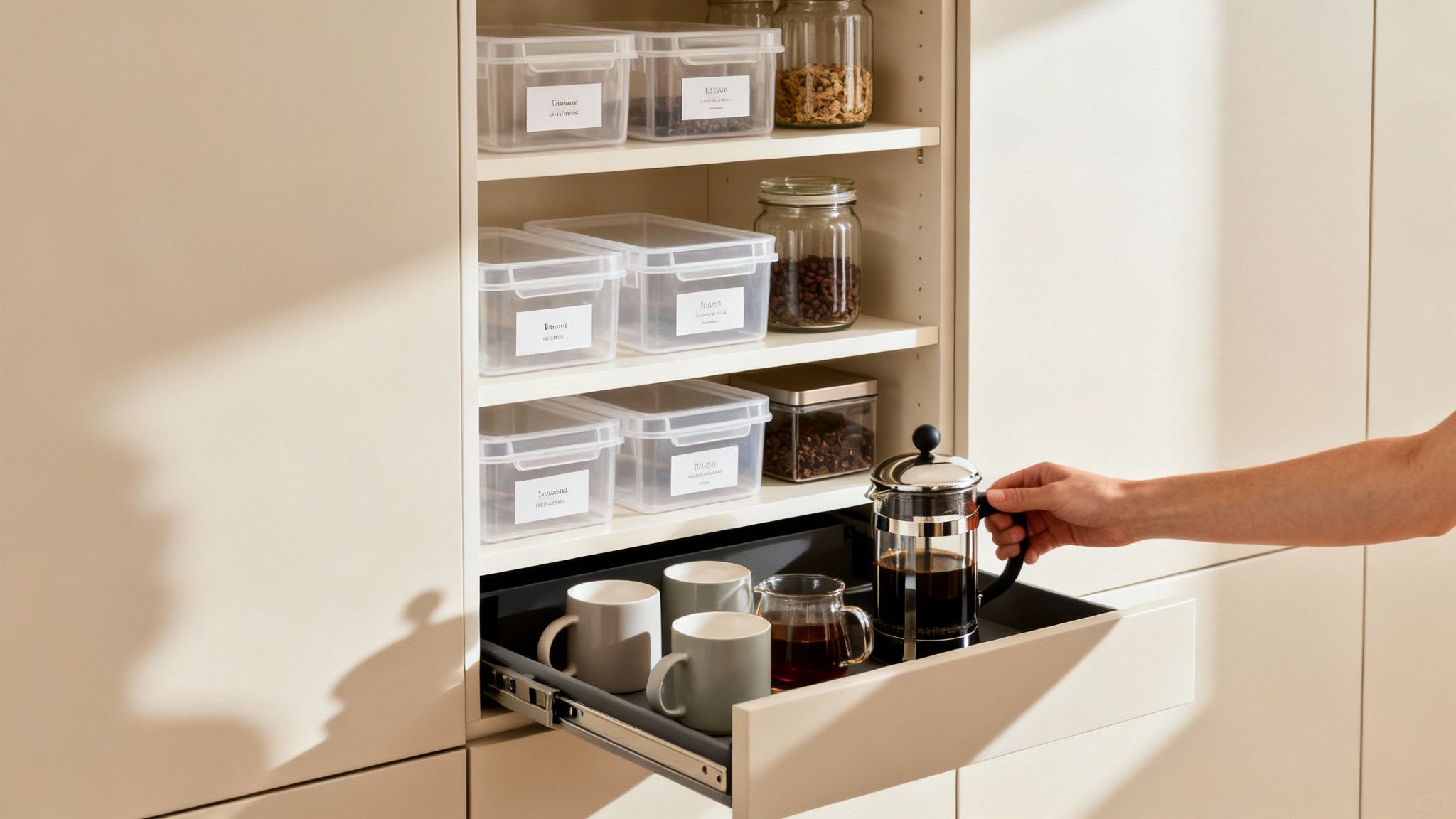
First things first, get your new hardware installed. Carefully place those pull-out shelves, slot in the vertical dividers, and set up your tiered risers in their designated cabinets. This is the new skeleton of your kitchen, built to make every single item easy to find and grab.
With the framework in place, you can start the incredibly satisfying process of putting everything back. To keep from feeling overwhelmed, tackle just one category at a time. As you place items, think about setting up “micro-stations” that simplify your daily routines.
For instance, pull together your coffee maker, mugs, beans, and sugar into one cabinet near the sink. Just like that, you have a dedicated coffee station, turning a scattered morning scramble into a simple, one-stop ritual. You can do the same for a smoothie station (blender, protein powder, seeds) or a lunch-packing zone with all your containers and reusable bags ready to go.
The Undeniable Power of Labeling
Now that everything has a home, labeling is the single most important step for making it stick. It's the final touch that turns your organizational project into a system the whole family can actually follow. Without labels, those perfectly sorted bins are just pretty boxes waiting for chaos to creep back in.
You don't need a fancy label maker, although they are fantastic. Simple handwritten labels on masking tape or chalkboard stickers work just as well. The real keys are clarity and consistency.
- Be Specific: Instead of a generic "Snacks" label, break it down. Think "Salty Snacks" and "Granola Bars." This simple distinction stops one bin from becoming a jumbled mess of everything.
- Label Everything: Don't just label the bins and baskets—label the edge of the shelf, too. The goal is to eliminate any and all guesswork.
- Think Visibly: For staple ingredients like flour and sugar that you've decanted into clear containers, labels are non-negotiable. It's the only way to avoid a baking mix-up, and it makes taking inventory at a glance so much easier.
This small bit of effort pays off big time, preventing clutter from returning and empowering everyone to put things back where they belong.
Building a Lasting Habit: The One-Touch Rule
The most brilliant organization system will eventually fail if it isn't maintained. The secret to keeping your kitchen cabinets in pristine condition isn't a massive weekly cleanup; it's a simple but powerful habit I call the 'one-touch rule.'
The rule is as straightforward as it sounds: when you take something out, you put it back in its designated spot the moment you're done with it. That’s it. No more leaving the olive oil on the counter overnight or letting mail pile up next to the toaster.
An organized kitchen is not about achieving a one-time state of perfection. It’s about creating a sustainable system of small, consistent habits that prevent clutter from ever taking hold again.
This approach is incredibly effective. It's estimated that in 80% of organized homes in North America, this simple habit slashes household clutter by about 40%. When you pair this rule with smart organizers—like slide-out baskets that can improve accessibility by 20% or lazy Susans that eliminate 100% of wasted space in blind corners—your system becomes a self-sustaining success. If you're interested in the latest innovations, you can explore this cabinet market report for more on efficiency trends.
Advanced Organization and Professional Upgrades
Alright, you’ve put in the work. You’ve purged, you’ve created zones, and you've installed some great organizers. Your kitchen is probably feeling more functional than it has in years.
But what happens when you’re still bumping up against the limits of your existing layout? This is where we go beyond simple fixes and start looking at upgrades that can fundamentally change how your kitchen works for you. Sometimes, no amount of clever bin placement can fix a poor workflow or a genuine lack of space.
When to Consider a Professional Remodel
So, how do you know if it's time to call in the pros? A few clear signs tell you that your organizational woes run deeper than just clutter. Recognizing them can save you from sinking more time and money into temporary solutions that don't fix the real problem.
It might be time for a professional touch if:
- You've simply run out of room: Despite your best decluttering efforts, you’re constantly struggling to find a home for essential items.
- The workflow is broken: Are you constantly trekking across the kitchen to get from the fridge to the sink to the stove? That's a layout problem, not an organization one.
- Your cabinets are giving up: Old, sticky hardware, warped shelves, or a peeling finish can make even the most organized system a daily frustration.
These issues are symptoms of a bigger need—a redesigned space. A professional kitchen designer, like the folks at Kitchen Renovations Perfected, can help you completely reimagine your layout for a truly ergonomic flow.
A professional remodel isn't just about getting shiny new cabinets. It's about redesigning the space to actually fit your lifestyle. It’s an investment in a kitchen that is genuinely effortless to use, day in and day out.
High-Impact Cabinetry Upgrades
When you bring a professional on board, you unlock a whole world of custom and semi-custom solutions designed to solve specific storage problems with real elegance. These aren't just standalone organizers you pop into a drawer; they are features built directly into your cabinetry for a seamless look and far superior function.
These upgrades aren't just add-ons; they become core, high-functioning components of your kitchen.
Game-Changing Built-In Solutions
Let's look at some of the most effective built-in upgrades that professionals can weave into a new kitchen design.
Pull-Out Pantry Systems
Forget digging into a deep, dark pantry abyss. Imagine a tall, multi-tiered pull-out pantry that glides out smoothly, presenting every single item at a glance. Every can, box, and jar is instantly visible and easy to grab, turning a chaotic closet into a model of efficiency.
Appliance Garages
Sick of your toaster, blender, and coffee maker hogging precious counter space? An appliance garage is your answer. It’s a dedicated cabinet, often with a lift-up or sliding door, that keeps these items hidden but still plugged in and ready for action. It’s the ultimate trick for maintaining those clean, clear countertops.
Integrated Spice Racks
While drawer inserts are a good start, a built-in spice solution is next-level. Picture a narrow pull-out cabinet right next to your stove, with slanted shelves that display every spice jar perfectly. This keeps them protected from heat and light while ensuring the one you need is always right at your fingertips.
Custom Drawer Organizers
Professionals can design drawers with built-in dividers made specifically for your things. This could be a custom knife block integrated right into a drawer, a two-tiered cutlery tray that doubles your storage, or a peg system in a deep drawer that holds your stacks of plates and bowls securely in place.
The Power of Frameless Cabinets
One of the biggest shifts I've seen in modern kitchen design is the move to frameless cabinetry, often called full-access or European-style cabinets. Unlike traditional American cabinets that have a thick wood frame around the cabinet opening, frameless cabinets, well, don't.
This might seem like a small detail, but the impact on your storage is massive. Without that frame in the way, the cabinet opening is wider, giving you much easier access and a surprising amount of extra usable space—often up to 15% more per cabinet.
For anyone struggling with storage, that extra room can be a total game-changer. It allows for wider drawers and shelves, making it easier to organize everything from bulky pots and pans to small appliances. Choosing to work with a remodeler opens up all these advanced options, letting them create a kitchen that isn’t just organized, but expertly designed for your life.
Tackling Your Toughest Cabinet Questions
Once you have a plan, it's time to zero in on those specific trouble spots. Every kitchen has them—the deep corner cabinet, the drawer overflowing with plastic containers. Let's walk through the most common questions I get and the real-world solutions that actually work.
What’s the Best Way to Organize Deep Kitchen Cabinets?
Deep cabinets are famous for being black holes. Things go in, but they rarely come out without a full-scale excavation. The goal here isn't just to tidy up; it's to make the back of the cabinet just as accessible as the front.
Your best bet is to install something that brings the contents to you. Pull-out shelves or drawers are a game-changer. Instead of getting on your hands and knees, you just slide the shelf out and everything is right there. For lower cabinets, I always recommend deep drawers for heavy pots and pans. In a pantry, fitting these sliding shelves with clear bins is the perfect way to conquer that dead space.
How Should I Organize My Food Storage Containers and Lids?
Ah, the plastic container avalanche. We’ve all been there. The only way to win this battle is to stop storing containers with their lids on. It feels counterintuitive, but trust me, it’s the secret.
- Nest the containers: Stack the bases inside each other, from largest to smallest. You'll be amazed at how much space this frees up.
- File the lids: Get a simple bin or a plate rack and store all the lids vertically, like records in a crate. This lets you see every single lid at a glance and grab the one you need without causing a mess.
I see people make the same mistake over and over: storing food containers with their lids snapped on. It seems organized, but it eats up an enormous amount of precious cabinet real estate. Separating them is the single most effective trick to keep container chaos at bay for good.
How Often Should I Reorganize My Kitchen Cabinets?
A full-scale reorganization is a great thing to do every year or two. It’s your chance to really take stock of what you have, get rid of what you don't use, and fine-tune your systems. But the key to keeping it organized long-term isn't about the big overhaul; it's about the daily upkeep.
I tell all my clients to build a 10-minute "reset" into their weekly routine. Just take ten minutes to put stray items back in their designated zones and give a quick wipe-down to any messy shelves. This small habit is what prevents the clutter from creeping back in and makes that big annual clean-out far less daunting. Think of it as building a routine, not just finishing a project.
At Kitchen Renovations Perfected, we know that a truly functional kitchen starts with smart organization. If you're tired of temporary fixes and want to explore custom cabinetry that provides a permanent solution to your storage woes, our design team is ready to help. Visit us to schedule your complimentary consultation and see how we can transform your space.