When it comes to a kitchen remodel, the cabinets are the main event. They're not just boxes on a wall; they define the entire look, feel, and flow of the space. Getting started can feel like a monumental task, but I always tell my clients to narrow it down to three core things first: your style, your budget, and how you genuinely live in your kitchen.
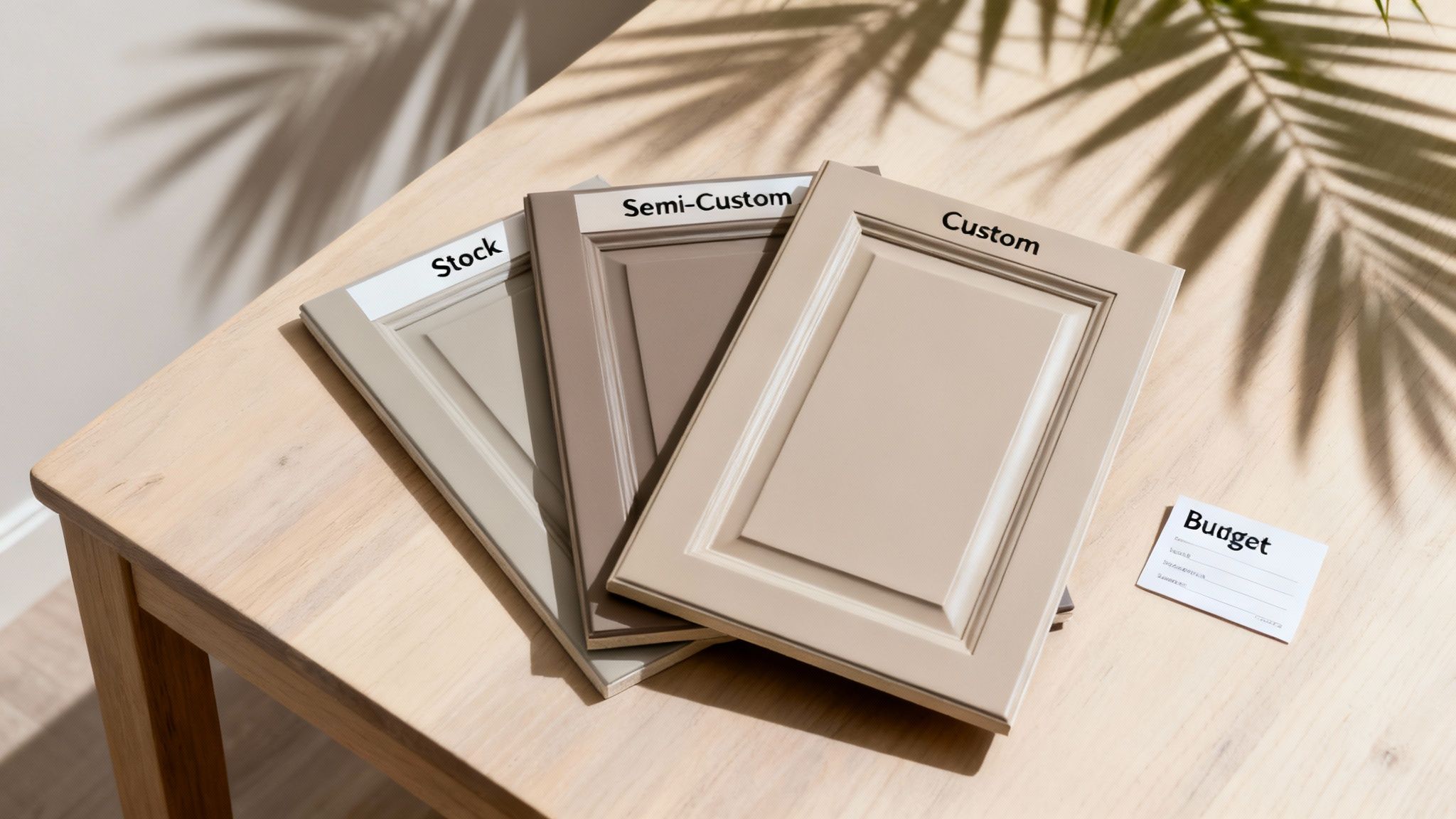
Your answer to those questions will point you toward one of the three main categories: stock, semi-custom, or fully custom cabinets. Making this one decision upfront simplifies everything that comes after.
Your Starting Point for Choosing Kitchen Cabinets
The excitement of a new kitchen is real, but so is the choice paralysis that can set in. The best way to cut through the noise is by understanding the fundamental framework of cabinetry options.
I often use a car analogy to explain it. Stock cabinets are like driving a brand-new, reliable sedan right off the lot. It's affordable, ready to go, but what you see is what you get. Semi-custom is like ordering that same sedan but adding the sport package, a sunroof, and picking your own interior color. Custom cabinets? That's like commissioning a car built from the ground up, designed to your exact engineering and aesthetic specs.
Stock, Semi-Custom, Or Custom: What Is Right For You?
Let’s break down what each of these options really means for your project.
- Stock Cabinets: These are the workhorses of the cabinet world. They’re mass-produced in standard sizes and a limited range of styles. If you need cabinets now and are working with a tight budget, this is your best bet.
- Semi-Custom Cabinets: This is the sweet spot for many homeowners. You start with a standard framework but get to make key modifications. Think adjusting drawer depths, choosing from a much wider array of finishes, or adding built-in organizational features. It’s a fantastic blend of personalization and value.
- Fully Custom Cabinets: The sky's the limit here. Custom means your cabinets are built from scratch, specifically for your kitchen. This is the perfect solution for tricky layouts, historic homes with non-standard dimensions, or if you have a very specific design vision you want brought to life.
For a deeper dive into the nuts and bolts of cabinet construction and materials, this practical guide to kitchen cabinets is a solid resource to explore.
To help you see how these choices stack up, here’s a quick-glance table.
Kitchen Cabinet Options at a Glance
This table offers a snapshot comparison of the three cabinet types, helping you quickly see how they align with your project's primary constraints: cost, time, and creative freedom.
| Cabinet Type | Cost | Customization | Typical Lead Time |
|---|---|---|---|
| Stock | $ (Most Affordable) | Limited to none | 1-3 weeks |
| Semi-Custom | $$ (Mid-Range) | Moderate | 4-8 weeks |
| Custom | $$$ (Premium) | Virtually Unlimited | 8-16+ weeks |
Think of this as your initial filter. If your timeline is a month, custom is likely off the table. If you need a very specific cabinet width to fit an odd corner, stock probably won't work.
Considering The Boca Raton Climate
Living here in Boca Raton introduces a crucial, non-negotiable factor: our relentless humidity. The salty, moist air is beautiful but brutal on home finishes. Wood can swell and warp, and certain finishes can peel or bubble over time.
This means your material selection is just as critical as the style you choose. A beautiful cabinet that can't stand up to the local climate is a poor investment.
Your cabinet choice is an investment in your home's value and your daily quality of life. Making an informed decision at the start prevents costly regrets later and ensures your kitchen remains beautiful and functional for years to come.
As we move forward, we'll get into the specifics of which materials and construction techniques hold up best in South Florida. But for now, having a clear understanding of the stock, semi-custom, and custom landscape gives you the foundation you need to make every subsequent choice with confidence.
Matching Cabinet Styles to Your Boca Raton Home
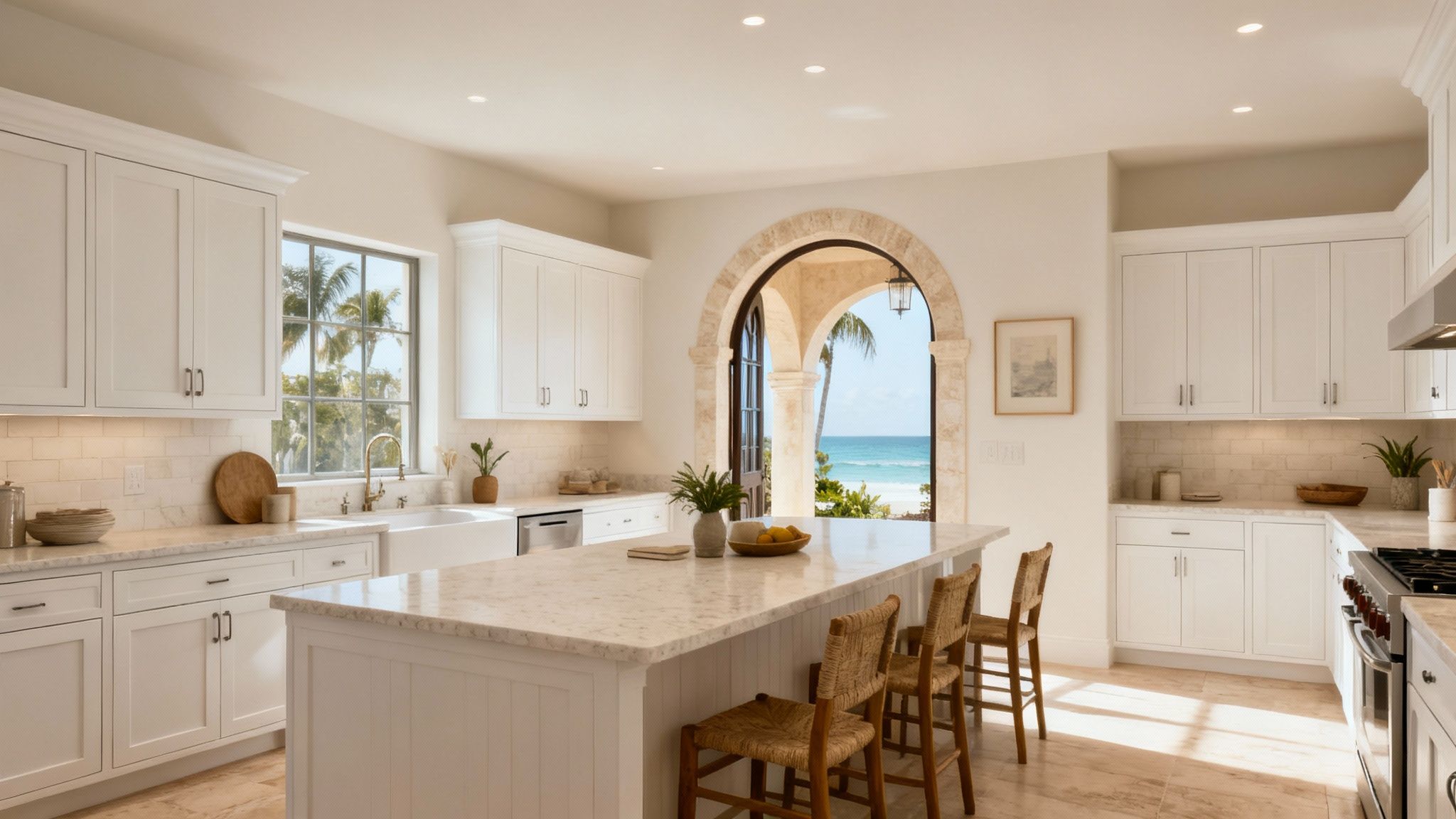
Your cabinets are the foundation of your kitchen's entire look. They set the tone for everything else you choose, from countertops to flooring. The trick is to pick a style that feels like it belongs in your home—something that honors its architecture and reflects your own taste, rather than just chasing a trend.
Think of your home’s existing style as your North Star. If you have a Mediterranean-inspired home in Royal Palm Yacht & Country Club, ultra-modern slab cabinets are going to feel out of place. On the flip side, a sleek, modern condo overlooking the Intracoastal would be overwhelmed by ornate, traditional cabinetry. Harmony is the goal.
Popular Cabinet Door Styles and Their Local Fit
Getting a handle on the most common door styles is the first step. Each one brings its own distinct personality to the room.
- Shaker Cabinets: This is, without a doubt, the most popular and versatile style out there. With a simple, clean frame and a recessed center panel, Shaker doors can do it all. They look just as good in a casual beach bungalow as they do in a sophisticated transitional kitchen. Their timeless look makes them a smart, stylish investment, accounting for nearly 60% of kitchen cabinet styles in recent remodels.
- Slab (Flat-Panel) Cabinets: For a clean, contemporary feel, nothing beats slab doors. The unadorned surface is perfect for modern homes and condos where simplicity is key. They’re a fantastic way to show off a beautiful wood grain or a bold, high-gloss color without any distraction.
- Raised-Panel Cabinets: This is a more traditional look. The raised center panel creates depth and shadow lines, lending a formal, classic feel. It’s a perfect match for the grandeur of Mediterranean or traditional estate homes, adding a real sense of established elegance.
How Cabinet Style Impacts Your Kitchen's Layout
Beyond looks, the style of your cabinets can actually change how your kitchen feels and functions. The right choice can make a tight space feel more open or help a large kitchen feel more organized.
Take a narrow galley kitchen, which you see in a lot of local condos. Slab or Shaker doors in a light color are your best friends here. Their simple profiles don't add visual clutter, which helps create an illusion of more space. When you're working with a smaller footprint, finding clever condo kitchen remodeling ideas can be a game-changer for getting the most out of every square inch.
Pro Tip: In a smaller L-shaped or U-shaped kitchen, I often recommend using glass-front upper cabinets on one wall. It breaks up the monotony of solid wood, adds a sense of depth, and gives you a spot to display your favorite dishes, making the whole room feel larger and more personal.
A Real-World Example in Boca Raton
Let’s put this into practice. Imagine a client with a gorgeous waterfront condo in Highland Beach. The whole place is lined with floor-to-ceiling windows, and the goal is to keep the focus on that incredible ocean view.
- What Not To Do: Dark, raised-panel cabinets with heavy, ornate hardware. It would immediately feel oppressive, compete with the view, and make the kitchen feel dated and closed-in.
- The Right Call: White Shaker or high-gloss white slab doors. This choice bounces all that natural light around, creating a bright and airy coastal vibe. The cabinetry becomes an elegant backdrop, allowing the view to remain the star of the show.
This is exactly what I mean by listening to your home. The best cabinet choice enhances what you already have. It doesn’t scream for attention; it works with the environment to create a cohesive, balanced space that's not just beautiful but truly functional.
What's Inside Counts: Decoding Cabinet Materials and Construction
The real secret to a kitchen that lasts isn't just about the color or the door style—it's about what's underneath. The materials and construction are the bones of your kitchen, and getting this part right is crucial, especially here in South Florida where humidity is a constant battle.
Think of it this way: you can have the most beautiful cabinet doors, but if the box they're attached to warps or swells, the whole kitchen fails. Let’s break down what you’re actually choosing between.
Cabinet Box Materials: The Foundation of Your Kitchen
The "box" is the cabinet's main structure. It's easy to overlook, but its integrity is everything.
- Plywood: Hands down, this is my top recommendation for any kitchen in the Boca Raton area. Plywood is made by gluing together thin layers of wood, with the grain of each layer running in the opposite direction. This cross-grain construction is a game-changer for stability, making it incredibly resistant to the warping and swelling that our humid climate can cause. It’s strong, holds screws tightly, and is built for the long haul.
- MDF (Medium-Density Fiberboard): MDF is an engineered product made from compressed wood fibers, and it has one major advantage: a perfectly smooth, stable surface that’s ideal for a painted finish. You won't see any wood grain, just a flawless coat of color. It's an excellent choice for doors, but I'd be cautious about using it for entire cabinet boxes, especially under a sink where a leak could cause it to swell up like a sponge.
- Particleboard: This is your most budget-friendly option, made from wood chips and adhesive. While today's particleboard is better than it used to be, it's the most vulnerable to moisture. A small, unnoticed leak can cause it to crumble. For our climate, it's a real gamble unless it’s sealed flawlessly with a high-quality laminate or veneer.
If you want to dig even deeper into the pros and cons, our complete guide to the best kitchen cabinet materials lays out a side-by-side comparison of how they perform.
My Two Cents on South Florida Kitchens: I’ve seen gorgeous kitchens with particleboard boxes start to fail within a few years simply from our ambient humidity. Do yourself a favor and invest in plywood construction from the start. It’s the single best piece of insurance you can buy for your kitchen renovation.
Framed vs. Frameless: A Question of Style and Space
After you've sorted out the material, you'll need to decide on the construction style. This choice really shapes the final look and feel of your kitchen.
Framed cabinets are the classic American style. A solid wood face frame is attached to the front of the cabinet box, almost like a picture frame. The doors and drawers are then mounted onto this frame. It’s a rock-solid, traditional construction that gives the cabinets a very substantial look.
Frameless cabinets, often called "European-style" or "full-access," do away with the face frame entirely. Instead, the doors mount directly to the sides of the cabinet box. The benefit? You get a little more usable interior space and a clean, modern aesthetic with minimal gaps between the doors. The trade-off is that they demand absolute precision during installation to get that perfect alignment.
How to Spot a Quality Cabinet in the Wild
When you're walking through a showroom, it's easy to be swayed by a pretty finish. But knowing where to look tells you the real story of a cabinet's quality. This is how you go beyond the price tag and assess true value. It's no surprise that homeowners are demanding better quality; the global kitchen cabinet market was valued at around USD 160 billion in 2023 and is projected to hit USD 245 billion by 2032. You can find more details about this expanding market on Dataintelo.com.
Here’s your cheat sheet for inspecting a cabinet like a pro:
- Check the Drawer Joints: Pull a drawer all the way out and look at the corners. The gold standard is dovetail joinery—an interlocking joint that's incredibly strong and a true mark of quality craftsmanship. If you see staples or just glue, that drawer won't survive years of daily use.
- Test the Hardware: Open and close everything. Drawers should glide smoothly and silently. Look for full-extension, soft-close glides. This lets you pull the drawer all the way out to reach the back, and it prevents slamming, which protects both the cabinet and your sanity.
- Feel the Shelves: Are the shelves thick and solid, or do they feel flimsy? A good cabinet will have shelves that are at least ¾-inch thick plywood. Anything less is likely to sag over time under the weight of heavy pots and stacks of dishes.
Paying attention to these small construction details is what separates a kitchen that looks good for a year from one that looks and functions beautifully for decades.
Stock, Semi-Custom, and Custom Cabinets Compared
Getting a handle on the real differences between stock, semi-custom, and custom cabinets is probably the most important decision you'll make. It’s the one choice that truly dictates your budget, timeline, and the final look of your kitchen, setting the stage for everything that follows.
Think of it like choosing how to travel. Stock cabinets are like taking a direct flight—fast and efficient. Semi-custom is like a road trip with a few planned scenic stops. Custom? That’s charting your own course from scratch, building the path as you go. Picking the right journey for your kitchen remodel is the secret to a happy destination.
Stock Cabinets: The Speedy and Sensible Choice
Stock cabinets are the “off-the-rack” solution for kitchens. They’re mass-produced in standard sizes and styles, which makes them by far the most affordable and quickest option to get your hands on.
If you have a straightforward kitchen layout and need to get the job done fast, stock cabinets can be an amazing, budget-friendly choice. They’re perfect for flips, rental properties, or any project where time and money are the biggest concerns. The main trade-off? You get what you see. Customization is pretty much off the table.
Because they’re pre-built and sitting in a warehouse, you can often have them delivered in just a few weeks. That’s a game-changer when you can’t live without a functional kitchen for months on end.
Semi-Custom Cabinets: The Popular Middle Ground
This is where most people land, and for good reason. Semi-custom cabinets offer a fantastic mix of the other two worlds. They begin with standard cabinet sizes but open the door to a whole range of modifications, giving you a much more personalized kitchen without the full custom price.
Want to make a cabinet a few inches deeper to fit a specific appliance? No problem. Need a very particular shade of gray? You’ll have a much wider palette to choose from. This is also where you can start adding smart upgrades like built-in spice racks or pull-out trash bins. This flexibility is key for solving those little annoyances that stock cabinets just can't fix.
This option provides a strategic blend of personalization and value. You gain significant design freedom to create a kitchen that feels unique, while keeping costs more manageable than a fully custom project.
Custom Cabinets: The Ultimate in Personalization
When you go custom, you’re basically commissioning a piece of functional art for your home. Every single detail—from the exact height and width to the wood species, finish, and hardware—is built from the ground up just for your space.
This is the go-to solution for historic homes with quirky dimensions, kitchens with unusual layouts, or for anyone who has a crystal-clear vision of what they want. The result is a kitchen where every last inch is put to work beautifully. This level of craftsmanship is definitely having a moment; custom cabinets grew their market share from 20% in 2022 to 25% by mid-2024, which tells you that more homeowners are investing in tailored, high-quality spaces. You can read more about these cabinet market trends and what they mean for consumers.
For a custom project, even local climate comes into play. Factors like humidity can guide your material selection, which is something a good cabinet maker will always discuss.

As you can see, in a high-humidity environment like we have here in Boca Raton, solid wood often gets the nod for its durability, while MDF can be a great choice in less humid settings. It's these nuanced decisions that make a custom project truly yours.
Finishes, Hardware, and Smart Storage: The Details That Define Your Kitchen
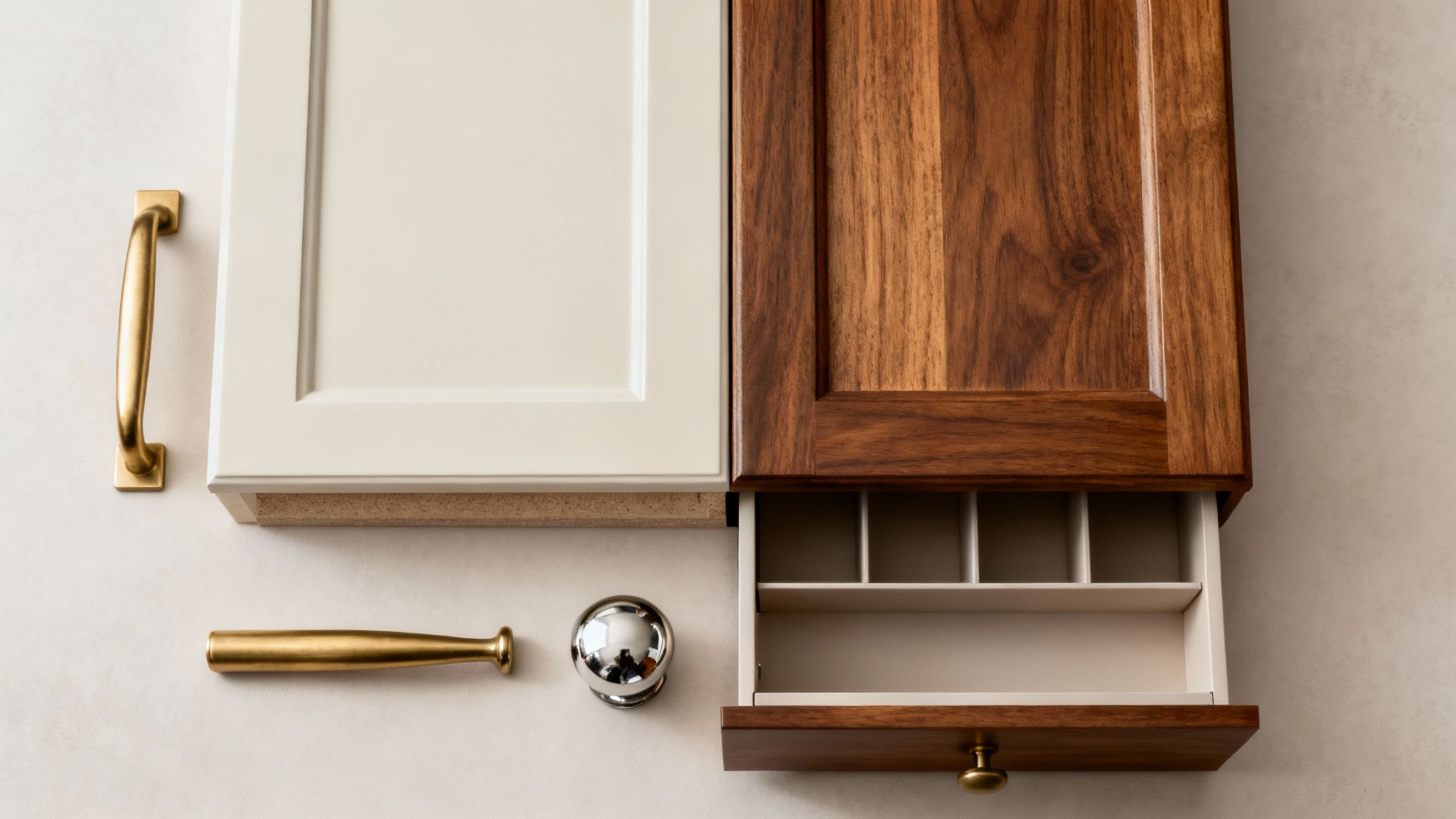
Once you’ve locked in the style and material for your cabinets, it’s time for the fun part—adding personality. The finish, hardware, and internal organizers are what transform a functional space into a kitchen that’s a genuine pleasure to use every single day. These are the details that make the kitchen truly yours.
The first big decision here is the finish. Are you leaning toward a clean, painted look or the classic warmth of a wood stain? This choice sets the entire mood for the room.
Painted vs. Stained Cabinet Finishes
A painted finish gives you that crisp, uniform look and opens up a nearly endless world of color. From classic whites and moody grays to the bold, coastal blues we see so often here in Boca Raton, paint delivers an opaque surface that completely hides the wood grain. It’s perfect for achieving that flawless, modern aesthetic.
A stained finish, on the other hand, is all about celebrating the natural beauty of the wood itself. It enhances the grain and character, adding a warmth that feels traditional or even a bit rustic. I've found that stains are also much more forgiving with minor dings and scratches since the color soaks into the wood instead of sitting on top.
Painted Cabinets
- Pros: Unlimited color options, provides a smooth and clean look, ideal for MDF or paint-grade wood.
- Cons: More susceptible to chipping over time, and hairline cracks can appear at joints as wood naturally expands and contracts with humidity.
Stained Cabinets
- Pros: Beautifully showcases natural wood grain, incredibly durable, and hides wear and tear exceptionally well.
- Cons: Color options are limited by the wood's natural tones, and it's less effective at brightening a dark kitchen.
If you’re ready to dive into the world of color, our guide on the best kitchen cabinet colors has a ton of inspiration to help you find the perfect shade.
Your cabinet finish is a long-term commitment. A quality, factory-applied paint or stain is designed to last for years, so pick something you'll still love a decade from now, not just what's trending today.
Selecting Hardware to Complement Your Style
I always tell my clients that hardware is the "jewelry of the kitchen," and for good reason. The knobs and pulls you choose are the final touch that can tie the whole design together. The right hardware elevates the look; the wrong choice can feel jarring and out of place.
Think about the style of your cabinets and the overall feel of your home. Sleek, minimalist bar pulls in matte black are a natural fit for modern slab doors. On the other hand, traditional raised-panel cabinets might call for elegant knobs in polished nickel.
Don't be afraid to mix things up a bit. Using knobs on upper cabinets and pulls on lower drawers is a timeless combination that’s both visually interesting and practical. Materials like brushed brass can add a touch of warmth and luxury, while oil-rubbed bronze lends a more rustic, old-world charm. The key is simply to maintain a consistent style and finish throughout the space.
Making Your Kitchen Work Smarter, Not Harder
A beautiful kitchen is one thing, but a kitchen that works for you is a game-changer. This is where smart storage and clever organization come in. Integrating these solutions from the beginning is one of the most impactful decisions you can make.
Think about what drives you crazy in your current kitchen. Tired of digging for a pot in the back of a deep, dark cabinet? Can you never find the right spice when you need it? Modern cabinetry has brilliant solutions for these exact frustrations.
Here are a few of the most popular upgrades I recommend:
- Deep Drawer Organizers: Forget stacking pots and pans. Deep drawers with dividers or peg systems keep everything neat and prevent your cookware from getting scratched up.
- Pull-Out Spice Racks: These narrow cabinets, usually placed right next to the stove, keep all your spices organized and within arm's reach while you're cooking.
- Corner Cabinet Solutions: Don't let those awkward corners become a black hole. A "Lazy Susan" (a rotating carousel) or a "LeMans" unit (which has shelves that swing out) makes every inch of that space usable.
- Integrated Trash and Recycling: Hiding your bins inside a dedicated pull-out cabinet cleans up the look of your kitchen and frees up precious floor space. It’s a simple change that makes a huge difference.
Choosing the right combination of finishes, hardware, and storage is how you fine-tune your cabinets to your lifestyle. These are the elements that transform a collection of boxes into the beautiful, effortlessly organized heart of your home.
Pulling It All Together: Your Kitchen Cabinet Game Plan
We’ve walked through the big stuff—from materials that can handle our Boca Raton humidity to the finishes that really define your kitchen’s vibe. Now it's time to get tactical. This isn't just a checklist; it's your game plan for walking into a showroom with confidence and making sure your project runs smoothly from start to finish.
Getting these details right before you sign on the dotted line is the secret to avoiding those gut-wrenching, last-minute surprises and costly errors. Think of this as your final walkthrough before the real work begins.
Questions to Ask Your Kitchen Designer
The first conversation with a designer sets the tone for the entire project. Walking in prepared with smart questions shows you’re serious and helps you quickly figure out if they’re the right partner for you.
Here are the non-negotiable questions I tell my clients to ask:
- On Construction & Warranty: "Show me the physical difference between your plywood and particleboard cabinet boxes. What's the warranty on the cabinet structure itself, and what are the specific exclusions?"
- On Finishes & Durability: "How does this painted finish handle chipping versus the stained wood? And what’s your recommended cleaning routine to keep this finish looking new?"
- On Lead Times & Delays: "What's the realistic lead time right now, from the day I order to the day they arrive? What are the most common delays you’re seeing, and how will you keep me in the loop if one happens?"
- On Customization: "For this specific cabinet line, where are the hard limits? Can we tweak depths and widths, or are we locked into standard sizes? What about adding things like pull-out spice racks later?"
How to Measure Your Kitchen Space (The Right Way)
Your designer will take the official final measurements, but coming to the first meeting with a detailed sketch is a massive head start. It helps them immediately grasp the possibilities and the limitations of your space.
- Sketch the Room's Footprint: Start with a simple bird's-eye view. Mark where every door, window, and major appliance is located. Don't worry about making it perfect.
- Measure Every Wall: Grab a tape measure and get the length of each wall. Here’s a pro tip: measure at the bottom, middle, and top of the wall. Walls are almost never perfectly straight, and those small differences matter.
- Map All Obstructions: Note the exact location and size of windows, doors, light switches, outlets, plumbing lines, and vents. Measure from the nearest corner to the edge of the trim for total accuracy.
- Check Ceiling Height: Measure from floor to ceiling in a few different spots. You might be surprised to find a slight slope you never noticed.
A detailed sketch paired with a few photos on your phone is worth a thousand words. It’s a simple step that cuts down on back-and-forth and gets the design process moving much faster.
Navigating Boca Raton’s Local Quirks
Remodeling here, especially in a condo or a community with a strong HOA, comes with its own set of rules. Knowing them upfront will save you from some serious headaches down the road.
- Condo Board Approvals: Many buildings in Boca and Highland Beach have strict rules. We're talking about approved work hours, specific insurance requirements for your contractor, and sometimes even limits on material choices. Your first step should be to get a copy of the renovation guidelines from your HOA or condo board—before you sign anything.
- Local Building Codes: Your contractor is responsible for permits, but it helps to be aware of the basics. Local codes dictate things like the required distance between a cooktop and the cabinets above it, or how many electrical outlets you need on a countertop.
- Making the Most of Your Space: Let's face it, many of us are working with compact layouts. This is where smart storage becomes a game-changer. Thinking about 10 practical storage solutions for small spaces can spark ideas for your cabinet design, helping you reclaim every last inch, which is especially critical in condo kitchens.
With this framework in hand, you're ready to make your final decisions. By tackling these practical steps, you can move forward confidently, knowing your kitchen renovation will be as seamless as the beautiful new space you're creating.
Bringing your dream kitchen to life requires a partner who understands both design and execution. At Kitchen Renovations Perfected, we guide you through every choice, from initial concept to flawless installation, ensuring your new space is as functional as it is beautiful. Schedule your complimentary design consultation today and let's start creating the heart of your home.