Imagine you're hosting a backyard barbecue on your beautiful Boca Raton deck. The food is great, the company is better, and you have complete peace of mind knowing every detail isn't just stylish, but impeccably safe. Deck railing codes aren't just bureaucratic red tape; they're the safety net that ensures your outdoor space is a secure haven for family and friends.
Think of these rules as the essential blueprint for a safe and lasting investment.
Why Deck Railing Codes Are Your Foundation for Safety
Building a deck anywhere in Florida, from Delray Beach to Parkland, means you're working with a specific set of safety regulations that govern everything from railing height to its overall strength. These rules are drawn from the International Residential Code (IRC), which serves as the national standard for home construction. Florida then adopts and integrates these standards into the Florida Building Code, sometimes with local tweaks.
You don't need to memorize a dense legal document to get this right. It's really about understanding a few core principles that make every deck a safe place to relax and entertain. The main goals are simple:
- Prevent Accidental Falls: This is the big one. Codes set minimum heights and maximum opening sizes to keep everyone, especially curious children, from falling.
- Ensure Structural Integrity: Your railing has to be strong enough to handle people leaning on it, accidental bumps, and the general wear and tear of life without failing.
- Provide Safe Access: For stairs, specific rules for handrails make sure everyone can move between levels safely and with confidence.
The 'Why' Behind the Numbers
Every single number and measurement in the code is there for a reason, backed by safety research and real-world data. Take the height requirement, for example. The IRC is very clear: for any residential deck more than 30 inches off the ground, the guardrail must be at least 36 inches tall. This isn't a random number; it's the specific height calculated to prevent an average-sized adult from accidentally toppling over. You can learn more about how deck railing height is determined from extensive safety studies.
Then there's the famous "4-inch sphere rule" for the spacing between your balusters (the vertical posts). This rule is a direct result of child safety research.
Studies showed that a 4-inch gap is small enough to prevent the head of a young child from passing through, which dramatically reduces the risk of them getting stuck or falling.
Likewise, the strength requirements ensure your railing can hold firm even if a few people lean against it during a crowded party. When you understand the "why" behind these key deck railing code requirements, you stop seeing them as restrictions. Instead, you see them for what they are: proven methods for protecting your loved ones and your property value.
Before we dive deeper, here's a quick cheat sheet summarizing the most important requirements.
Florida Deck Railing Requirements At A Glance
This table breaks down the core residential code standards you'll need to follow. It’s a great starting point for planning your project or inspecting an existing deck.
| Requirement | Florida Code Standard | Why It Matters |
|---|---|---|
| Minimum Height | 36 inches from the deck surface | Prevents an average adult from falling over the guardrail. |
| Infill Spacing | Openings cannot allow a 4-inch sphere to pass through | Protects small children from falling through or getting their head stuck. |
| Stair Rail Spacing | Openings cannot allow a 4 3/8-inch sphere to pass through | A slightly larger allowance for the angled space on stairs. |
| Load Capacity | Must withstand 200 lbs of force (top rail) & 50 lbs (infill) | Ensures the railing won't break under the weight of someone leaning or falling against it. |
| Stair Handrail Height | 34 to 38 inches from the stair nosing | Provides a comfortable and secure grip for people of various heights using the stairs. |
Understanding these basics is the first step. Now, let’s get into the specifics of each of these critical safety rules.
The Big Three of Railing Safety: Height, Spacing, and Strength
When we talk about building a safe, code-compliant deck, it really boils down to three critical elements: Height, Strength, and Spacing. These aren't just arbitrary numbers on a piece of paper; they're the direct result of years of safety research designed to prevent very real accidents.
Think of it like a three-legged stool. If any one of those legs is too short, too weak, or missing altogether, the whole thing becomes a hazard. Understanding these three concepts is the first step for any homeowner in Delray Beach or Parkland looking to build a new deck or check if an existing one is up to snuff.
This infographic lays out the essentials at a glance.
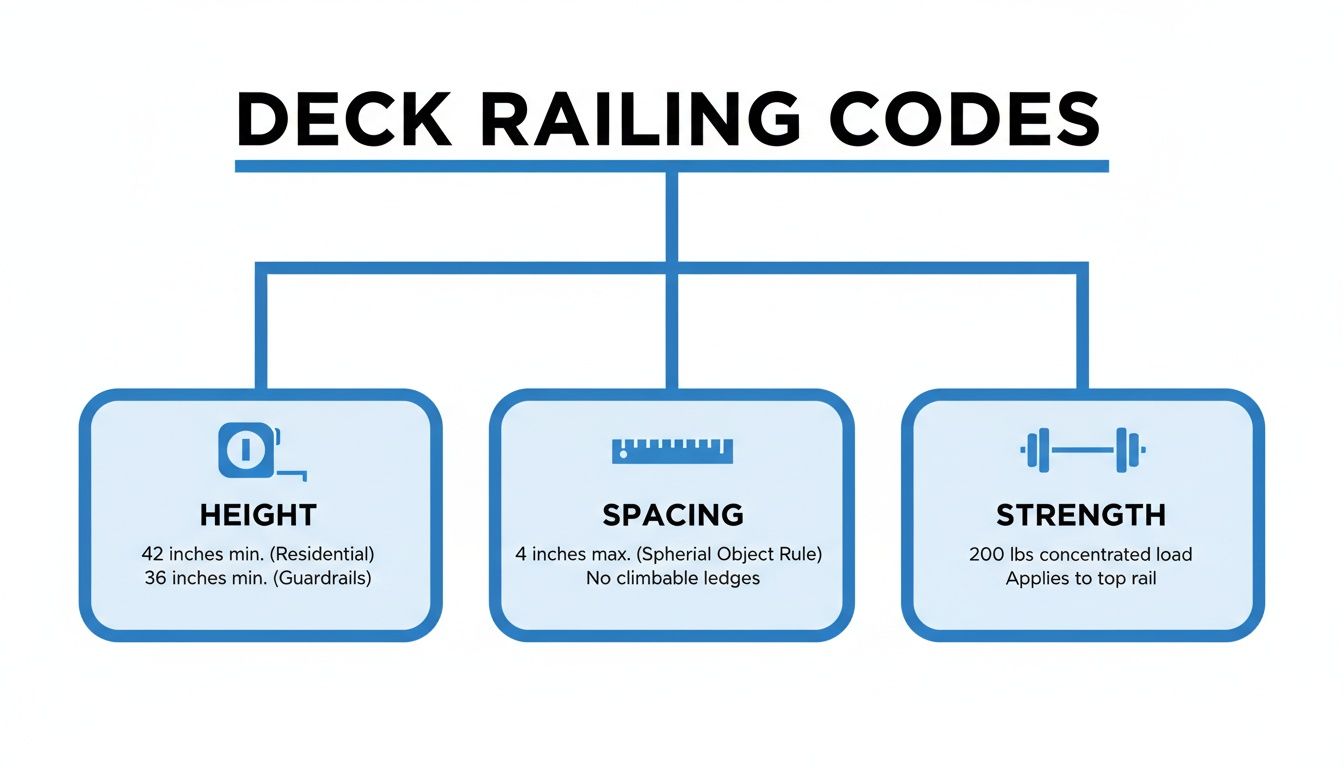
As you can see, each piece of the puzzle—Height, Spacing, and Strength—is equally vital for creating a railing system that will pass inspection and keep everyone safe.
Pillar 1: Guardrail Height Requirements
The first and most obvious rule is height. The logic is simple: a railing has to be tall enough to stop an adult from accidentally falling over the edge. For residential decks in Florida, the standard is very clear.
The rule of thumb, straight from the International Residential Code (IRC) and the Florida Building Code, kicks in when your deck's surface is more than 30 inches off the ground. At that point, a guardrail is mandatory. The top of that rail must be at least 36 inches high, measured from the deck boards you walk on.
Now, there are some exceptions. If you're dealing with a commercial property or a multi-family building, the requirement usually jumps to a 42-inch guardrail. This taller standard accounts for the higher foot traffic and different safety considerations. It’s also good to know how these safety principles apply to other structures you might add, like when you're building a privacy fence on a deck.
Pillar 2: Infill Spacing and the Sphere Rules
The second pillar, spacing, is all about protecting the little ones—toddlers, kids, and even small pets. This is where inspectors get serious about what we call the "sphere rules." These rules define the maximum allowable gap anywhere in your railing system.
There are two critical spacing rules to remember:
- The 4-Inch Sphere Rule: This applies to the main body of your railing, specifically the gaps between the vertical balusters or spindles. Those openings must be small enough that a 4-inch sphere can't pass through. That dimension isn't random; it was chosen because it's smaller than the head of a young child, effectively preventing them from getting stuck or falling through.
- The 6-Inch Sphere Rule: This one is specific to stair railings. It applies to that little triangular gap between the bottom rail, the stair tread, and the riser. For this space, a slightly larger 6-inch sphere must not be able to pass through.
These rules are non-negotiable, no matter what material you're using. It doesn't matter if you're deciding between https://kitchenrenovationsperfected.com/composite-deck-vs-wood/ or opting for modern glass or cable railings. For cable systems, this means the cables have to be properly tensioned so they can't be spread more than four inches apart when someone pushes on them.
Pillar 3: Strength and Load Capacity
Last but certainly not least is strength. A railing can look perfect, but if it can't handle a real-world push, it's a huge liability. When you’re planning that outdoor kitchen in your Parkland home, you need to know your railing will hold up when people lean on it. The IRC requires deck railings to withstand a 200-pound concentrated force—applied in any direction at any point—as well as a 50-pound-per-square-foot uniform load.
This isn't just an arbitrary number. A study by the Consumer Product Safety Commission (CPSC) found that 15% of the 224,000 deck injuries they analyzed were due to structural failures. In over 70% of those cases, the railings collapsed under pressure, often during a party when multiple people leaned against them at once. That's why in places like Boca Raton, Palm Beach County enforces this part of the Florida Building Code so strictly.
This is where experience really counts. We engineer our installations to handle loads up to 400 pounds, double the minimum requirement. It's a safety margin that ensures your deck can withstand a crowded family barbecue or a big neighborhood get-together without anyone ever having to worry.
Key Takeaway: A truly safe railing is a complete system. The height stops people from going over it, the spacing stops children from going through it, and the strength stops the whole thing from collapsing under pressure. You can't compromise on any of the three.
Decoding Stair Railing and Handrail Rules
Once you add stairs to your deck, a whole new set of safety rules kicks in. It's a common point of confusion, but the code actually treats the railings on your stairs differently from the main guardrail around the deck's perimeter. Think of it this way: the deck guard is a passive barrier, while a stair rail is an active support system you rely on with every step.
The key is understanding the two distinct components on a staircase: the guard and the handrail. The guard is the structural barrier on the open side of the stairs, preventing falls off the edge. The handrail is the part you actually hold onto for balance. They often work together, but they have separate requirements.

Stair Guard Requirements Height and Spacing
The guard running along the slope of your staircase has slightly different height rules than the guard on the flat part of the deck. While a deck guard must be at least 36 inches tall, the code gives a little leeway for stairs.
- Minimum Height: The top of the stair guard must be at least 34 inches high. This isn't measured from the deck surface, but vertically from the nosing (the very front edge) of each stair tread.
- Infill Spacing: The classic 4-inch sphere rule gets a slight adjustment here. To account for the angle, the balusters can't be far enough apart to let a sphere of 4 and 3/8 inches pass through.
- The Triangle Gap: Pay close attention to the triangle-shaped opening created under the bottom rail by the step and the riser. This space must be small enough that a 6-inch sphere can't pass through. This rule is specifically designed to protect small children.
These measurements work together to create a continuous, secure barrier along the entire flight of stairs, closing gaps that could otherwise be dangerous.
Graspable Handrail Specifics
Any time your deck stairs have four or more risers (the vertical part of the steps), you are required to install a dedicated, graspable handrail. This is not the same as the wide, flat top of a typical 2×6 guardrail cap. The code demands a rail profile that your hand can securely wrap around for support.
The Florida Building Code, which mirrors the IRC on this, is very clear: a handrail must be continuous for the entire flight of stairs and meet specific size and clearance rules. This ensures it’s actually useful if someone slips or loses their balance.
Here’s a breakdown of what your inspector will be looking for:
- Height Range: The top of the handrail must sit between 34 and 38 inches above the nosing of the stair treads. This is a comfortable and ergonomic height for most people.
- Grip Size: The rail itself has to be "grippable." For a round profile, that means a diameter between 1.25 and 2 inches. For other shapes (like a "bread loaf" profile), the total perimeter must be between 4 and 6.25 inches, with no single cross-section wider than 2.25 inches.
- Clearance: Your knuckles need space! There must be at least 1.5 inches of clear space between the handrail and whatever it's mounted to—be it a wall or the guard posts.
- Continuity and Returns: The handrail must run uninterrupted from the top step to the bottom step. At each end, it needs to have a "return," meaning it curves back smoothly into the wall, a post, or the floor. This is a critical safety feature that prevents a purse strap, backpack, or loose clothing from snagging on the end of the rail and causing a nasty fall.
To make this clearer, let's compare the main deck guardrail against the specific handrail required for stairs.
Deck Guards vs Stair Handrails A Quick Comparison
While they might look similar, the code treats the guardrail on your deck and the handrail on your stairs as two different safety features with distinct jobs. This table breaks down the essential differences.
| Feature | Deck Guardrail | Stair Handrail |
|---|---|---|
| Primary Function | Fall prevention from deck edge | Stability and support on stairs |
| Minimum Height | 36 inches from deck surface | 34 inches from stair nosing |
| Required On | Decks >30 inches high | Stairs with 4+ risers |
| Grip Requirement | Not required to be graspable | Must meet specific size/shape criteria |
| End Treatment | Open ends are acceptable | Must have "returns" to prevent snagging |
As you can see, while both are crucial for safety, the handrail's design is all about providing a secure grip for a person in motion, whereas the guardrail is a static barrier. Getting these details right is essential for a safe, code-compliant deck.
Common Code Violations and How to Avoid Them
Even the most well-planned deck project can hit a snag during inspection. Knowing where things usually go wrong is the best way to make sure your project in Palm Beach County sails through the approval process. Think of this as your cheat sheet for spotting and fixing potential issues before they turn into expensive headaches.
Most violations aren't about cutting corners. They're usually just simple misunderstandings of the deck railing code. Let's walk through the most common mistakes inspectors find and talk about the straightforward fixes to keep your project on track.
Problem One: Improper Post Attachment
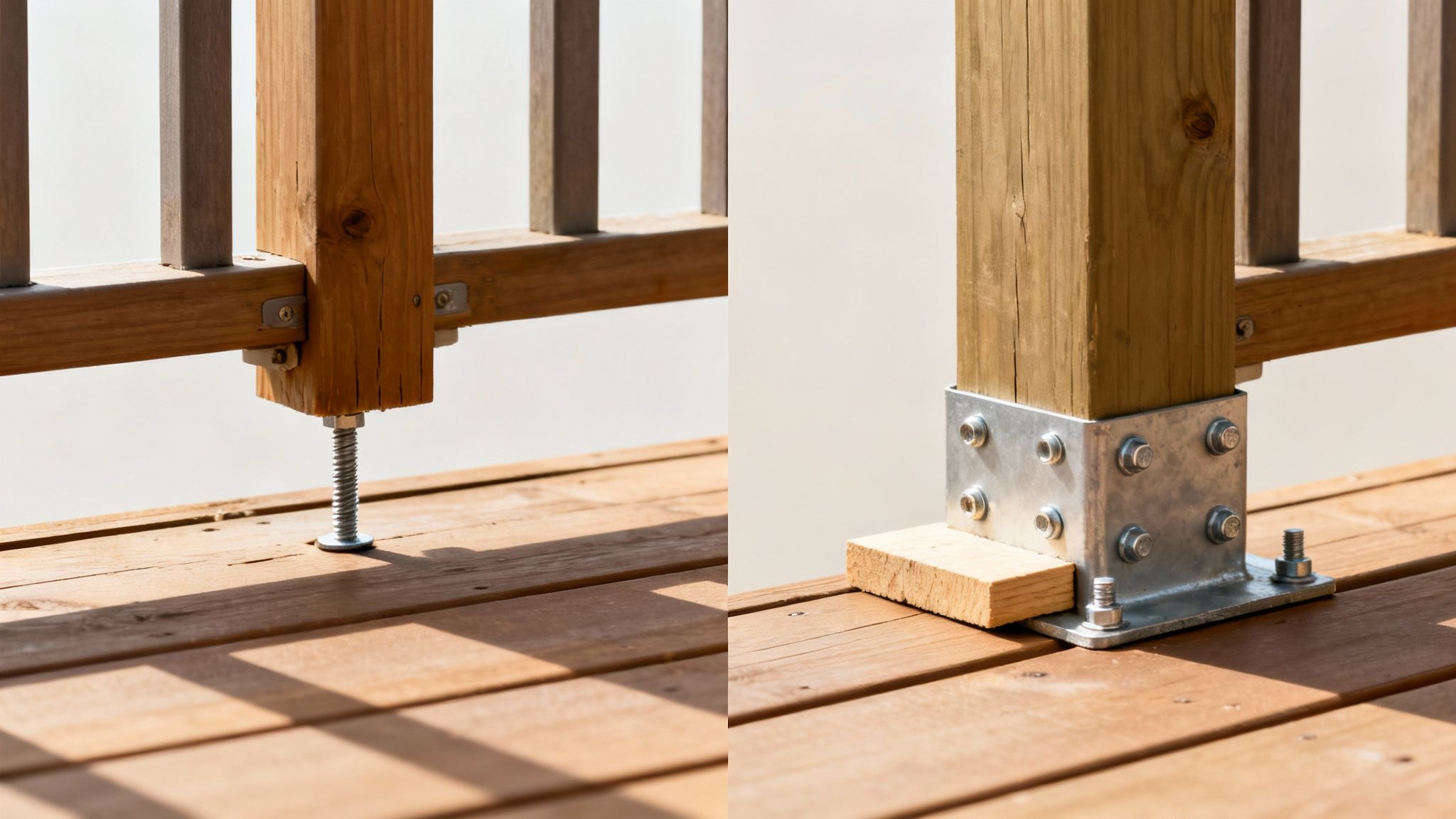
A wobbly railing post is one of the most critical—and common—failures I see. The problem almost always boils down to how the post is connected to the deck's frame.
The Violation: Simply toe-nailing or using lag screws to attach a post to the side of a rim joist. This method just doesn't have the muscle to stand up to the 200-pound lateral force required by code. Over time, the wood fibers get crushed, and that post will become dangerously loose.
The Solution: The only right way to do this is with through-bolts and proper blocking. This means drilling completely through the post and the deck's rim joist, then locking it all together with galvanized bolts, nuts, and washers. You're creating a solid mechanical connection that won't give, ensuring your railing can handle real-world pressure.
Problem Two: Incorrect Infill Spacing
Baluster spacing might seem like a small detail, but it's a huge safety focus for inspectors. The "4-inch sphere rule" is non-negotiable and one of the most frequent reasons a DIY project fails inspection.
The Violation: Leaving gaps between balusters wider than four inches. This usually happens when people measure from the center of one baluster to the center of the next, instead of measuring the actual open space between them.
The Solution: Always, always measure the clear space. Here’s a pro trick: use a scrap piece of 2×4 (which is actually 3.5 inches wide) as a spacer when you install your balusters. If the block fits snugly between them, you know you're well within the code's limit. This simple step makes your railing safe for kids and pets.
Problem Three: Bottom Rail Height
That little gap under the bottom rail is another spot where measurements are critical. It’s easy to overlook, but it's just as important for safety as the spacing between the balusters.
The Violation: The space between the deck surface and the bottom of the lower rail is big enough for a 4-inch sphere to slide through. This creates a dangerous opening right at floor level.
The Solution: Make sure you install the bottom rail so the gap is less than four inches. Just like with the balusters, using a block of wood as a guide during installation makes it foolproof. For homeowners who want to merge safety and style, many of our https://kitchenrenovationsperfected.com/covered-patio-design-ideas/ feature railings that beautifully integrate low-clearance bottom rails.
In fact, just knowing the typical issues inspectors look for can help you avoid them altogether. A deep dive into the most common home inspection problems shows that exterior structures like decks are flagged all the time for safety issues that are easily preventable with a little planning.
Problem Four: Unsafe Stair Handrails
Stairs bring their own unique set of rules to the table. A very common mistake is thinking the wide top of the stair guardrail can also serve as the handrail.
The Violation: Using a flat, wide 2×6 as the top rail on the stairs. This is not considered "graspable" by the code. Another common error is having the rail end abruptly instead of returning safely to a post or wall.
The Solution: You need to install a separate, dedicated handrail. It must meet graspability requirements, which usually means a diameter between 1.25 to 2 inches. This handrail has to be continuous for the entire flight of stairs and needs to have smooth returns at the top and bottom. This prevents sleeves or purse straps from getting snagged.
Navigating Permits and the Inspection Process
Building a beautiful, code-compliant deck railing involves more than just lumber and screws. You also have to navigate the official permit and inspection process, which can feel a little daunting. For homeowners in communities like Boca Raton and Highland Beach, this administrative side of the project is just as crucial as the physical construction.
Think of it as getting an official seal of approval that guarantees your deck is built to last and, most importantly, is safe for your family and guests.
So, when do you need a permit? The short answer is: almost always. In Florida, any deck that sits more than 30 inches above the ground, or any deck attached to the house (regardless of height), will require a building permit from your local municipality. Trying to skip this step can open a can of worms, leading to fines, orders to tear down your work, and serious headaches if you ever decide to sell your home.
Preparing for Your Permit Application
Securing a permit isn't as simple as filling out a one-page form. Your local building department needs to see a detailed plan to ensure your project meets all deck railing code requirements right from the start. A solid, well-prepared application is the key to avoiding delays and rejections.
Your submission package will typically need to include:
- Detailed Site Plans: These drawings show exactly where the deck will sit on your property, its dimensions, and how far it is from property lines.
- Structural Drawings: This is the most critical part. These plans have to detail everything from the footing depth and post size to the joist spacing and, of course, the railing construction.
- Material Specifications: You'll need to list the types of lumber, the specific hardware (like through-bolts for posts), and any manufactured railing systems you plan to use.
This is where many DIY projects hit a wall. Creating plans that meet the rigorous standards of the Florida Building Code takes real technical expertise. It's one of the main reasons working with an experienced team is so valuable; a licensed contractor handles the entire submission process, making sure your plans are correct from day one.
Pro Tip: Try not to see the permit process as a hurdle. It's really a built-in quality control system. The plan reviewer is the first expert to verify that your design is safe before a single board is ever cut, saving you from potentially expensive mistakes down the line.
What Inspectors Look for During Inspection
Once your permit is approved and construction is underway, an inspector will visit your site at key stages. When it comes to your railing, they aren't just giving it a casual glance. They are laser-focused on the details that ensure structural integrity and safety.
Their checklist will include verifying:
- Proper Post Attachment: They'll look to see that your posts are secured with through-bolts and proper blocking, not just lag screws.
- Correct Spacing: They will physically measure the gaps between balusters and under the bottom rail with a 4-inch sphere to ensure nothing can pass through.
- Load Resistance: They will often give the railing a firm push and pull to test its stability and ensure it can handle that required 200-pound force.
- Stair Safety: On stairs, they'll confirm the handrail height, check its graspability, and make sure it has secure returns at the top and bottom.
Navigating this complex process is a core part of professional deck construction services. Hiring an expert removes the guesswork, the stress, and the risk of a failed inspection, ensuring your project moves smoothly from concept to completion and results in a safe, beautiful, and fully legal outdoor space.
It's Not Just About Rules—It's About Keeping People Safe
Let's be honest, nobody gets excited about reading building codes. It can feel like you're just jumping through hoops for the city. But when it comes to your deck railing, these codes are far more than just bureaucratic red tape. They are the non-negotiable blueprint for keeping your family and friends safe.
Think of it this way: these rules aren't arbitrary. They're the direct result of decades of safety research, designed to prevent the very real danger of falls. Whether you're in Boca Raton or Parkland, following these standards ensures your beautiful outdoor space is built on a foundation of safety that will last for years.
What a Code-Compliant Deck Really Means
A railing built to code is a railing you never have to think about again. It’s the invisible framework that lets you relax and enjoy your deck without a second thought.
Here’s what that peace of mind looks like in the real world:
- Hosting with Confidence: You can have a big family get-together without a nagging worry in the back of your mind every time someone leans against the railing. You know it’s solid.
- Protecting Little Ones: Proper baluster spacing means small children and pets can't slip through or get stuck. It’s a simple rule that prevents a world of hurt.
- Protecting Your Investment: A deck that meets code will fly through inspection, keep your homeowner's insurance valid, and become a genuine asset when you sell your home.
At Kitchen Renovations Perfected, our reputation is built on getting the details right. We know that real quality means safety and style go hand-in-hand, and we bring that mindset to every single project we build.
By making code compliance a priority from day one, you do more than just ensure your project passes its final inspection. You create a worry-free environment for every barbecue, birthday party, and quiet sunset you'll enjoy out there. Your deck stops being just a structure and becomes a true extension of your home—a place where you can fully unwind, knowing it was built right.
Common Questions About Deck Railing Codes
Even after you've got the basics down, deck railing codes can still throw a few curveballs. There are always those specific situations that feel a bit like a gray area. Let's walk through some of the most common questions we hear from homeowners right here in the Boca Raton area to clear up any lingering confusion.
Do I Really Need a Railing on a Low Deck?
This is probably the number one question we get, and the answer comes down to what we call the "30-inch rule." The Florida Building Code is pretty clear: a guardrail is not required as long as the deck's surface is 30 inches or less from the ground below. This measurement is taken at any point within 36 inches of the deck's edge.
But here’s the thing: just because you can skip the railing doesn't always mean you should. We always encourage homeowners to think about who will be using the deck. If you have small children or elderly relatives visiting, even a two-foot drop can lead to a nasty injury. A railing offers peace of mind that a codebook can't.
Key Takeaway: The 30-inch rule is the legal floor, not the ceiling for safety. When it comes to your family, going beyond the bare minimum is always a smart move.
Are Cable and Glass Railings Allowed in Florida?
Yes, absolutely! Those sleek, modern looks you see with stainless steel cables or clear glass panels are perfectly fine here in Florida. They just have to meet the exact same safety rules as any other railing.
There are a couple of key things to watch out for with these materials:
- Cable Railings: It's all about the tension. The cables need to be tightened enough so that a 4-inch sphere can't squeeze through them. This often means you need to space them a little closer together than four inches to start, because they will have some give when pushed.
- Glass Panels: The glass itself has to be safety glass—either tempered or laminated. This ensures that if it ever breaks, it shatters into dull, relatively harmless pieces instead of dangerous shards. Just as important, the glass and its mounting hardware must be engineered to handle that 200-pound load test.
What if My Old Deck Railing Doesn't Meet Current Code?
If you live in an older home, you might have a deck with balusters spaced six inches apart, which was common years ago. In most cases, if the deck was built to code at the time of construction, you're "grandfathered in" and don't have to tear it out.
That protection disappears, however, the moment you decide to do a major renovation. Any significant structural work on the deck will trigger the requirement to bring everything—including the railings—up to today's code.
Legalities aside, we always recommend upgrading non-compliant railings. A railing with wide baluster spacing is a serious safety risk for small children. Sometimes it's an easy fix, like adding a few more balusters, but other times it might mean a full replacement is needed to make sure your deck is truly safe for everyone.
A safe and beautiful deck enhances your home and lifestyle. At Kitchen Renovations Perfected, we bring meticulous attention to code compliance and craftsmanship to every outdoor project. If you're ready to create an outdoor space that's built right from the ground up, contact us for a complimentary consultation.