When you're considering concrete countertops, the real decision boils down to a classic head-versus-heart debate. You're weighing their unmatched custom style and industrial-chic vibe against their very real need for consistent maintenance. They offer incredible design freedom and solid durability, but they're also porous by nature and demand regular sealing to fend off stains and cracking.
Weighing the Pros and Cons of Concrete Countertops
Concrete has made a serious journey from the sidewalk to the center of high-end home design, becoming a true statement piece in modern kitchens. Choosing concrete isn't like picking out a precut slab of stone; it's more like commissioning a piece of functional art for your home. Think of it as a blank canvas—a versatile, moldable material that brings an earthy, industrial feel that you just can't get from traditional granite or quartz.
It's no surprise this material has found a loyal following in luxury markets like Boca Raton and Delray Beach, where custom renovations and unique aesthetics are the name of the game. Since the early 2000s, polished concrete has been delivering a high-end look, often for 30-50% less than what you might pay for premium granite. But you have to be realistic about the downsides. Its porous nature means an unsealed surface can soak up spills and stains 40% faster than quartz. It also doesn't handle heat as well as engineered stone, with a risk of cracking if exposed to temperatures above 300°F.
To get a better feel for it, it helps to understand the general pros and cons of concrete as a material in more familiar settings. From there, we can dive deep into everything from cost and installation to long-term care, helping you decide if concrete is the right champion for your renovation project.
Concrete Countertops at a Glance
For a quick, high-level look, this table breaks down the key factors homeowners need to think about.
This summary is a great starting point for wrapping your head around the trade-offs. If you want to dig even deeper, our comprehensive guide on how to choose kitchen countertops can provide even more context.
| Feature | The Upside (Pros) | The Downside (Cons) |
|---|---|---|
| Aesthetics | Highly customizable; unique industrial-chic look that develops a beautiful patina over time. | Can feel cold or stark if not balanced with warmer design elements; hairline cracks are possible. |
| Customization | Can be poured into literally any shape or size, with options for integrated sinks and drainboards. | Truly custom work is complex and absolutely requires a highly skilled, experienced professional. |
| Durability | Extremely hard and very scratch-resistant once it's been properly sealed and cured. | Naturally porous and will easily stain from acids (like wine or lemon juice) and oils without a good sealer. |
| Heat Resistance | Generally heat-resistant for everyday use, but extreme, direct heat can cause damage. | Not as heat-proof as granite; sudden temperature changes (thermal shock) can cause it to crack. |
| Maintenance | Simple to clean day-to-day with just pH-neutral soap and water. | Needs regular waxing and must be resealed every 1-3 years to protect it from stains and moisture. |
| Cost | Can be more budget-friendly than some high-end natural stones like marble or premium quartz. | The price can climb quickly with high-end custom designs, complex forms, and unique finishes. |
Ultimately, concrete offers a blend of raw beauty and hands-on ownership that appeals to many, but it's important to go in with your eyes wide open about the care it requires.
What’s the Big Deal with Concrete Countertops, Anyway?
So, what is it that makes homeowners really lean into the idea of concrete countertops? It’s more than just their cool, industrial vibe. A few key characteristics set this material in a league of its own, transforming a basic kitchen work surface into something truly personal. The biggest draw, and the one that gets the creative juices flowing, is its incredible capacity for customization.
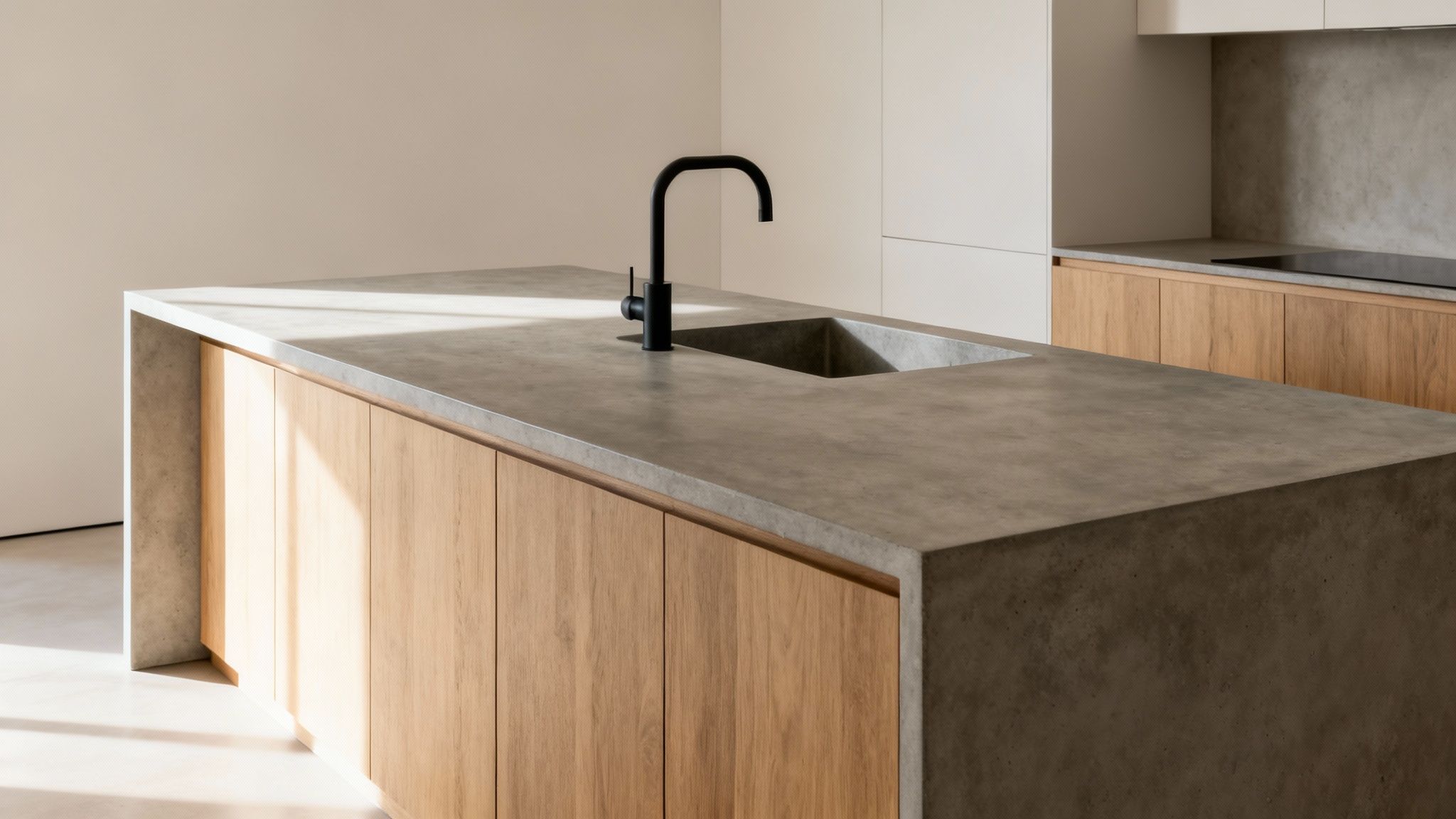
Think about it this way: choosing a quarried stone like granite or marble is like buying a beautiful, high-end suit off the rack. It’s fantastic, but you’re ultimately limited by what the quarry produced in that specific slab. Concrete, on the other hand, is like commissioning a bespoke, custom-tailored suit. It starts as a liquid, so we can pour it into virtually any shape you or your designer can dream up.
This simple fact blows the doors wide open for design possibilities that you just can’t get with other materials.
Unmatched Design Freedom
The ability to literally mold your countertop means it can become a seamless, architectural feature of your kitchen. This is where the practical artistry of concrete really comes to life.
- Integrated Sinks: Picture a sink basin flowing directly from the countertop itself. There are no seams, no ugly caulk lines, and no crevices to trap gunk.
- Built-In Drainboards: An expert craftsman can form subtle slopes and grooves right into the surface next to the sink, creating a permanent and stylish drainboard that’s part of the counter.
- Unique Shapes and Edges: Forget the standard edge profiles. Concrete allows for dramatic waterfall edges that flow to the floor, gentle curves, and unique cutouts that perfectly hug the contours of your space.
- Embedded Items: Want to make it truly yours? You can embed all sorts of things directly into the concrete—from colorful recycled glass and smooth river stones to functional features like built-in metal trivets.
This customization is one of its greatest strengths. Contractors can pour the concrete on-site or precast it in a workshop to fit massive islands exceeding 9 feet—a common request in Sun Belt remodels where kitchen projects often average over 60 square feet of counter space. This opens the door for embedding custom lighting, unique drains, or even heating elements, which is a fantastic touch for family-focused designs in homes around Parkland. You can always explore more about countertop market trends to see how these innovations are shaping modern kitchens.
The bottom line is that a bespoke approach ensures no two concrete countertops are ever identical. Yours will be a one-of-a-kind installation, reflecting your specific taste and how you actually use your kitchen in a way mass-produced surfaces never can.
Surprising Durability and Strength
While its good looks and flexibility are what first grab your attention, concrete is also an absolute workhorse. When it’s properly mixed, poured, and sealed by a professional, it cures into an incredibly hard and durable surface.
It holds up beautifully to the controlled chaos of a busy family kitchen, resisting most scratches and impacts from everyday life. This is a surface that isn’t afraid of a heavy pot, a dropped utensil, or a flurry of meal prep activity. That inherent strength gives it a feeling of permanence and solidity that’s incredibly reassuring.
An Evolving, Authentic Look
Here’s where concrete gets a little romantic. Unlike engineered materials that look the same on day one as they will in ten years, concrete develops a unique patina over time. Think of it like a quality leather bag or a favorite pair of jeans—it starts to tell the story of your life.
Over the years, the surface might develop subtle color variations or fine, non-structural hairline cracks. Far from being flaws, many homeowners find these little marks add to its beauty, giving the countertop a warm, lived-in character. This slow, graceful aging process creates a rich, organic feel that feels authentic and deeply personal—something manufactured materials can only try to imitate.
Facing the Drawbacks: An Honest Look at Concrete's Flaws
As much as we love the custom beauty of concrete, it's not the right fit for everyone. Making a smart choice means going in with your eyes wide open, and that includes understanding the material's quirks and needs. Let's be clear: no countertop is perfect, and concrete's potential flaws are tied directly to its raw, natural character.
The biggest thing to wrap your head around is that concrete is naturally porous. Picture a dry sponge—that’s essentially what an unsealed concrete countertop is like. It's ready to soak up anything you spill on it. A splash of red wine, a dribble of olive oil, or a squeeze of lemon juice can quickly sink in and leave a permanent mark if the surface isn't protected.
This is precisely why sealing is non-negotiable. A good sealer acts like a bodyguard for your countertop, filling in those microscopic pores and creating a barrier that liquids can't easily breach. It’s not a one-time thing; think of it as the most critical part of your long-term care plan.
The Specter of Cracking
Cracking is another concern I hear about all the time. It’s crucial to know there are two very different kinds of cracks. First, you have minor, non-structural hairline cracks. These can sometimes appear as the concrete settles and finishes its curing process over weeks or months.
Honestly, many people come to see these tiny lines as part of the countertop's industrial charm—like the unique grain in a plank of wood or the veining in a slab of marble. They don't affect the strength of the countertop one bit; they just add to its story.
On the other hand, large, structural cracks are a real problem. These are almost always a sign of a mistake in the fabrication, a poor installation job, or inadequate support from the cabinets below. This is where hiring a true professional makes all the difference. An expert ensures the concrete mix is just right and reinforced correctly to handle the daily demands of a busy home.
The reality is, while hairline cracks are a possibility, they are often celebrated as part of the countertop's authentic patina. A skilled artisan minimizes this risk and helps you understand what to expect as the surface ages gracefully.
Managing Maintenance and Upkeep
The ongoing maintenance is where the "pros and cons" debate really heats up. Concrete isn't like quartz, which you can basically install and forget. It needs a little bit of regular attention to keep it looking its best.
- Regular Sealing: Depending on the sealer used and how much action your kitchen sees, plan on resealing your countertops every 1 to 3 years.
- Gentle Cleaning: Stay away from harsh, acidic, or abrasive cleaners. They can eat away at the sealer, leaving the concrete underneath exposed. A simple pH-neutral soap and a soft cloth are all you need for daily wipe-downs.
- Mindful Habits: It's tough, but it's not indestructible. Always use cutting boards to avoid scratching the surface, and put trivets under hot pots and pans to prevent thermal shock, which can cause cracking.
I often tell clients to think of it like maintaining hardwood floors. A little routine care goes a long way and ensures you’ll be enjoying that beautiful surface for decades.
Logistical and Installation Hurdles
Finally, let's talk logistics. There's no getting around it—concrete is heavy. It typically weighs in at 20 to 25 pounds per square foot. That heft means your cabinets might need some extra bracing to support the load, which can add a bit of time and cost to the project.
The installation itself is also more art than science. Whether it’s poured on-site or pre-cast in a workshop, it's a labor-intensive process with a longer timeline than just plopping down a slab of granite. The concrete needs time to cure properly, and that’s a phase you absolutely cannot rush. It requires patience and an installer who truly knows their craft, but the payoff for that initial investment is a countertop built to last.
Despite its porous nature, a well-maintained concrete surface is remarkably resilient. Durability stats back this up; properly sealed concrete resists impacts better than marble, with compressive strengths up to 4,000-7,000 psi. Additionally, for eco-conscious homeowners in Florida, concrete often leverages recycled aggregates, aligning with sustainable building trends. You can discover more insights about countertop material performance to see how it compares.
Breaking Down the Cost and Installation Process
Let's get down to brass tacks. When people start seriously considering concrete countertops, two big questions always pop up: What's this actually going to cost me, and what does the installation look like? Getting a handle on the budget and the timeline is absolutely essential. This isn’t like picking out a slab of granite at a stoneyard; it's a completely custom process where the price tag reflects true artistry and complexity.
The cost of a concrete countertop is anything but straightforward. It’s a direct measure of the skill and labor involved, with a few key variables really driving the final price.
- Thickness and Size: It's simple, really. Thicker, larger, and more seamless countertops mean more material and more complicated molds, which bumps up the cost.
- Color and Pigments: Your basic grey is always the most economical choice. If you want specific custom colors mixed in, those integral pigments will add to the budget.
- Finish and Edge Details: A simple, smooth finish is the standard. But if you're after more elaborate looks—like a hand-troweled texture, an acid-stained patina, or decorative edge profiles—that extra labor and skill will be reflected in the price.
- Complexity: This is a big one. Features like integrated sinks, built-in drainboards, or unique cutouts for appliances add a significant amount of labor and will increase the total cost.
This diagram highlights some of the inherent challenges of the material that a skilled installer has to master, which directly influences both the cost and the process itself.
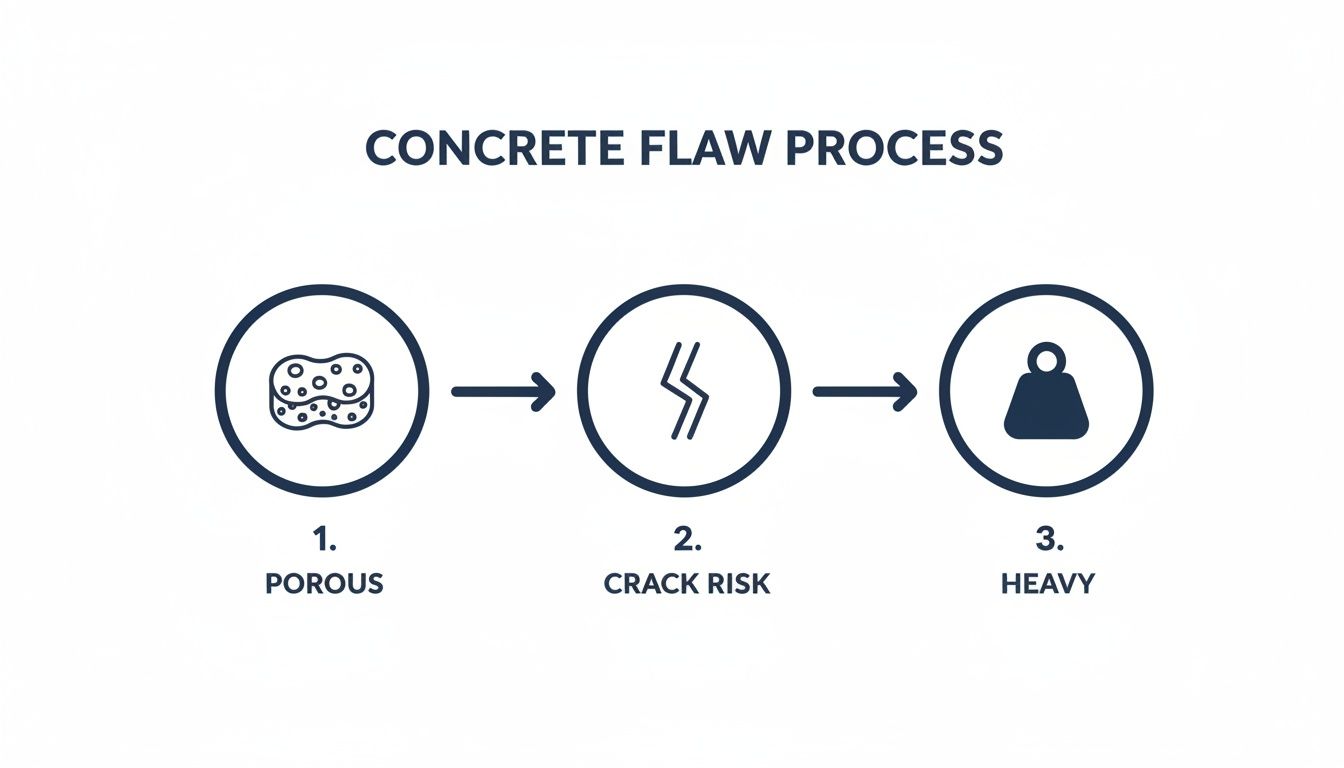
As you can see, dealing with porosity, the risk of cracks, and the sheer weight of the material is what separates a professional, lasting installation from a disaster. It’s why hiring an expert is non-negotiable.
Navigating the Budget
So, what should you really expect to pay? With all the custom work involved, you're typically looking at a range of $65 to $150 per square foot, installed. That puts concrete right in the same ballpark as many mid- to high-end quartz options (which run about $45-$200 per sq ft) and a lot of granites. In the massive US countertops market—which is on track to hit 1.1 billion sq ft and be worth $56.8B by 2026—concrete really shines for homeowners who want something truly unique and bespoke.
Think of it less as a purchase and more as an investment in a piece of functional art. You're paying for an artisan to craft a one-of-a-kind surface for your home, and that’s a far more involved process than just cutting and placing a pre-made slab.
For a much closer look at planning your finances for this project, our detailed breakdown of the concrete kitchen countertops cost is a great resource.
The Installation Journey: A Multi-Step Process
Installing concrete countertops is less of a delivery and more of an on-site art project. This is absolutely not a weekend DIY job; it takes precision, patience, and a deep understanding of how this material behaves. Finding the right professionals is the most important step, and this helpful guide to choosing local concreting services can give you a great head start.
Here’s a quick overview of what the process usually involves:
- Template Creation: First things first, the installer makes an exact template of your cabinets. This ensures a perfect fit, accounting for the sink, cooktop, and any odd angles in your kitchen.
- Form Building: Using that template, a custom mold (or "form") is built, usually out of melamine-coated particleboard. This is what will hold the liquid concrete and give your countertop its final shape.
- The Pour: The concrete mix is prepared—often with fiber or wire mesh reinforcement for added strength—and poured into the forms. This can be done off-site in a workshop (pre-cast) or right on top of your cabinets (cast-in-place).
- Curing and Hardening: This is the most critical part, and it requires patience. The concrete has to cure slowly and evenly for at least 7-10 days to get as strong as it needs to be. Rushing this step is one of the main reasons countertops crack down the road.
- Finishing and Sealing: Once it's fully cured, the countertop is freed from its mold, then ground and polished to achieve your desired look. The final step is applying several coats of a high-quality, food-safe sealer to protect it from stains and moisture.
From the first measurement to the final polish, you should plan for the entire process to take several weeks. It’s a longer timeline, for sure, but it’s something you need to factor into your renovation schedule. The payoff is a durable, handcrafted surface that’s truly built to last.
How Concrete Stacks Up Against Other Countertops
Picking a countertop is more than just a functional choice—it’s about defining the character of your kitchen. When you start considering concrete, the big question is how it really performs against the heavyweights: quartz, granite, and marble.
Let's get past the basic pros and cons and put these materials head-to-head. We'll see where each one truly shines in the areas that matter most to our clients here in Boca Raton, Parkland, and Delray Beach.
Aesthetics and Style
Right out of the gate, concrete’s biggest draw is its unique look. It creates a solid, seamless surface that feels modern, a little bit industrial, and completely custom. You’re not just installing a countertop; you're adding a sculptural piece to your home.
This is a world away from the classic, organic beauty you get from the intricate veins and patterns in granite and marble. Quartz, meanwhile, is the master of consistency. As an engineered product, it delivers predictable patterns, which is ideal if you want a specific look without any natural variations. Concrete carves its own path, offering a handcrafted feel that develops a beautiful, one-of-a-kind patina over the years.
Maintenance and Daily Life
This is where the materials really start to show their differences. Let's be clear: concrete countertops require a bit of a commitment. Because they're naturally porous, they must be sealed regularly—usually every 1 to 3 years—to fend off stains. Think of it like caring for a beautiful hardwood floor; it needs a little upkeep to stay looking its best. Granite is similar, also needing periodic sealing, though sometimes less often.
This is where quartz often wins over busy families. As a non-porous, manufactured material, it never needs sealing. Period. That low-maintenance appeal is a big reason why the quartz market is growing at a 7.60% CAGR and has such a dominant market share. For clients looking for a bold statement, concrete is an amazing, durable choice, especially when backed by a lifetime cabinetry warranty. You can discover more insights about countertop market trends from Mordor Intelligence.
For a deeper dive, check out our complete kitchen countertop materials comparison guide.
Durability and Performance
All these materials are tough, but they each have their own kryptonite.
- Concrete: Once it's properly cured and sealed, it's incredibly hard and scratch-resistant. Its main vulnerabilities are the potential for hairline cracks as your home settles and susceptibility to damage from direct, high heat.
- Granite: Legendary for its heat resistance. You can usually set a hot pan right on it without a second thought. It’s extremely hard but can chip if you drop something heavy on the edge.
- Quartz: Highly resistant to scratches and stains, thanks to that non-porous surface. Its primary weakness is heat—the resins that bind it together can be damaged or discolored by high temperatures.
- Marble: The most delicate of the bunch. It’s known for scratching and etching easily, especially when it comes into contact with acids like lemon juice or wine. It's beautiful, but it's a high-maintenance partner in a busy kitchen.
Countertop Showdown Concrete vs The Classics
To make the choice a little easier, we've broken down how these four popular materials compare side-by-side. This table gives you a quick snapshot of where each one excels and where it might fall short for your specific lifestyle and design goals.
| Attribute | Concrete | Quartz | Granite | Marble |
|---|---|---|---|---|
| Aesthetic | Industrial, raw, modern, custom | Consistent, uniform, wide range | Natural, classic, unique veins | Elegant, luxurious, soft veining |
| Heat Resistance | Good (but can be damaged by thermal shock) | Fair (resins can be damaged) | Excellent | Good (but can scorch) |
| Stain Resistance | Good (when properly sealed) | Excellent (non-porous) | Good (when sealed) | Poor (very porous) |
| Scratch Resistance | Good | Excellent | Excellent | Fair (scratches easily) |
| Maintenance | Regular sealing required (1-3 years) | None (just cleaning) | Sealing required (varies) | High (sealing & careful cleaning) |
| Customization | Excellent (colors, shapes, inlays) | Good (colors, patterns) | Limited (natural slab variations) | Limited (natural slab variations) |
| Cost | $70-$140 / sq. ft. | $60-$120 / sq. ft. | $50-$100 / sq. ft. | $75-$250 / sq. ft. |
Ultimately, the best countertop is the one that fits your life. While concrete asks for a bit more attention than quartz, it pays you back with a look and feel that's completely your own.
In the end, concrete offers a unique blend of industrial style and custom artistry that really stands apart. While it demands more upkeep than quartz, its ability to be molded into any shape with integrated features provides a level of personalization that other materials simply cannot match. It’s a choice for those who value bespoke design over set-it-and-forget-it convenience.
Your Concrete Countertop Care and Maintenance Plan
Keeping your new concrete countertop looking its best is actually pretty straightforward. It all boils down to one thing: protecting the sealer. Think of the sealer as the invisible force field for your countertop—it's what stands between everyday spills and the porous concrete beneath. Your main job is simply to keep that shield in good shape.
Just like you wouldn't let a beautiful hardwood floor go without a protective finish, concrete needs a high-quality sealer to fend off the daily abuse of a busy kitchen or bathroom. This barrier is what stops a splash of red wine or a drip of olive oil from becoming a permanent mark.
Understanding Your Countertop's Shield
Not all sealers are the same, and knowing what you have makes a big difference in how you care for it.
- Topical Sealers: This is what you'll find on most kitchen countertops. It’s a protective film that sits on the surface, sort of like a coat of polyurethane on a wood table. It gives you fantastic resistance to stains and acids but can be scratched or damaged by high heat.
- Penetrating Sealers: Sometimes called impregnating sealers, these work by soaking into the concrete itself to clog up the pores from the inside. They leave a very natural, matte feel but don't offer as much protection against acidic things like lemon juice or vinegar.
For a high-traffic area like a kitchen, a tough topical sealer is almost always the way to go. It provides the best all-around defense against the mess of real life.
The crucial takeaway is this: Your daily cleaning routine isn't just about cleaning the concrete itself; it's about preserving the life of the sealer. Harsh chemicals and abrasive pads can strip this protective layer, leaving your countertop vulnerable.
Your Simple Maintenance Schedule
Consistent, gentle care is the secret. You don't need a cabinet full of expensive, specialized products—just a simple, mindful routine.
Daily Care:
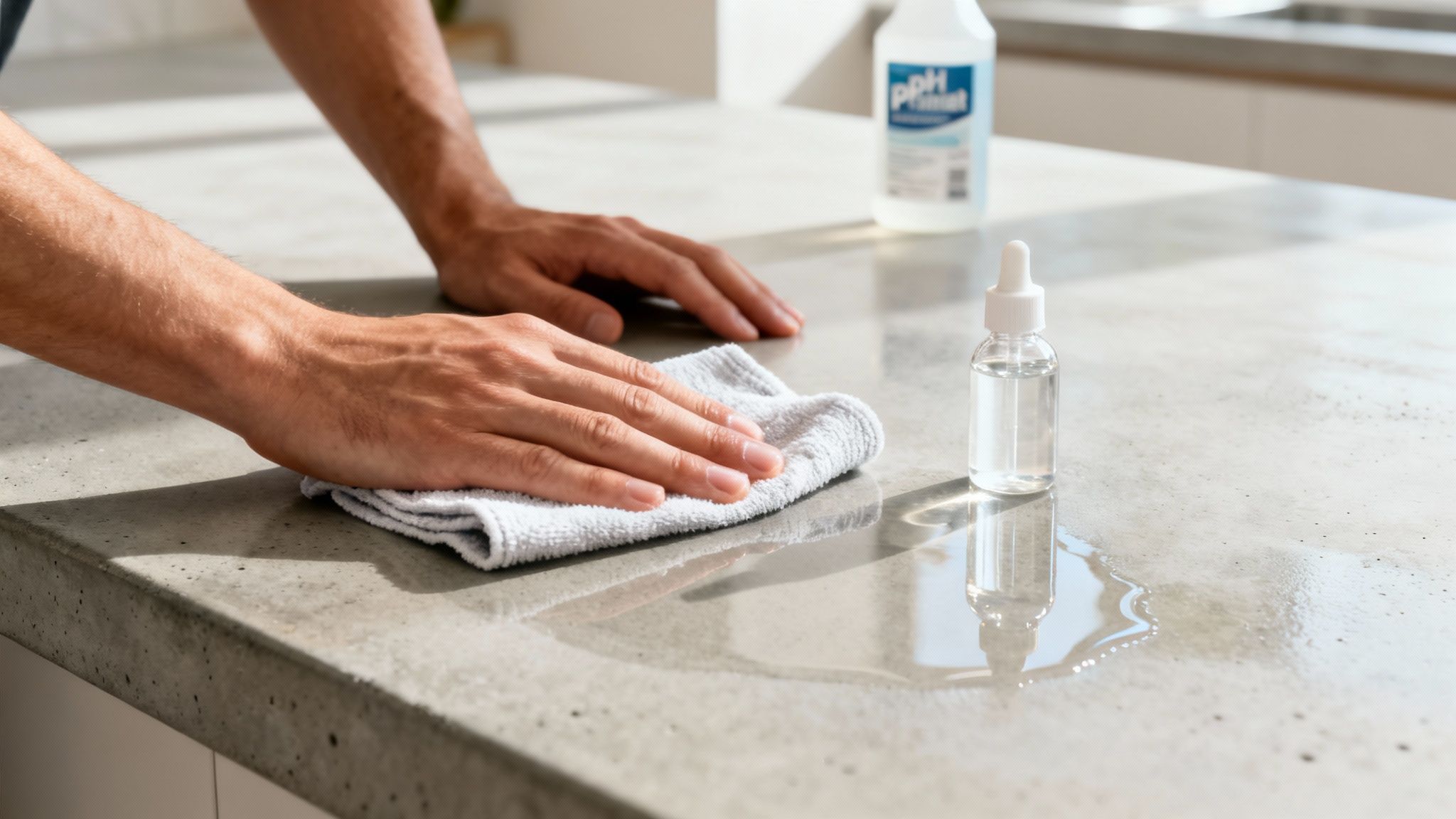
For day-to-day cleaning, a soft cloth with a little warm water and a pH-neutral cleaner is all you need. A gentle dish soap is a great example; if it's safe for your hands, it's safe for your sealer. The key is to wipe up spills, especially acidic ones, as soon as you notice them.
Things to Avoid at All Costs:
The biggest enemies of your sealer are harsh chemicals and abrasive scrubbing. Be sure to steer clear of these:
- Cleaners containing ammonia, bleach, or other aggressive chemicals.
- Acidic cleaners, including those made with vinegar or citrus oils.
- Abrasive powders (like Comet) or scouring pads that will literally scratch the finish off.
Protecting Against Physical Damage
While the concrete itself is incredibly tough, the sealer on top needs a bit of consideration to avoid physical damage. A few simple habits will keep that surface looking brand new.
- Always Use a Cutting Board: Never chop food directly on the countertop. A sharp knife can easily slice right through the sealer and even scratch the concrete, creating an opening for stains to seep in.
- Use Trivets for Hot Pans: Concrete is great with heat, but a sudden, intense temperature change (called thermal shock) can cause cracking. More importantly, extreme heat can melt, burn, or discolor most topical sealers. Always use a trivet or hot pad.
- Wipe Up Spills Promptly: The longer something sits, the more time it has to work its way through the sealer. Red wine, coffee, oil, and lemon juice are the usual suspects—get them cleaned up right away.
With this easy care plan, your concrete countertops won't just survive; they'll thrive, developing a unique character and beauty that will last for decades.
Answering Your Concrete Countertop Questions
Even after going through all the pros and cons, a few questions are probably still swirling around in your head. That's completely normal. Choosing a new countertop is a big decision, and it’s smart to get all the facts straight before you pull the trigger.
Here are the most common questions we get from homeowners in Boca Raton, Delray Beach, and Parkland, answered with straight-up, practical advice.
Will My Concrete Countertops Actually Crack?
This is the big one, the question everyone asks first. The honest answer is that tiny, hairline cracks can sometimes show up as the concrete settles and cures over time. But here's the key: these are almost always just cosmetic. They don't affect the strength of the slab.
Think of them less as a flaw and more like the unique grain in a piece of hardwood—they add character. Reputable installers use special reinforcement and carefully manage the curing process to keep this to an absolute minimum. Serious, structural cracks are extremely rare and usually signal a bad installation job or cabinets that aren't providing proper support, which is exactly why you need an experienced pro.
How Often Do I Need to Reseal Them?
The resealing schedule really boils down to two things: the quality of the sealer and how hard you are on your kitchen. As a general rule, expect to have a professional reseal done every 1 to 3 years. This renews that crucial protective layer that fights off stains and moisture.
Pro Tip: You can stretch the time between professional reseals by applying a food-safe wax every few months. It's a quick and easy DIY job that adds an extra layer of defense, keeping your countertops looking their best.
Are Concrete Countertops Safe for Food Prep?
Yes, 100%. Once the countertop is sealed with a high-quality, food-grade sealer, the surface becomes non-porous and totally safe for chopping veggies or rolling out dough directly on it. The sealer acts like a shield, blocking bacteria from getting into the concrete itself.
Just be sure to use gentle, pH-neutral cleaners for your daily wipe-downs to keep that protective barrier intact.
Can I Choose Any Color for My Countertops?
You sure can! This is where concrete really shines. While its natural grey is a classic look, we can mix pigments right into the concrete to create just about any color you can imagine, from soft, sandy beiges to bold, deep charcoals.
We can also use topical stains and dyes after the concrete has cured to create more complex, layered looks that can even mimic the patterns of natural stone. This incredible flexibility means your countertops can be a true one-of-a-kind piece, designed specifically for your home.
Ready to see how a custom concrete countertop could transform your space? The design experts at Kitchen Renovations Perfected are here to walk you through every option, from your initial idea to the final, flawless installation.