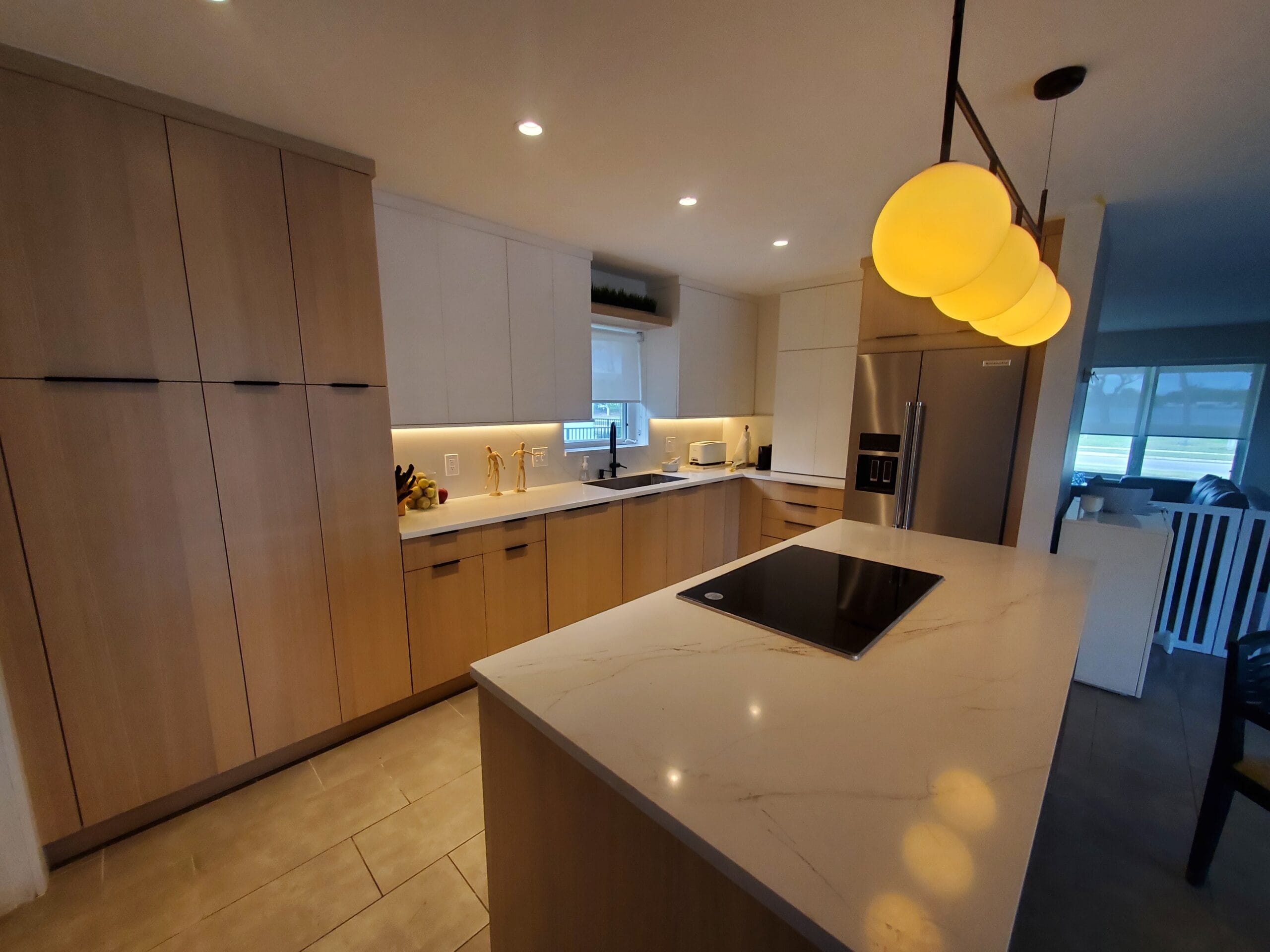
Before you can build an addition, you have to turn your big idea into a workable plan. This is where you get clear on the purpose of the space, figure out your priorities, and make sure your dreams line up with your budget. Honestly, this first step is the single most important part of keeping costs in check and making sure the final space actually makes your life better.
Translating Your Vision into a Practical Blueprint
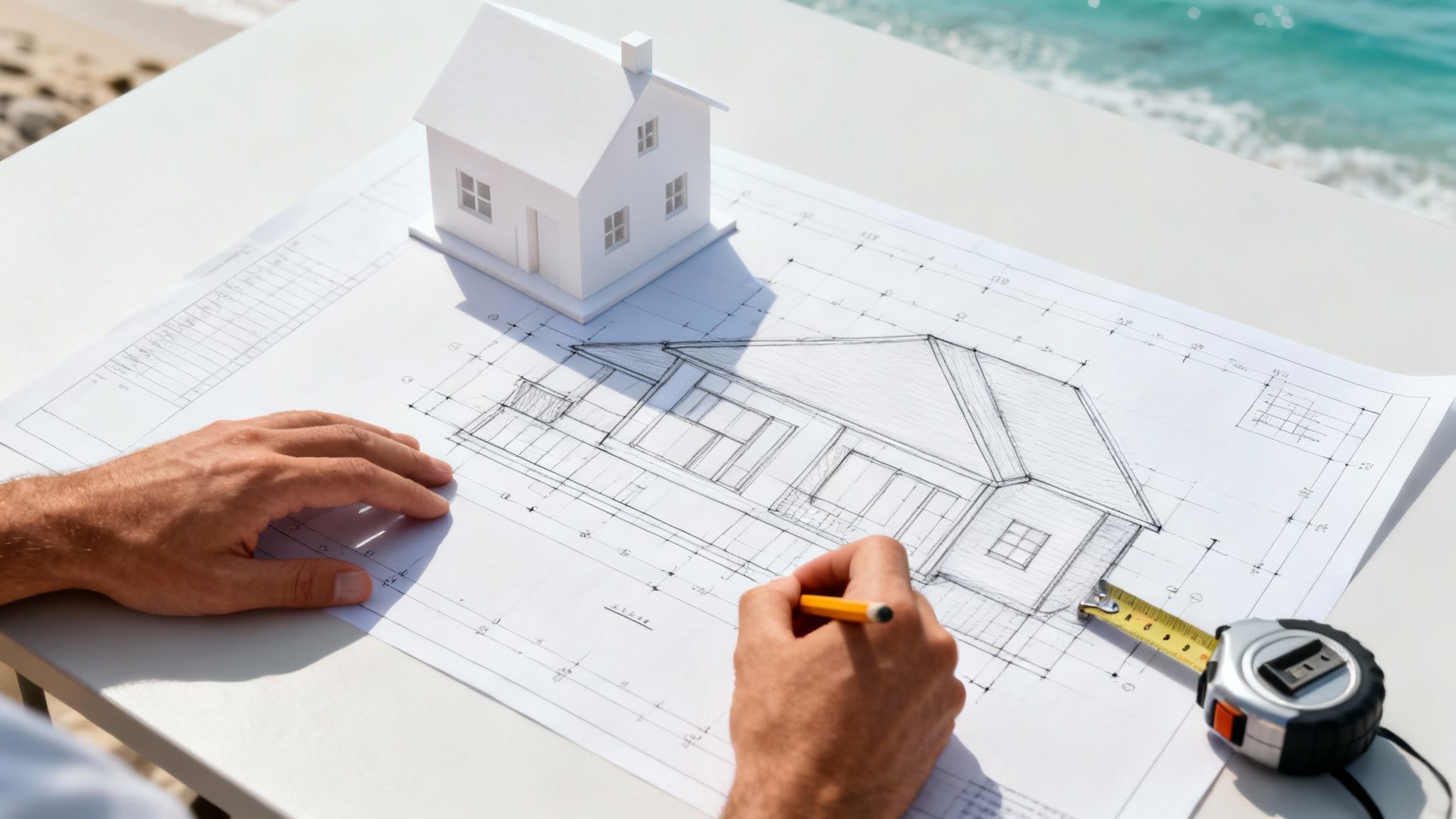
Long before any dirt gets moved, your home addition is just an idea. This initial phase is where creativity has to meet reality, and I can't stress enough how critical it is. A well-defined vision becomes your north star for every decision that comes next, from the architectural drawings all the way to the final coat of paint. It helps prevent scope creep, clarifies what's truly important, and ensures the finished room serves your family's real-world needs.
With the current real estate market, we're seeing a lot of homeowners choose to invest right where they are instead of moving. This trend is a huge part of the boom in residential remodeling. In fact, U.S. residential construction spending recently hit a seasonally adjusted annual rate of $914.8 billion, and additions are a big piece of that pie. In just one month, remodeling spending jumped 8.2%, which shows how many people are opting to expand their current homes.
Defining the Purpose of Your New Space
The first and most important question to ask is simple: Why do you need this extra space? The answer will drive the entire design. Are you picturing a huge family room for movie nights and parties, or do you need a quiet, dedicated home office to get away from the daily chaos?
Here in the Boca Raton area, we see a few common scenarios:
- The In-Law Suite: This is often a ground-floor addition with a bedroom, an accessible bathroom, and a small sitting area. It gives aging parents both comfort and independence.
- The Entertainment Hub: An open-concept extension right off the kitchen is perfect for creating that seamless great room that flows right out to the patio or pool deck.
- The Primary Retreat: A second-story addition can be the perfect spot for a luxurious primary suite, complete with a spa-like bathroom and huge walk-in closets, which frees up valuable space downstairs.
Each of these goals requires a completely different approach to the layout, utilities, and even the foundation. The more specific you can be about the main function, the better your design choices will be.
Creating Your Wish List: Needs vs. Wants
Once you know the why, it's time to dream a little. Make a detailed list of everything you could possibly want in the new space. Then, go through that list and sort every single item into one of two categories: "must-have" or "nice-to-have." This is a crucial exercise for managing your budget.
A "must-have" is something essential for the room to work, like plumbing for a new bathroom. A "nice-to-have" is an upgrade that adds a touch of luxury but isn't critical, like heated floors. Knowing the difference gives you obvious places to cut back if costs start to climb.
For instance, your list for a new family room might shake out like this:
- Must-Haves:
- Impact-resistant sliding glass doors opening to the patio.
- Plenty of electrical outlets for a media center and lamps.
- Durable flooring that can handle kids, pets, and foot traffic.
- Nice-to-Haves:
- A built-in wet bar with a wine fridge.
- A recessed smart lighting system.
- A vaulted ceiling to make the space feel more open.
This prioritized list is an incredibly valuable tool when you start talking to contractors. It makes it crystal clear what's non-negotiable and where you have some wiggle room. As you think about different ways to expand your home, a great resource is this guide to home extensions and loft conversions.
Visualizing the flow and layout is also a huge part of this process. Our guide to developing a functional floor plan can help you see how the new space will connect to the rest of your home. A clear blueprint from the very beginning saves time, money, and a lot of headaches later on.
Mastering Boca Raton Building Codes and Permits
This is where the rubber really meets the road. Navigating the maze of building codes and permits can make or break your home addition project. In South Florida, you’re not just dealing with typical construction rules; you’re up against some of the toughest regulations in the nation, all designed to keep homes standing during a hurricane and maintain community standards.
Don't skim this part. Getting a firm grip on the local requirements in places like Boca Raton, Delray Beach, and Parkland is non-negotiable. Doing your homework here saves you from a world of delays, surprise costs, and headaches, ensuring your new space is both safe and fully compliant.
Hurricane Codes and Structural Integrity
Here in our corner of Florida, the Florida Building Code is gospel, with a huge focus on hurricane-readiness. This single fact dictates nearly every major choice for your addition. Forget just picking windows that look nice; they absolutely must be impact-rated to handle high-velocity debris. It's a non-negotiable starting point for any new construction.
The same intense scrutiny applies to your roofing system. We're talking about the whole assembly—the sheathing, the underlayment, and every single fastener holding it all together. The goal is to create a sealed "building envelope" that can laugh off extreme wind pressure and keep water out. This is exactly why a simple sketch won't do; you need detailed architectural and engineering plans proving every component meets these stringent codes.
Your contractor has to prove that every structural element—from the foundation straps anchoring your walls to the roof fasteners—is engineered to meet or exceed the High-Velocity Hurricane Zone (HVHZ) standards. This isn't just paperwork; it's the core of the permit review.
Getting a Handle on Zoning and Setbacks
Before a single line is drawn, you have to dig into your local zoning ordinances. These rules control exactly where on your property you can even build. The most important rule to understand is the setback—the minimum distance your home must be from your property lines.
Let's say you want to bump out your family room 15 feet into the backyard. If your property has a 20-foot rear setback and your current house is 25 feet from the boundary, you've only got 5 feet to play with. Getting this wrong can be catastrophic, potentially forcing you to tear down a newly built structure.
The best way to avoid this nightmare is to get a recent property survey. It's a map that clearly shows your property lines, existing structures, and any easements, giving your design team the precise canvas they need to work on.
The Permit Application and Inspection Gauntlet
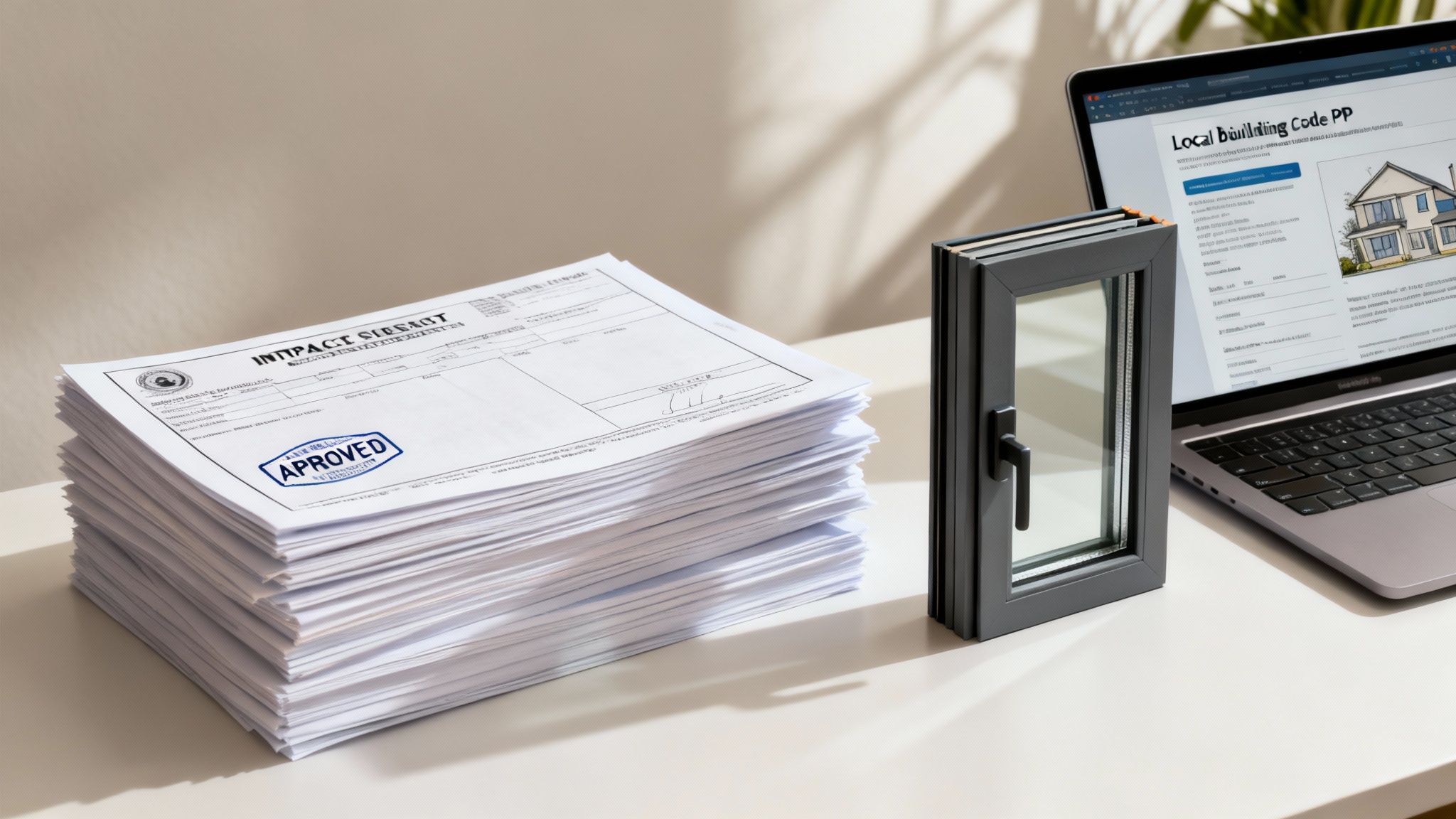
Applying for a building permit isn't a one-and-done task; it's a sequence of submissions and approvals that demands precision. The city won't even look at your project without a complete and correct package of documents.
Here’s a quick rundown of what you’ll almost certainly need:
- Architectural Plans: Detailed blueprints showing floor plans, elevations, and how the new space is put together.
- Structural Engineering Plans: The nitty-gritty drawings specifying the foundation, framing, and all the load-bearing elements.
- Energy Calculations: You'll need to prove your addition meets Florida's energy efficiency standards.
- Product Approvals: All key materials—windows, doors, roofing—must come with documentation showing they're approved for use in Florida.
Once the permit is finally in hand, the real oversight begins. A city inspector will visit your site at critical milestones to sign off on the work. They'll need to approve the foundation, framing, electrical, plumbing, and insulation before you can cover anything up.
Failing an inspection can stall your project for days or even weeks. A seasoned contractor anticipates this, scheduling inspections strategically and making sure the work is 100% ready for review. That proactive management is what keeps the project moving forward smoothly.
Budgeting Your Addition with Realistic Local Costs
Let’s talk numbers. Real, local numbers.
When you start thinking about a home addition, the first question on your mind is almost always, "What is this actually going to cost me?" You can find plenty of generic calculators online, but they often miss the mark for our area. Building in Boca Raton means dealing with specific—and non-negotiable—factors like hurricane codes and local labor costs that those tools just don't account for.
It's about more than just square footage. The real cost is in the complexity of the job and the level of finish you choose. A simple ground-floor family room bump-out is a completely different project, and price tag, than a second-story master suite that demands major structural work on the existing home.
Right now, we're seeing a clear trend: more homeowners are choosing to expand their current home rather than move. This has kept the remodeling market incredibly busy. In fact, recent data shows private residential spending was boosted by an 8.2% monthly gain in improvements (which includes additions), even as new home construction slowed. You can dig into the residential construction spending trends on NAHB.org. It’s solid proof that investing in your home right here, right now, is a smart move.
What Really Drives the Cost of an Addition?
Knowing where your money is going is the key to setting a budget you can stick to. Your total investment is a mix of several big-ticket items.
- Foundation and Structural Work: This is literally the base of your project. Here in South Florida, that usually means a concrete slab foundation with reinforced footers engineered for our soil. If you're building up, not out, the cost to reinforce the existing first floor and foundation is a major line item.
- Framing and Roofing: This is what gives your addition its shape. Lumber prices are a big factor here, as is the complexity of your roof. The real craftsmanship comes in tying the new roofline seamlessly into the old one—it’s a detail that separates the pros from the rest.
- Hurricane-Rated Windows and Doors: We've mentioned it before, but it bears repeating: impact-resistant windows and doors are mandatory in Boca Raton. They're a significant investment, often costing 2-3 times more than non-impact versions, but they are absolutely essential for code compliance and your family's safety.
- The "Big Three" Systems (HVAC, Electrical, Plumbing): Extending your home's vital systems isn't just about adding another vent or outlet. Your project might require a more powerful HVAC unit, a new electrical sub-panel, or extensive plumbing work to get a new bathroom up and running.
- Exterior and Interior Finishes: This is where you have the most control, and where the budget can really swing. From stucco and stone on the outside to the flooring, cabinets, countertops, and light fixtures on the inside, your choices will have a huge impact on the final number.
Uncovering the "Soft Costs" People Forget
Beyond the lumber and concrete, there are several "soft costs" that are crucial to the project but often get overlooked in initial estimates. Forgetting to budget for these can blow your budget by 10-15% or more.
My Two Cents: Always, always have a contingency fund. I tell every client to set aside at least 10-20% of the total construction cost. This is your safety net. It’s for the things we can’t see, like hidden termite damage behind a wall, or for the last-minute upgrades you realize you can't live without.
These essential soft costs include:
- Design and Architectural Fees: You need professional plans to get a permit. This is the blueprint for everything.
- Permit and Inspection Fees: The City of Boca Raton and other local municipalities charge fees to review plans and inspect the work at various stages.
- Land Survey: You'll likely need an updated survey to confirm property lines and ensure your addition meets all setback requirements.
Here’s a look at what you can generally expect to invest in our local market, broken down by the type of addition.
Estimated Home Addition Costs in Boca Raton Area (Per Square Foot)
This table provides estimated cost ranges for different types of home additions in the Boca Raton, Delray Beach, and Parkland markets. Costs vary based on complexity, finishes, and specific site conditions.
| Addition Type | Average Cost Per Square Foot | Key Cost Factors |
|---|---|---|
| Basic Room Addition | $250 – $450 | Ground-level, simple roofline, standard finishes (e.g., family room, bedroom). |
| Kitchen or Bathroom Addition | $400 – $650+ | Extensive plumbing, electrical, high-end cabinetry, countertops, and fixtures. |
| Primary Suite Addition | $450 – $700+ | Combines bedroom and luxury bathroom; often includes walk-in closets and premium finishes. |
| Second-Story Addition | $500 – $800+ | Requires significant structural reinforcement, new staircase, and complex roof work. |
Keep in mind, these are starting points. The best way to understand the potential cost for your specific project is to get a personalized estimate.
We built a tool to help you do just that. Try our free home addition cost estimator to plug in your details and get a more tailored projection based on real-time local data. It’s the perfect first step to turning your vision into a workable budget.
How to Find and Vet the Right Contractor
Choosing your general contractor is, without a doubt, the single most critical decision you'll make for your home addition. This isn't just about hiring a crew; it's about bringing a partner into your life and home for months. In the Boca Raton area, where a deep understanding of hurricane codes and local building nuances is non-negotiable, getting this choice right is everything.
The right partner means a smooth, predictable process. The wrong one can turn your dream project into a nightmare of delays, surprise costs, and endless frustration. You're looking for someone who is not only a skilled builder but also a clear communicator, financially sound, and completely transparent.
Starting Your Search for a Qualified Contractor
So, where do you find this person? The absolute best place to start is with people you trust.
Talk to friends, neighbors, or coworkers who have recently built an addition. A personal referral is worth its weight in gold because they can tell you about the entire journey—the communication, the cleanup, the budget adherence—not just the glossy final photos.
Beyond your immediate circle, tap into local industry networks.
- Local Supply Houses: The folks at the lumber yards or high-end window and door suppliers see contractors day in and day out. They know who pays their bills on time, who returns materials, and who has a reputation for quality.
- Architects and Designers: If you're working with an architect or designer, they'll have a shortlist of builders they trust to bring their vision to life correctly.
- Professional Associations: Check out reputable organizations like the National Association of the Remodeling Industry (NARI) or local chapters of home builder associations. These are great sources for finding credentialed pros.
As you compile your list, a quick search for a remodeling contractor near me will help you see who has a solid local presence and what past clients are saying. Your goal should be to narrow it down to three, maybe five, contractors you want to interview.
The Non-Negotiable Credentials
Before you spend time on a phone call or meeting, do a quick background check. In Florida, a legitimate contractor must be properly licensed and insured. There's no wiggle room here—this is the bright line that protects you from shoddy work and serious financial liability.
Crucial Tip: If a contractor ever suggests you pull the permits for the job yourself, end the conversation immediately. This is a massive red flag. It almost always means they are unlicensed or are trying to dodge responsibility for the project.
Make sure every single candidate can provide proof of these two items:
- A Florida State License: Your contractor needs a valid license from the Florida Department of Business and Professional Regulation (DBPR), which you can—and should—verify on their website. For an addition, they'll typically hold a Certified General Contractor (CGC) or Certified Building Contractor (CBC) license.
- Comprehensive Insurance: Ask to see their certificates of insurance. You need to see two things: general liability and workers' compensation. General liability covers damage to your property, while workers' comp is vital. Without it, if a worker gets hurt on your property, you could be the one on the hook financially.
Key Questions to Ask During the Interview
Once you've confirmed their credentials, it's time for a real conversation. This is your chance to see past the sales pitch and understand their process, communication style, and professionalism.
Don't just wing it. Go into the meeting with a list of pointed questions.
- Relevant Experience: "How many additions similar to mine have you completed here in the Boca area in the last couple of years?"
- Project Management: "Will you be on-site every day? If not, who is my dedicated project manager and main point of contact?"
- Their Team: "Do you use the same subcontractors on most jobs? Can you confirm they are all licensed and insured?"
- The 'What Ifs': "How do you handle unexpected problems or change orders? What does that communication look like for me as the homeowner?"
- Timeline: "Based on what we've talked about, what's a realistic start date and how long do you estimate the project will take?"
- Payments: "Can you walk me through your payment schedule? What specific milestones trigger each payment?"
Listen carefully to how they answer. Are their responses clear and direct, or are they vague? A true pro will appreciate your diligence and have thoughtful answers. They should make you feel confident and informed, never rushed or pressured. Remember, you're looking for the right expertise and the right personality fit for a long-term partnership.
What to Expect During the Construction Process
You’ve signed the contract, the permits are approved, and now the real fun begins. Transitioning from paper plans to an actual structure is exciting, but it also means your home is about to become an active construction site. Knowing the sequence of events isn't just for your own curiosity; it's essential for managing your expectations and keeping stress levels in check.
A well-run project has a rhythm and a logical flow, with each step building on the last. Let's walk through that process so you can follow along and know when your input is most valuable.
It's a great time to be investing in your home. The U.S. construction industry is a massive economic force, with a projected spend of $2.15 trillion for 2025 that’s expected to hit $2.34 trillion by 2028. Even when the broader market gets shaky, residential remodeling stays remarkably strong. More and more homeowners are choosing to build out rather than move out, and these numbers prove it. You can see more on these trends in these 2025 construction industry insights.
From Dirt Work to a Weatherproof Shell
The first real sign of progress is usually the loudest. Site prep kicks things off—clearing the area, marking the footprint of your new addition, and bringing in the heavy equipment. This is when your vision starts to take physical shape right in your backyard.
With the site ready, the crew gets to work on the foundation. Here in Boca Raton, that almost always means a monolithic concrete slab, heavily reinforced with footers designed to handle our sandy soil. Once that concrete is poured, it needs time to cure properly. It’s a waiting game, but a crucial one.
Then comes one of the most exciting parts: framing. The walls and roof structure go up with incredible speed, and for the first time, you can truly walk through and feel the scale of your new space. It’s a major milestone.
The crew's next big push is to get the addition "dried in," which means making it weatherproof. This involves a few key steps:
- Sheathing and House Wrap: The frame gets covered in plywood or OSB, followed by a weather-resistant barrier.
- Roofing: Underlayment and the final roofing materials go on to make everything watertight.
- Windows and Doors: Your hurricane-rated windows and exterior doors are installed, officially sealing the structure from the elements.
Getting the building envelope sealed is a huge relief, especially with Florida’s pop-up thunderstorms. It protects the new structure and allows the interior work to start without weather delays.
Bringing the Interior to Life
Once the shell is secure, the focus moves inside. This phase is a carefully choreographed dance between plumbers, electricians, and HVAC technicians. They run all the pipes, wiring, and ductwork through the open walls and ceiling cavities before any drywall goes up. We call this the "rough-in" stage.
Expert Tip: This is your last, best chance to make small but significant tweaks. Realize you want an outlet behind the couch? Need a dedicated circuit for that new treadmill? Tell your project manager now, before everything is sealed up. It's a simple change at this stage but a major headache later.
After the rough-in work passes its municipal inspections, the walls get filled with insulation. Next, the drywall hangers arrive to transform the open framing into actual rooms. Once the drywall is taped and finished, the space is ready for the final touches: paint, flooring, cabinets, light fixtures, and all the other details that make it feel like home.
It’s also critical to protect your investment during this period. For any homeowner in Florida, taking a moment to understand builders risk insurance is non-negotiable. This policy is designed to cover your project against things like theft, fire, or storm damage while it's under construction.
The infographic below shows the vetting process that gets you to this point, highlighting the crucial steps before a single nail is hammered.
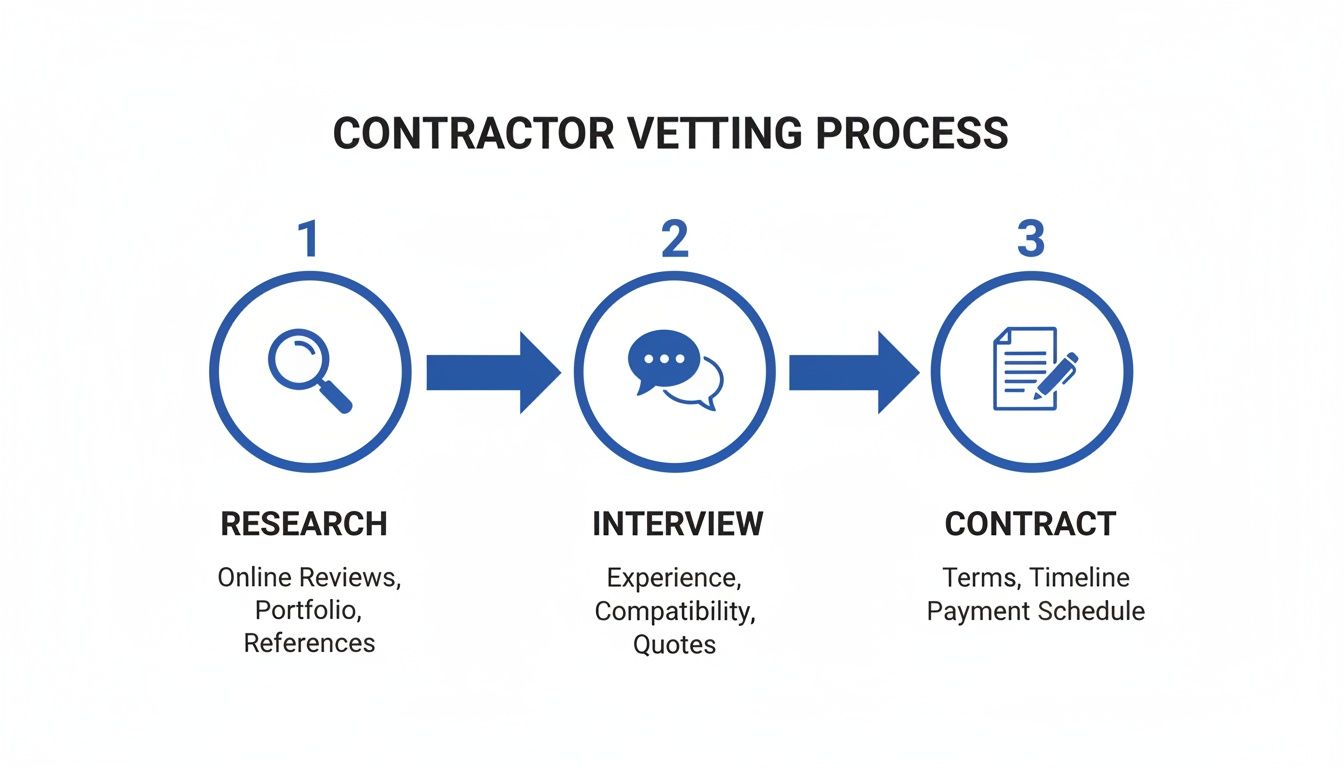
As you can see, a methodical approach of research, interviews, and a thorough contract review is the foundation for finding the right building partner for your project.
Got Questions About Your Home Addition? We've Got Answers.
Building an addition is a big step, and it’s only natural to have a long list of questions. You’re not just building walls; you’re changing the way you live in your home. We hear the same concerns from homeowners all over the Boca Raton area, so we’ve answered some of the most common ones right here.
How Long Will This Actually Take?
This is always the first question, and the honest-to-goodness answer is: it really depends. Every project has its own rhythm, dictated by its size, the city's permitting workload, and our classic South Florida weather.
A relatively straightforward project, like bumping out a wall to expand your family room, might take 3-4 months from the day we break ground.
But if you’re planning something more ambitious, like a full second-story addition, you’re looking at a timeline closer to 8-12 months. A huge chunk of that time is eaten up by the pre-construction phase. Just getting through design and permitting in places like Boca Raton or Delray Beach can take a few months all on its own, depending on how complex the plans are and how busy their offices are.
Any contractor worth their salt will give you a detailed schedule before a single hammer is swung. Think of it as your project's GPS—it shows you every milestone, from pouring the foundation to passing the final inspection.
What Kind of Value Does an Addition Really Add to My Home?
In a market like ours, a thoughtfully planned addition is one of the smartest investments you can make. You can generally expect to see a 50-80% return on your investment in pure home value. The trick is to add space that feels like it was always meant to be there.
We see it all the time in neighborhoods from Parkland to Highland Beach: an addition that adds a first-floor master suite or blows out the back of the house for a true open-concept kitchen doesn't just add value—it makes the home exponentially more desirable. You get the best return when the new space blends seamlessly with the old.
For instance, adding a full bathroom almost always pays for itself. The same goes for transforming a tiny, closed-off kitchen into the spacious heart of the home. You're not just selling square footage; you're selling a better lifestyle.
Can We Live Here While You’re Building?
Yes, for most projects, you absolutely can. We’re keenly aware that we’re working in your home, not just a construction site. Our job is to be as invisible as possible.
We take serious measures to contain the chaos, sealing off the work zone with heavy-duty plastic barriers and using dust control systems to keep the rest of your home clean.
That being said, let’s be realistic: it's still construction. There will be noise, there will be dust, and there will be a crew of people at your house every day. Some days are louder than others—especially the day we have to break through an existing wall to connect the old space to the new.
This is where communication is everything. We’ll always give you a heads-up before a particularly disruptive phase. That way, you can plan around it, whether that means working from a coffee shop for the day or just knowing when to turn up the TV. It’s manageable, but knowing what’s coming makes all the difference.
I'm Ready to Start. What's the First Step?
That's the exciting part! Before you call anyone, take some time to really nail down two things: what you want to achieve and what you're comfortable spending. Get specific. "I need a home office with lots of natural light" is a much better starting point than just "I need more space."
With that clarity, your next call should be to a design-build firm you trust. This first conversation is incredibly important. A seasoned pro will:
- Walk your property: They’ll get a feel for the existing structure, your lot lines, and any potential zoning hurdles.
- Listen to your ideas: They can help you flesh out your vision and might even suggest creative solutions you hadn't thought of.
- Talk numbers: Based on what you want, they can give you a ballpark estimate of what the project will cost.
- Map out the process: They’ll break down the entire journey for you, from initial sketches to final walkthrough.
This initial meeting turns your dream into a real, actionable plan.
Ready to see what’s possible for your home? The team at Kitchen Renovations Perfected has been bringing these projects to life for homeowners across the Boca Raton area for years. Schedule your free, no-obligation consultation today, and let's start the conversation.