When you start looking at quartz countertops, the first question on everyone's mind is, "How much is this going to cost?" It's a big part of any kitchen remodel budget, so let's get right to it.
On average, you can expect to pay anywhere from $50 to $150 per square foot for installed quartz countertops. Most homeowners find their sweet spot somewhere in the middle, typically spending between $70 and $100 per square foot. That price isn't just for the slab itself; it's an all-in figure that covers the material, the custom cutting (fabrication), and the professional installation.
Unpacking the Average Cost of Quartz Countertops
Think of buying quartz countertops like buying a car. You have your base models, your popular mid-range options with a few extra bells and whistles, and your fully-loaded luxury editions. The final price tag depends entirely on the "trim level" you choose.
Getting a handle on these different tiers is the key to setting a realistic budget. It helps you figure out where your project will likely land, whether you're aiming for a simple, durable upgrade or a show-stopping centerpiece for your kitchen. For those of us in places like Boca Raton and Delray Beach, knowing these numbers from the get-go brings immediate clarity to the investment you're about to make.
A Look at Quartz Price Tiers
Not all quartz is created equal. The material is generally grouped into three main tiers, and the price reflects the complexity of the design, the quality of the materials, and the reputation of the brand.
- Entry-Level Quartz: This is your most budget-friendly choice. It’s perfect if you want the toughness and low-maintenance appeal of quartz without the premium price. Designs here are usually simpler—think solid colors or patterns with subtle, uniform flecking.
- Mid-Tier Quartz: This is where most people land, and for good reason. You get a much wider selection of colors and more sophisticated veining that starts to convincingly mimic natural stone like marble. It’s the ideal balance of eye-catching aesthetics and solid value.
- Premium Quartz: At the top of the line, you’ll find breathtaking designs with intricate, dynamic patterns and rare color blends. These slabs are often crafted by high-end brands and look virtually identical to exotic, one-of-a-kind marble.
The national average price for quartz countertops falls between $50 and $150 per square foot, depending on the quality tier, making it a premium yet accessible choice. Entry-level options start at $50–$70 per square foot, while mid-tier slabs range from $70–$100. Premium quartz, with its advanced patterns, can exceed $100–$150 per square foot.
If you want to get a better handle on how these costs are calculated, it’s helpful to understand how professionals calculate cost per square foot for construction projects. This basic knowledge empowers you to really understand any quote you receive.
To make it even clearer, here's a quick look at how the different price tiers break down for a typical kitchen.
Quartz Countertop Price Tiers At A Glance
This table breaks down the average costs per square foot for different quality tiers of quartz, including typical project totals for a standard kitchen.
| Quality Tier | Average Cost Per Square Foot (Installed) | Typical 40 sq. ft. Project Cost | Best For |
|---|---|---|---|
| Budget | $50 – $70 | $2,000 – $2,800 | Functional kitchens, rental properties, and budget-conscious updates. |
| Mid-Range | $70 – $100 | $2,800 – $4,000 | The average family home seeking a balance of style and affordability. |
| Premium | $100 – $150+ | $4,000 – $6,000+ | Luxury homes and high-end remodels aiming for a designer look. |
Having this kind of upfront clarity is crucial. When you understand the average price of quartz countertops before you even step into a showroom, you can walk in with confidence, ready to make smart decisions that bring your dream kitchen to life without breaking the bank.
Breaking Down Your Quote: What You're Really Paying For
Getting a quote for new quartz countertops can feel a bit like reading a foreign language. You see line items for materials, labor, and terms you’ve probably never heard before, but it’s actually much simpler than it looks. The best way to think about it is like getting a custom-tailored suit—you're not just paying for the fabric, but for the skill of the tailor who measures, cuts, and stitches it all together to fit you perfectly.
The final price is a package deal, covering every single step from the moment the slab is created to its final placement in your kitchen. When you understand what each component covers, you can see the real value behind the numbers and know exactly where your investment is going. A transparent quote, like the ones we provide at Kitchen Renovations Perfected, will always lay these things out clearly, so there are no surprises down the road.
The Three Pillars of Quartz Pricing
At its core, your final bill is built on three foundational costs: the raw material, the expert fabrication, and the professional installation. Each one is absolutely critical to the quality and durability of your new countertops.
-
The Quartz Slab (Material Cost): This is the price of the physical slab of quartz. As we’ve discussed, this can vary wildly depending on the brand, the complexity of the design, and its thickness. This piece of the puzzle typically accounts for 40-50% of your total project cost.
-
Fabrication (Shaping and Finishing): This is where true craftsmanship comes into play. Fabrication is the process of taking that raw slab and turning it into your countertop. It involves precision cutting the stone to your kitchen’s exact dimensions, creating the cutouts for your sink and cooktop, and polishing the edges for a beautiful, smooth finish. This stage is crucial for a flawless result and often makes up 20-30% of the cost.
-
Installation (The Final Fit): The last piece of the puzzle is bringing those perfectly fabricated slabs into your home. The installation team levels them, secures them to your cabinets, and expertly joins any seams. Professional installation is non-negotiable for a perfect, long-lasting fit, and it usually represents the final 20-30% of your quote.
The "Hidden" Costs That Can Affect Your Budget
Beyond those big three, several smaller—but still significant—details can nudge your total cost up or down. These are the finishing touches that truly customize the countertop to your home and your style.
To help you get a clearer picture of how these elements come together, the chart below gives you a great visual of the average price of quartz countertops across different tiers.
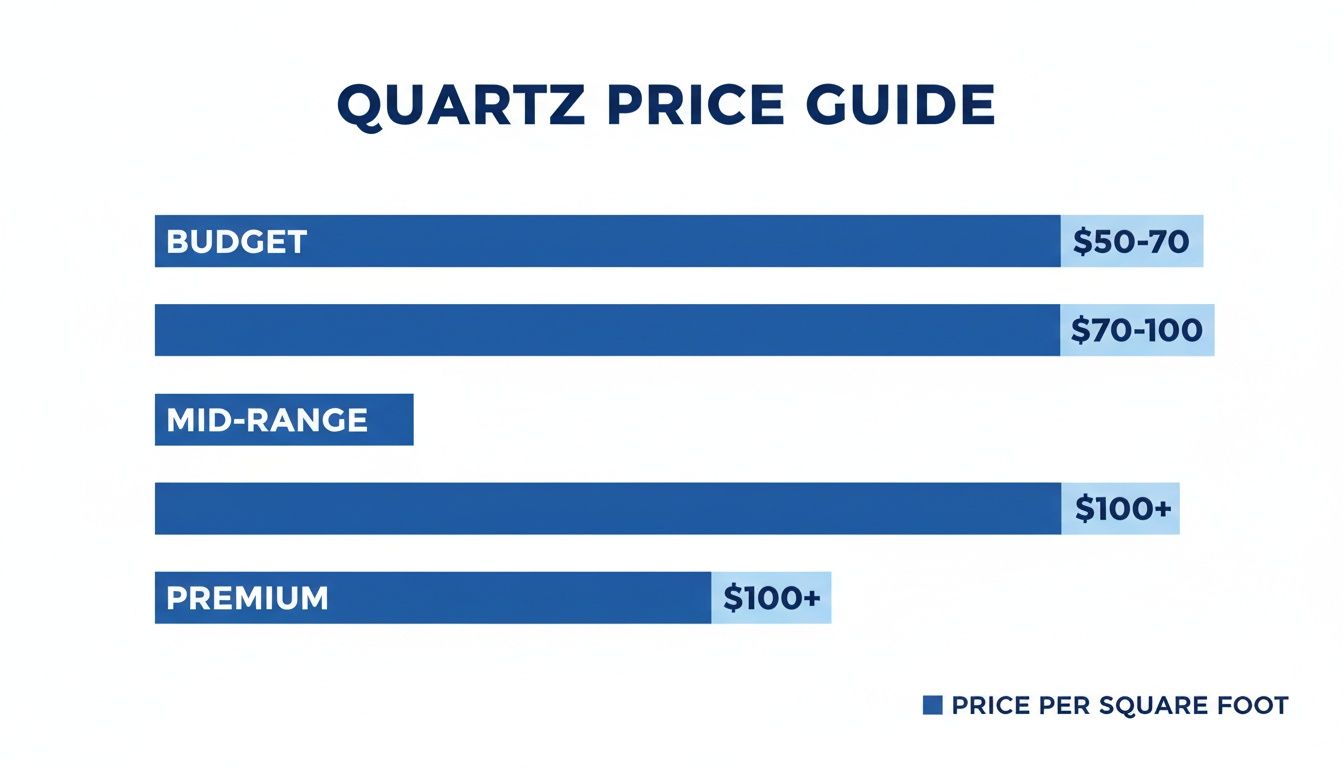
This guide helps set expectations by showing the distinct price brackets, from straightforward, budget-friendly options to show-stopping premium designs.
When you're budgeting, just remember that the total installed price is always a blend of materials and skilled labor. It’s the combination of a quality slab and an artisan’s craftsmanship that creates a stunning, durable result.
Here are a few other line items you might see on your estimate:
- Edge Profiles: A simple, standard eased edge is almost always included in the base price. But if you want something more decorative, like an ogee, bullnose, or waterfall edge, it will require extra fabrication work and increase the cost.
- Cutouts: Every hole needed for sinks, faucets, soap dispensers, or cooktops adds to the fabrication time and complexity.
- Tear-Out and Disposal: Unless you plan on doing the demo yourself, your installer will charge for the labor to remove your old countertops and haul them away.
- Seaming: For larger or L-shaped kitchens, you'll likely need more than one slab. The process of creating a nearly invisible seam between two pieces of stone requires serious skill and adds to the labor cost.
On average, installation costs for quartz countertops add $40–$150 per square foot on top of the material price, bringing the fully installed total to between $70–$150 per square foot. For a typical 50-square-foot kitchen, adding complex details like multiple cutouts or an ogee edge can tack on 25% or more to the final price. It’s a key factor to keep in mind for precise project planning. You can find more great insights on this topic by exploring countertop pricing at MSI Surfaces.
What Makes Quartz Countertop Prices Go Up?
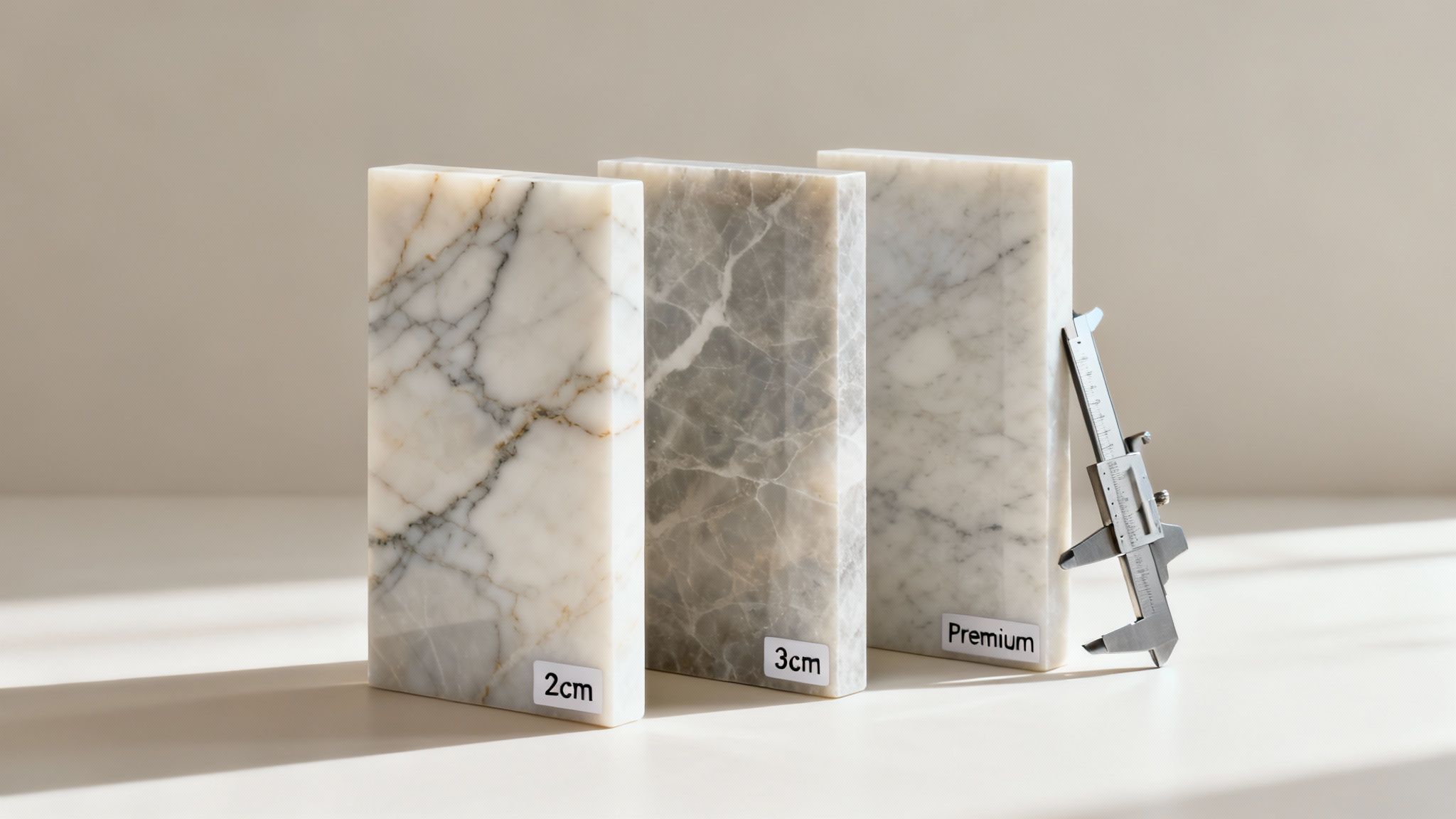
We've covered the average price of quartz countertops, but the truth is, not all quartz is created equal. A few key variables can swing your final cost from the budget-friendly end of the spectrum to the top-tier luxury bracket. Knowing what these factors are puts you in the driver's seat, letting you make smart choices that balance your dream kitchen with your real-world budget.
Think of it this way: two kitchens with the exact same square footage can end up with wildly different countertop quotes. One person might go for a simple, solid-colored slab with a standard edge. Another might pick a high-end brand with intricate veining and a fancy, labor-intensive edge profile. Both get stunning, durable quartz, but their final invoices will look nothing alike.
Let's break down exactly what moves the needle on price so you can decide where to save and where to splurge.
Brand and Design Complexity
One of the biggest factors in your final cost is the brand itself. Big names in the industry like Cambria, Silestone, and Caesarstone pour a lot of money into research and development to create unique, patented designs that you just can't get anywhere else. That level of artistry and quality control naturally comes with a higher price tag.
The look of the slab also makes a huge difference. A simple, solid-colored quartz is much easier and cheaper to manufacture than a slab with complex, multi-layered veining that mimics a rare slab of Calacatta marble. The more intricate and natural-looking the pattern, the more it costs to produce—and the higher your price per square foot.
Your choice of slab is the single biggest variable in your quote. A basic, builder-grade quartz might start around $50 per square foot, but a premium, marble-look design from a top brand can easily exceed $150 per square foot for the material alone.
This is where you have the most control. Opting for a simpler, but still beautiful, design can free up a surprising amount of room in your budget for other things, like a waterfall edge or a high-end sink.
Slab Thickness and Edge Profiles
After you’ve picked your design, the physical specs of the slab come into play. Quartz countertops typically come in two standard thicknesses, and your choice impacts not only the cost but also the installation requirements.
- 2cm (about 3/4 inch): This is the more affordable choice and is perfectly fine for most kitchen and bathroom applications. It does require a plywood sub-top for support, which is a standard part of the installation process.
- 3cm (about 1 1/4 inch): The thicker option gives you a more substantial, high-end look and doesn't need the plywood underlayment. Because it’s more material and heavier, the slab itself costs more, and it can add a bit to the labor cost to handle and install it.
The edge profile—that's the finished shape on the visible edge of your counter—is another key detail. A simple, squared-off "eased" edge is usually included in the base price. But if you want something more decorative, it requires extra fabrication work, which adds to the labor cost.
Common Edge Profile Tiers:
- Standard (Included): Eased, Bevel, Quarter Round
- Mid-Tier (Additional Cost): Full Bullnose, Half Bullnose
- Premium (Highest Cost): Ogee, Dupont, Waterfall
Layout Complexity and Fabrication
Finally, the shape of your kitchen itself plays a direct role in your fabrication and installation costs. A simple, straight countertop run is much easier (and cheaper) to cut and finish than a complex U-shaped kitchen with multiple inside corners, seams, and cutouts.
Every little detail requires precision from the fabricator. An undermount sink cutout, for example, is more work than a simple drop-in model. If you have a massive kitchen island, you might need an oversized "jumbo" slab or a very carefully planned seam—both of which can bump up the price.
The more cuts, corners, and seams your project has, the more hours of skilled labor it requires, and that will be reflected in your final quote. This is exactly why a custom approach is so critical; it ensures every unique detail of your space is perfectly accounted for.
How Quartz Stacks Up Against Other Countertop Materials
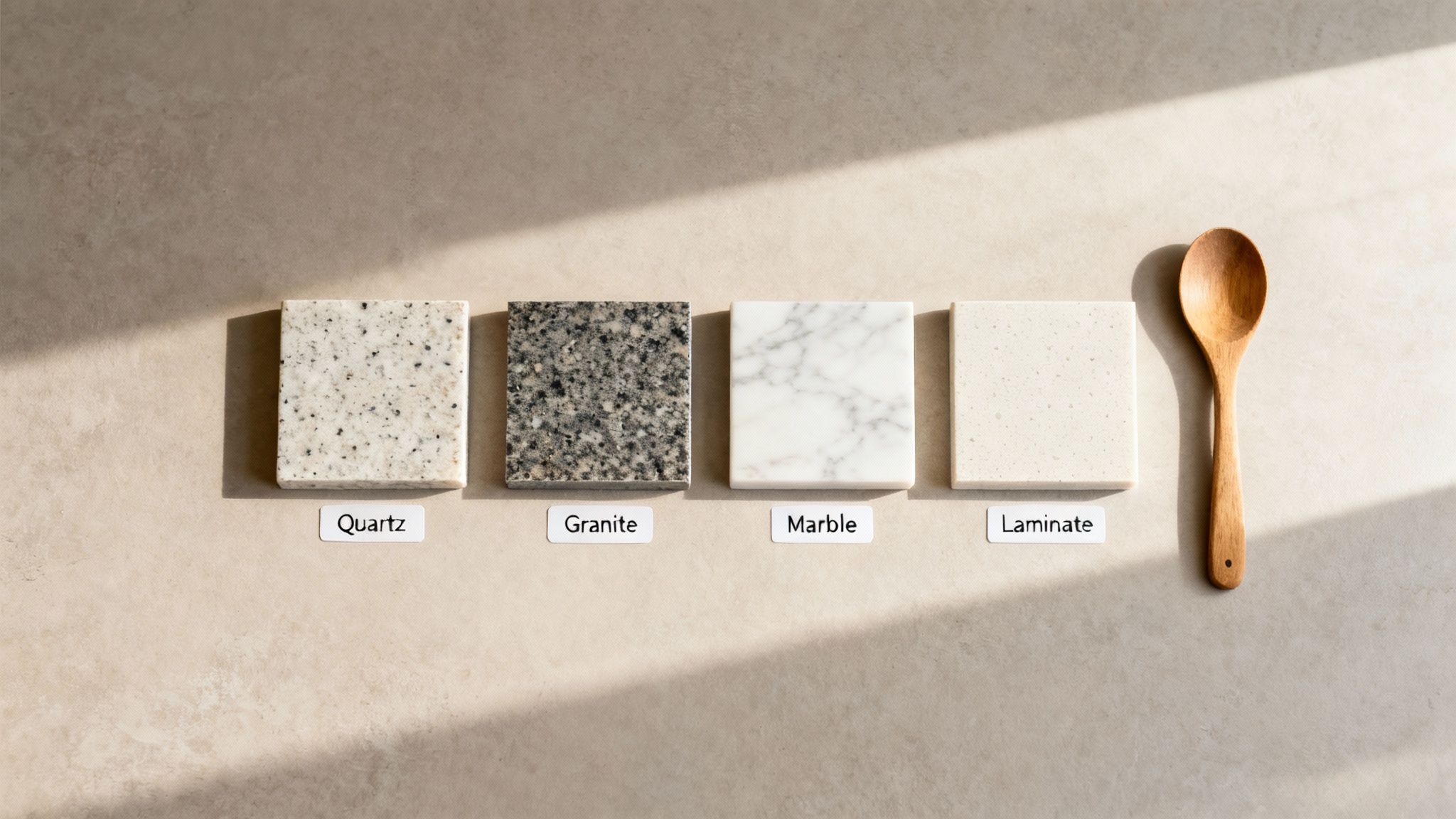
Knowing the average price of quartz is just one piece of the puzzle. To really understand its value, you have to see how it performs against the other big names in the kitchen. The best choice isn't always about the initial price tag; it's about the total cost of ownership over the years.
Think of it like buying a car. You could grab the one with the lowest sticker price, but what if it guzzles gas and needs constant, expensive repairs? A slightly pricier model might be far more reliable and efficient, saving you a ton of money and headaches down the road. Countertops are exactly the same.
Let's put quartz head-to-head with its main competitors—granite, marble, and laminate—to see how they really measure up in cost, durability, and long-term care.
Quartz vs. Granite
For years, granite was the go-to natural stone for countertops. It’s famous for its unique, one-of-a-kind patterns, and its initial price can certainly be competitive with quartz. In fact, some entry-level granite slabs might even cost a little less than basic quartz.
The real difference, though, is the maintenance. Granite is a porous natural stone, meaning it has tiny holes that can absorb liquids. It absolutely must be sealed when installed and then resealed every 1-2 years to protect it from stains. If you forget, a simple wine or oil spill could become a permanent mark.
On the other hand, quartz is engineered to be non-porous. That means it never, ever needs sealing, making it a lower-maintenance and more cost-effective choice for the long haul.
Quartz vs. Marble
When it comes to pure luxury, marble is the undisputed champion. Its soft, elegant veining is timeless, but that beauty comes at a cost—both in price and upkeep. Marble is much softer than quartz, leaving it vulnerable to scratches, chips, and etching from everyday things like lemon juice or tomato sauce.
Just like granite, marble is porous and needs constant sealing to fend off stains. Its delicate nature makes it a high-maintenance material best suited for homeowners who are willing to be extremely careful. With quartz, you can get that stunning marble look without any of the fragility or demanding maintenance.
Quartz vs. Laminate
Laminate countertops are, without a doubt, the most budget-friendly option out there. If you're looking for a quick, low-cost update, the initial investment is significantly lower than quartz.
But here’s the trade-off: durability. Laminate is easily damaged by scratches and heat, and it can start to peel (delaminate) over time, especially around the sink. While it might look fine at first, it just doesn't have the lifespan or resilience of an engineered stone like quartz. Making the switch from laminate to quartz not only elevates your kitchen's style but also adds significantly more to your home's resale value.
If you want to dig even deeper, we’ve put together a detailed kitchen countertop materials comparison that breaks it all down.
Countertop Material Cost And Performance Comparison
Sometimes, seeing everything side-by-side makes the decision much clearer. This table breaks down how quartz stacks up against the competition on the most important factors: cost, durability, and upkeep.
| Material | Average Cost Per Sq. Ft. (Installed) | Durability/Hardness | Stain Resistance | Annual Maintenance |
|---|---|---|---|---|
| Quartz | $50 – $150+ | Excellent (Hard & Flexible) | Excellent (Non-Porous) | None (No sealing needed) |
| Granite | $45 – $200+ | Very Good (Hard but Brittle) | Good (If Sealed Properly) | Required (Sealing every 1-2 years) |
| Marble | $60 – $200+ | Fair (Soft & Scratches Easily) | Poor (Porous & Stains Easily) | Required (Frequent sealing) |
| Laminate | $20 – $50 | Poor (Scratches & Burns) | Good (Surface Level) | None |
When you look at the whole picture, quartz stands out as a true powerhouse. It delivers the high-end look every homeowner wants with the everyday practicality they actually need. It's this unbeatable combination of beauty, strength, and low maintenance that makes quartz such a smart, stress-free investment for any kitchen.
Why Quartz Is a Smart Home Investment Today
When you’re picking out new countertops, you're doing more than just choosing a color or pattern. You're making a strategic decision that affects your home's value for years to come. Quartz has quickly become the go-to surface for savvy homeowners, and for good reason—it’s a smart, future-proof investment. Its popularity isn't some fleeting trend; it's a direct answer to the real demands of modern living.
Today’s households are busy. We need materials that can keep up with us. That’s where quartz really shines, delivering a stunning, high-end look without asking for much in return. It’s tough, durable, and requires zero sealing or special maintenance. This perfect marriage of luxury and practicality is exactly why it’s taken the market by storm.
The Growing Demand for Engineered Stone
The numbers don't lie. Homeowners are voting with their wallets, and they're choosing engineered stone for its sheer reliability. The U.S. quartz countertops market has seen incredible growth, jumping from $288.23 million in 2018 to $414.54 million and is on track to hit $656.56 million by 2032.
This surge perfectly aligns with the boom in residential remodeling, especially in upscale markets like South Florida. Here, families want beautiful homes that can also handle real life. It’s no surprise that the South holds 31% of the market share, fueled by growth in communities like Parkland and Delray Beach. When a material gains this much traction, it’s a clear sign that it’s delivering on its promises of style, performance, and value.
Marrying High-End Design with Everyday Life
A huge part of quartz's appeal is its incredible design flexibility. The early days of quartz gave us simple, solid colors. But manufacturing has come a long way. Today’s quartz can perfectly replicate the look of the world's most sought-after natural stones, from the dramatic veining of Calacatta marble to the soft elegance of Carrara.
You can get that jaw-dropping, elegant look of high-end marble without any of the headaches. Forget worrying about stains from a spilled glass of wine or etches from a lemon. Quartz gives you the beauty without the fragility.
This ability to blend show-stopping form with everyday function makes quartz a uniquely intelligent choice. You get the "wow" factor that boosts your home’s appeal, all while knowing your investment is built to last through spills, scratches, and the realities of a busy kitchen. If you're weighing your options, it's helpful to see a full breakdown of why quartz countertops are the perfect choice for your kitchen.
At the end of the day, putting quartz countertops in your home pays you back in two ways: through daily enjoyment and increased resale value. In a competitive real estate market, a stylish, modern, and bulletproof kitchen is a massive selling point. An upgrade to quartz isn't just a cosmetic improvement; it delivers a solid return. To see how these upgrades pencil out, take a look at our guide on the return on investment (ROI) of a kitchen remodel.
Your Next Steps to a Perfect Kitchen Renovation
Okay, so you’ve got a handle on what quartz countertops might cost. That’s a huge first step! But let's be honest, turning those numbers into a stunning, functional kitchen is where the real work begins.
Choosing the right partner to guide you through the maze of brands, thicknesses, edge profiles, and layouts is just as important as picking the slab itself. After all, the most beautiful quartz in the world won't look right without flawless fabrication and installation. You need a team that gets it right, ensuring your investment truly shines for years to come.
At Kitchen Renovations Perfected, we see the process differently. We believe getting a new kitchen should be an exciting journey, not a stressful one. We cut through the confusion and build everything on a foundation of trust, starting from our very first conversation. Our whole approach is about listening to what you want, respecting your budget, and helping you make sense of the endless options out there.
Your Personalized Design Consultation
Everything kicks off with our complimentary design consultation. Think of it less as a sales pitch and more as a collaborative workshop for your kitchen. We'll sit down together and really dig into your goals, exploring different quartz tiers and comparing designs to see how each choice fits into the bigger picture of your budget.
We want you to leave that first meeting feeling empowered and clear-headed. We’ll show you how to get the look you love without straying from your financial comfort zone, so there are no awkward surprises later on. For a deeper dive into making smart material decisions, check out our guide on how to choose kitchen countertops. Our main goal is to make sure you feel confident and genuinely excited about every single choice you make.
A successful renovation is built on more than just quality materials; it's built on clear communication, expert guidance, and a partnership you can count on from start to finish.
Transparent Quoting and Expert Execution
Once we've nailed down the vision, we’ll hand you a detailed, transparent quote. No smoke and mirrors here. You’ll see a clear breakdown of every cost, from the exact quartz slab you fell in love with to the specific labor needed for fabrication and installation. This level of clarity takes the guesswork out of the equation, giving you the peace of mind to move forward.
From that point on, our experienced crew takes the reins. We manage every detail, from coordinating schedules to overseeing the craftsmanship, making sure the final result is absolutely perfect. Your dream kitchen isn't some far-off idea—it's right here, and the path to getting it just got a whole lot clearer.
Ready to see what's possible? We invite you to schedule a consultation or stop by our Boca Raton showroom. Let's start this renovation journey together and build a kitchen your family will love for a lifetime.
Your Quartz Countertop Questions, Answered
When you're planning a remodel, questions are bound to come up, especially around the budget. I get it. To help you move forward with confidence, I've put together some straightforward answers to the questions I hear most often from homeowners about quartz countertop prices.
Is Quartz Cheaper Than Granite?
This is probably the number one question people ask, and the answer isn't a simple yes or no. It’s more about long-term value.
At first glance, some entry-level granite slabs might have a lower price tag than quartz. But once you get into the high-end, premium patterns, the prices for both materials are often neck and neck.
The real tie-breaker is maintenance. Granite is a natural stone, which means it's porous. To keep it from staining, you have to seal it every year or two, and that cost adds up over the life of your kitchen. Quartz, on the other hand, is engineered to be non-porous. It never needs sealing, which makes it a much lower-maintenance and often more cost-effective option in the long run.
How Can I Save Money on Quartz Countertops?
Absolutely. Getting a great price on quartz doesn't mean you have to settle for less. A few smart decisions can make a huge difference in what you end up paying.
- Stick with a Standard Thickness: Choosing a 2cm slab instead of a thicker 3cm one is a simple way to cut material costs.
- Pick a Common Pattern: The more intricate and marble-like the veining, the higher the price. Simpler, more common patterns are much more budget-friendly.
- Go for a Simple Edge: A standard eased or quarter-round edge is usually included in the base price. Fancy, decorative edges can add a surprising amount to the final bill.
- Work with a One-Stop Shop: Partnering with a design-build firm often creates savings because they handle everything from sourcing the slabs to managing the project, which is more efficient.
I've seen homeowners save 15-20% on their total project cost just by being strategic about these details. You can still get that beautiful, durable quartz surface without overspending.
Does the Brand of Quartz Make a Difference in Price?
Yes, it really does. Brands like Cambria, Silestone, and Caesarstone are the leaders in the industry for a reason. They put a ton of money into research and development to create unique, patented designs you won't find anywhere else. That commitment to quality and innovation is reflected in their pricing.
Top-tier brands also typically offer stronger, more comprehensive warranties, which gives you extra peace of mind. While you can find more affordable options from lesser-known brands, it’s worth taking a close look at their quality and warranty policies. You want to be sure you're making an investment that will last.
What Is the ROI on New Quartz Countertops?
Putting new quartz countertops in your kitchen is one of the smartest upgrades you can make. Kitchen renovations consistently deliver a great return on investment, and beautiful, hard-wearing surfaces are a huge draw for potential homebuyers.
Here in a competitive market like Boca Raton, a stylish kitchen with modern quartz countertops can seriously increase your home's resale value. It doesn't just make your home more attractive; it can also help it sell faster, letting you get back a significant chunk of what you invested.
Ready to transform your kitchen with the perfect quartz countertops? The team at Kitchen Renovations Perfected is here to guide you every step of the way, from design to flawless installation. Schedule your complimentary consultation today and let us help you create the heart of your home. Learn more about our process and see our work.