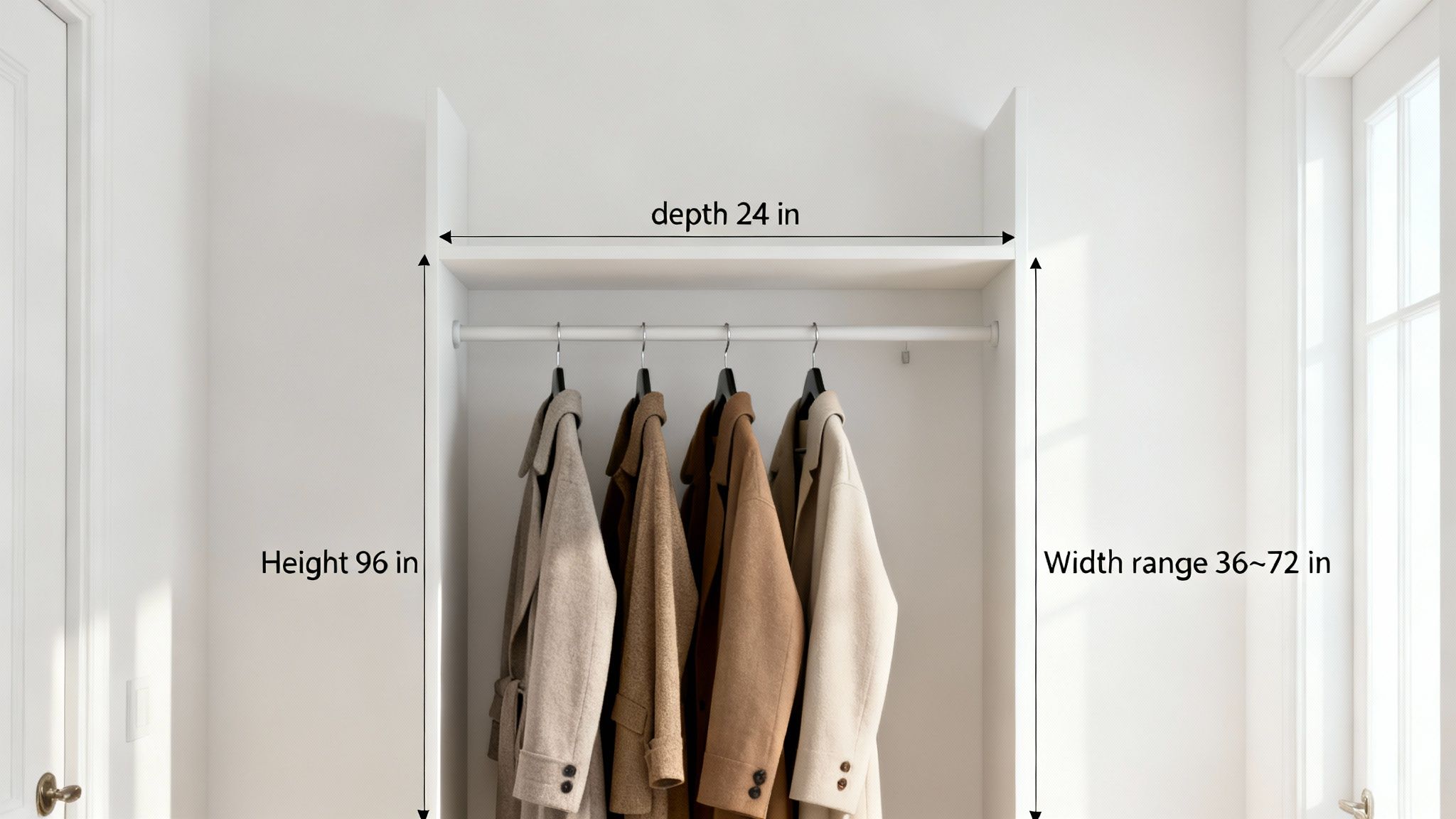
When you're planning a new coat closet, it helps to start with the tried-and-true numbers that builders and designers have relied on for years. The standard for a functional coat closet is a minimum depth of 24 inches, a width anywhere from 36 to 72 inches, and a typical height of 96 inches.
These aren't just random numbers; they form a solid blueprint that ensures your coats and jackets fit perfectly without getting crushed against the door.
Your Quick Guide to Standard Coat Closet Dimensions
Before you get lost in the exciting world of custom shelving and fancy organizers, let's nail down the basics. Think of these standard dimensions as the foundation of your project—they work for most homes and give you a great starting point, whether you're building new or remodeling your entryway here in Boca Raton.
Of course, these numbers are just the beginning. The perfect closet for your home is going to depend on your family's lifestyle. A busy household with kids, sports gear, and beach bags needs a much different setup than a couple in a sleek, modern condo.
Core Dimensions Explained
So, why do these specific numbers matter so much? Let’s break it down.
-
Depth (24 inches): This is the golden rule of closet design. A 24-inch depth is critical because the average clothes hanger is about 17 inches wide. This depth gives a hanging coat plenty of breathing room, preventing it from getting squished by the door or scuffed against the back wall. Anything less, and you'll find yourself angling hangers just to close the door—a daily frustration you don't need.
-
Width (36-72 inches): Width is all about capacity. A modest 36-inch closet is great for a small entryway, comfortably holding around 12 to 15 heavy coats. On the other end, a generous 72-inch space can handle a whole family’s outerwear, plus backpacks, umbrellas, and more.
-
Height (96 inches): A 96-inch height simply matches a standard 8-foot ceiling. This gives you enough vertical real estate for long trench coats to hang freely without puddling on the floor. It also leaves plenty of room for a high shelf above the rod—the perfect spot for stashing things you don't need every day, like luggage or holiday decorations.
For a quick overview, this table puts the key numbers in one place.
Standard Coat Closet Dimensions at a Glance
| Dimension | Standard Measurement | Why It Matters |
|---|---|---|
| Depth | 24 inches | Allows standard hangers to fit without angling clothes, preventing wrinkles. |
| Width | 36 to 72 inches | Determines the total storage capacity for coats, bags, and other items. |
| Height | 96 inches | Accommodates long coats and provides space for an upper storage shelf. |
These measurements give you a reliable framework for planning your project.
These industry standards weren't pulled out of a hat. They’ve evolved over decades to create the most practical and user-friendly closets possible. If you remember one thing, make it this: getting the 24-inch depth right is the single most important decision for a truly functional closet.
With this baseline knowledge, you’re in a great position to make smart choices. You can now look at your own entryway, understand its potential and its limitations, and start planning how to turn that cluttered drop-zone into a genuinely organized and welcoming space.
Why Getting Coat Closet Dimensions Right Matters
Let’s be honest, your coat closet is the first and last thing you—and your guests—experience in your home. It’s the gatekeeper of your entryway. When it’s not designed right, it creates an instant bottleneck, turning what should be a welcoming space into a cluttered, stressful mess.
Getting the dimensions spot-on isn’t just about having a place to throw things; it’s about creating a smooth, functional flow that makes your daily life easier.
Imagine a closet that’s too shallow. It’s like trying to parallel park a big SUV in a spot meant for a Mini Cooper. You can try, but it's not going to end well. Jackets get smashed against the door, hangers snag at weird angles, and grabbing a coat on your way out becomes a wrestling match. That daily friction can make even the most beautiful Boca Raton entryway feel chaotic.
Enhancing Functionality and Home Value
Properly planned dimensions do more than just save you from daily frustration. They actually protect your belongings. Your expensive outerwear needs room to breathe to maintain its shape, and a cramped closet just won't cut it.
Beyond that, a well-designed closet seriously boosts your home's appeal and value. It’s one of those small details that signals thoughtful, high-quality design to potential buyers—something they definitely notice.
A functional entryway closet isn’t a luxury; it’s a fundamental part of an organized home. It turns a simple storage box into an organizational hub that makes coming and going a breeze.
Ultimately, the goal is a seamless experience. The right width gives everyone in the family enough room for their gear. The correct height easily accommodates long coats while still leaving space for valuable upper shelving for off-season items. This is how you turn a purely utilitarian space into a real asset.
Adapting to Modern Lifestyles
The way we think about closet space has changed a lot over the years. Pre-WWII homes often had generous 6×4-foot closets for bulky coats and hats. But by the 1970s, many designs had shrunk them down to a mere 3×2 feet—a 40% reduction in storage! You can find more details on this shift in closet design over at SinclairCabinets.com.
Today, with homeowners trying to make the most of every square inch, smart entryway renovations are back in a big way. We've come to realize that the right coat closet dimensions are a small detail with a massive impact on daily convenience and the overall organization of your home.
Decoding the Dimensions: Reach-In vs. Walk-In Closets
Let's face it, not all closets are created equal. Getting the dimensions right for your entryway depends entirely on the space you have and how your family lives. The two main players here are the classic reach-in and the more luxurious walk-in.
The one you see most often is the reach-in closet. Think of it as your everyday, workhorse storage solution right by the door. The single most important number to remember for a reach-in is its depth: at least 24 inches. This isn't an arbitrary number; it's the minimum space needed for a standard hanger to fit straight without your coats getting squished against the door.
When it comes to width, you'll see reach-in closets ranging anywhere from a compact 36 inches to a more family-friendly 72 inches. A smaller closet is perfect for a condo or guest entrance, while a wider one can handle the daily chaos of a busy household.
The Standard Reach-In Blueprint
In most modern homes, the standard coat closet you'll find is typically 4 to 6 feet wide by 2 to 3 feet deep. This isn't just a builder's habit; it’s a direct response to homeowners wanting smarter, more organized spaces. In fact, the demand for efficient, built-in storage is booming, with the global custom closets market projected to grow substantially. People are tired of entryway clutter and are looking for real solutions. You can dig into this market trend over at Congruence Market Insights.
Getting these dimensions right has a ripple effect throughout your home, influencing everything from daily traffic flow to how well you care for your clothes.
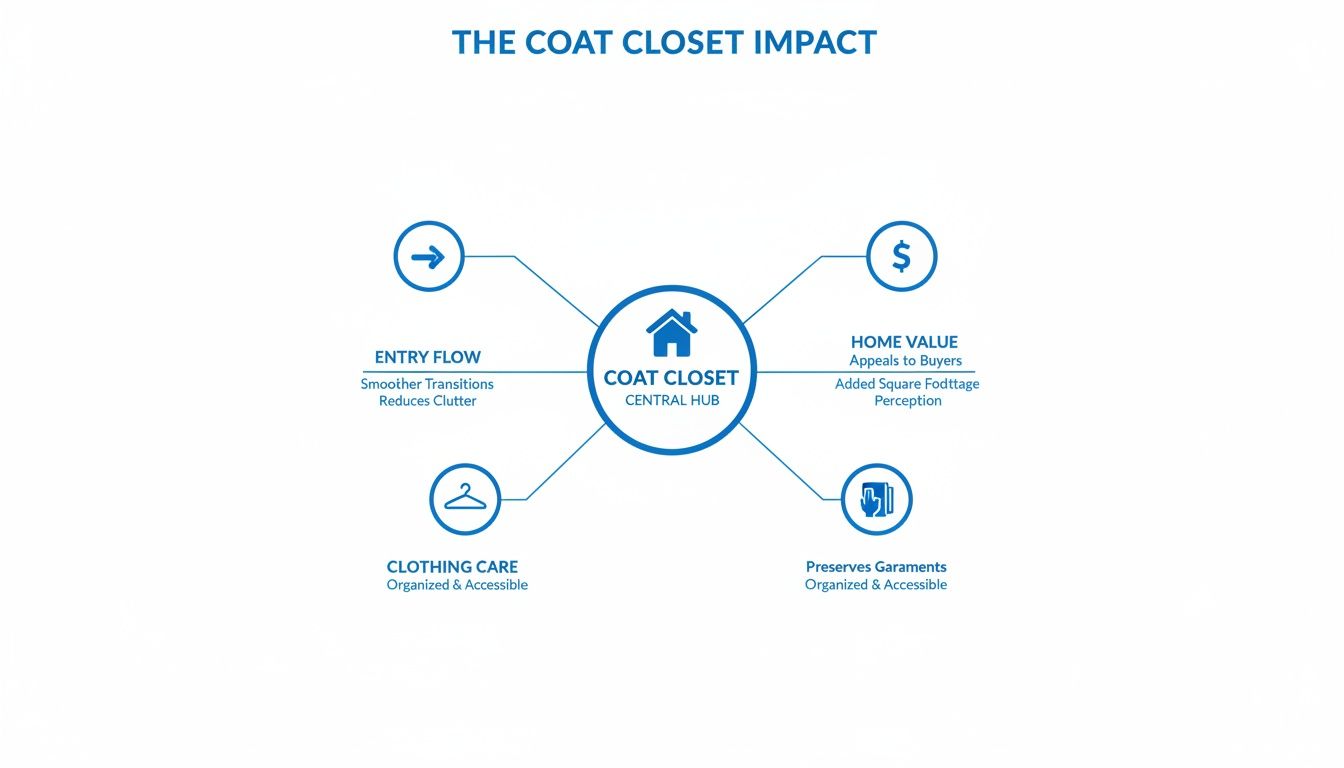
As you can see, a well-planned closet isn't just about storage—it can actually boost your home's value and make your daily routines smoother.
Exploring the Walk-In Entryway Closet
Now, if you've got the square footage to spare, a walk-in entryway closet is a game-changer. While less common, they are an incredible feature, especially in some of the larger homes here in Boca Raton.
The defining feature is depth. A walk-in needs a bare minimum of 48 inches (4 feet) deep just to feel like you can comfortably step inside. Most are much roomier, often hitting 6 feet deep or more. That extra space completely transforms what you can do.
A walk-in closet elevates storage from a single wall of hangers to a fully functional space. Suddenly, it’s not just a closet anymore—it’s more like a mini-mudroom built right into your foyer.
This added real estate opens up a world of possibilities:
- Multi-wall storage: You can wrap rods, shelves, and hooks around two or even three walls, maximizing every inch.
- Integrated seating: A small built-in bench gives you a place to sit down and deal with shoes.
- Dedicated zones: You finally have enough room to create specific spots for shoes, bags, umbrellas, and all that seasonal gear.
A walk-in turns the simple act of hanging up a coat into an organized, streamlined experience. If you're thinking about layouts, our guide on how to design a walk-in closet has plenty of ideas to get you started. In the end, a quick measure of your available space is the first step in deciding which of these powerful closet styles is the right one for your home.
Planning Your Interior Layout for Maximum Functionality
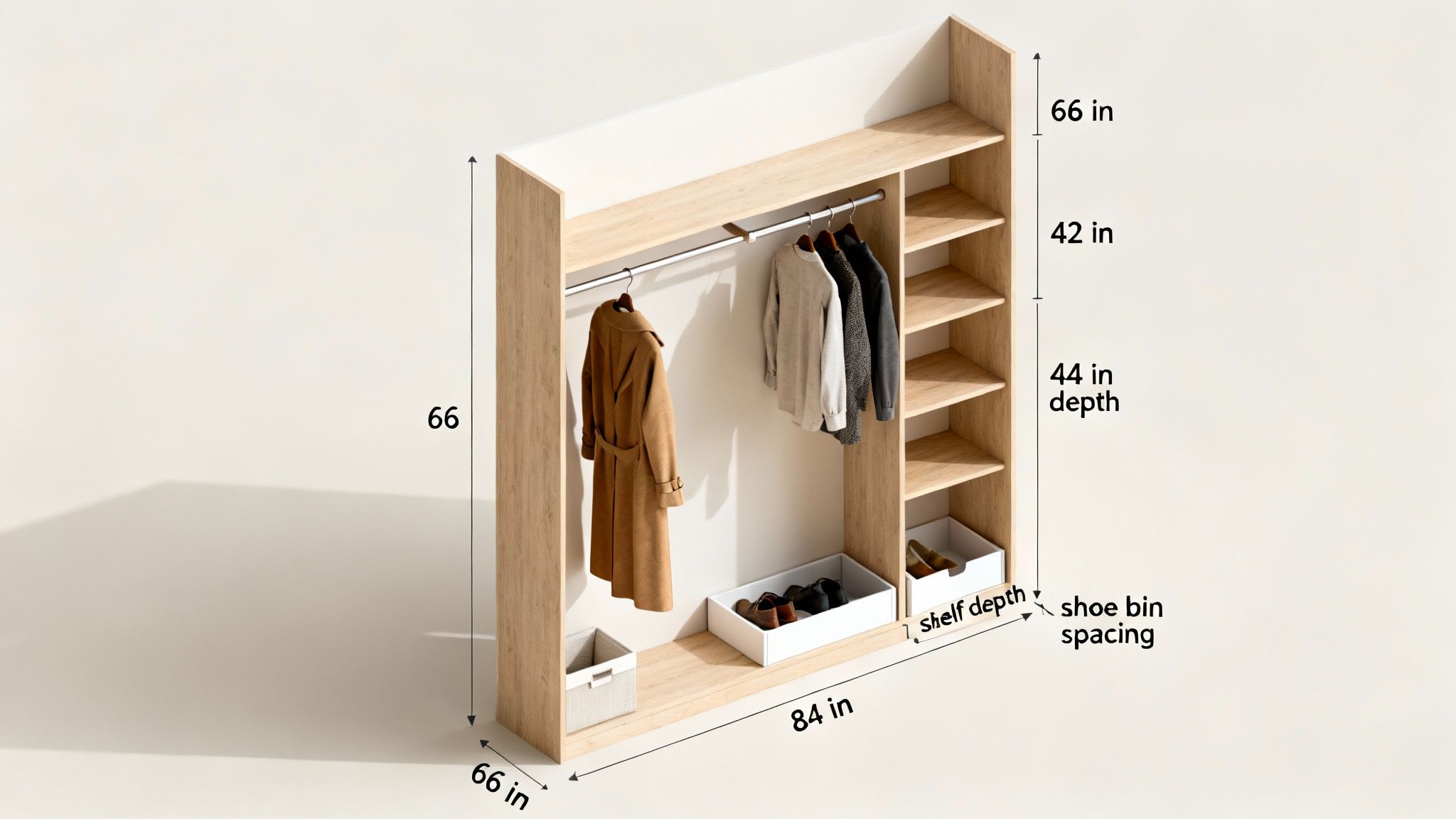
Getting the right exterior dimensions for your coat closet is a great start, but the real magic happens on the inside. Think of the empty closet as a blank canvas; its true value comes from how you arrange the key components. A well-planned interior is what turns a simple box into an efficient storage hub that makes your life easier.
This means looking past the overall footprint and getting specific about where your rods, shelves, and hooks will go. It’s the difference between a closet that works for you and one you’re constantly fighting with just to find a jacket.
Optimizing Your Hanging Space
The closet rod is the workhorse of your coat closet, and its height determines everything. For longer items like trench coats or formal dresses, a single-rod setup is perfect. To keep those coats from dragging on the floor, you'll want to install the rod about 66 inches from the ground.
If your closet needs to pull double duty, a double-rod system is a game-changer. It instantly multiplies your hanging capacity by creating two separate tiers of storage.
- Upper Rod: Place this one around 84 inches high. It's great for adult jackets and items you don't reach for every single day.
- Lower Rod: Setting this one at roughly 42 inches makes it perfect for kids’ coats, shorter jackets, or even pants hung over a hanger.
A small detail that makes a big difference: always account for the hanger itself, which adds about 3-4 inches to the length of your clothes. Factoring this in ensures everything hangs freely without bunching up on the floor or a shelf below.
This tiered approach is a favorite for Boca Raton families because it effectively doubles the hanging room without needing a wider closet.
Arranging Shelves and Clearances
Shelving is your best friend for turning unused vertical areas into prime real estate for shoes, hats, and storage bins. A top shelf, placed around 85-87 inches high and just above a single rod, is the ideal spot for stashing out-of-season gear. For the depth, 12-14 inches is a solid standard—deep enough for bins and folded sweaters but not so deep that things get lost in the back. Knowing how to organize closet shelves can help you get the most out of every square inch.
Finally, don't forget about door clearance. It’s a simple thing to overlook, but you need to make sure your door can swing open at least 90 degrees without bumping into furniture or walls. This guarantees you can actually reach everything inside without a struggle. Once you’ve nailed down these interior basics, this expert guide to maximizing closet space can give you even more brilliant ideas for creating a perfectly organized entryway.
Customizing Your Closet Beyond Standard Dimensions
Once you've got the basic coat closet dimensions down, the real fun begins. This is where we move past the simple box and start crafting a high-performance storage space that actually fits your life. A custom closet isn't just about nailing the measurements; it's about making your daily routine smoother.
Think about what drives you crazy in your entryway right now. Is it the pile of shoes that trips you up every time you walk in the door? Are backpacks and sports bags constantly in the way? Custom features are your answer. They turn that daily chaos into calm by giving every single item a proper home.
Tailoring Your Closet to Your Daily Life
The best closet designs are born from real-world problems. For a busy Boca Raton family, that might mean creating a system to wrangle the daily flood of school bags and soccer gear. For someone who loves the outdoors, the focus might be on heavy-duty storage for bulkier equipment.
Here are a few popular custom additions that make a huge difference:
- Built-in Cubbies: These are a total game-changer for shoe clutter. Giving each family member their own cubby finally ends the frantic morning search for a matching pair. Everything stays off the floor and neatly organized.
- Integrated Benches: A simple built-in bench is incredibly useful. It gives you a place to sit while taking shoes on or off, and it's the perfect spot to set down grocery bags or a laptop case for a moment.
- Valet Rods: Don't underestimate these small, retractable rods. They’re perfect for staging tomorrow's outfit, hanging dry-cleaning before you put it away, or giving guests an obvious place to hang their coats during a get-together.
A truly customized closet anticipates your needs. It’s designed not just for what you store, but for how you live. The goal is to create an intuitive system where everything has a logical and easily accessible place.
Advanced Storage Solutions and Smart Add-Ons
Beyond the basics, you can bring in specialized hardware and systems to take your organization up a notch. Think about pull-out drawers with dividers for keeping gloves, scarves, and winter hats perfectly sorted. You could also install a row of sturdy, oversized hooks just for heavy backpacks and gym bags, which takes the strain off your main hanging rod.
For those who really want to explore what's possible, you can even look into advanced concepts like generative design algorithms for custom interior layouts that can map out the most efficient way to use a tricky or non-standard space. By carefully picking features that solve your specific frustrations, your closet becomes more than just storage—it becomes an essential tool that simplifies your entryway and brings a sense of order to your home.
Bringing Your Ideal Closet Design to Life
Alright, you've done the homework. You've gone from figuring out basic coat closet dimensions to mapping out the perfect interior layout. Now for the exciting part: turning that vision into a real, functional, and beautiful part of your home.
This is where the rubber meets the road. It’s one thing to have a great recipe, but it's another thing entirely to cook a gourmet meal. The instructions are essential, but the final quality always comes down to the skill of the chef. Bringing a closet design to life is no different—it involves smart material choices, ensuring everything is structurally sound, and getting that flawless, professional finish.
The most successful remodeling projects are partnerships. Combining your personal vision with expert craftsmanship ensures that every detail, from hanger clearance to hardware finish, is handled with precision.
Working with a design-build team here in Boca Raton is what closes the gap between your ideas and the finished product. An experienced team helps you sidestep common mistakes, like underestimating the work involved in demolition or picking materials that just can't stand up to our South Florida humidity.
From Blueprint to Build
A professional team takes your layout and turns it into an actionable plan, managing everything from permits to the final coat of paint. They make sure every single component—whether it's a simple shelf or a custom set of drawers—is installed safely and correctly. That kind of oversight is what guarantees your new closet isn't just well-designed, but also built to last.
Drawing on years of hands-on experience, a dedicated team can often find ways to tweak your design for even better efficiency and style. They handle the whole process, coordinating the electricians, painters, and installers, which saves you the headache of trying to manage multiple contractors yourself.
Of course, budget is always a key part of the conversation. If you're weighing the costs of a professional installation, it helps to know what goes into the final price. You can find a detailed breakdown of the custom closet installation cost to get a clearer picture and plan your budget. Taking this final step with the right team ensures your new closet will be a seamless and valuable addition to your home for years to come.
Got Questions About Coat Closet Dimensions? We’ve Got Answers.
Even the best-laid plans can hit a snag. When you're in the middle of a remodel, specific questions always seem to come up. Let's tackle some of the most common ones we hear from homeowners about getting their coat closet dimensions just right.
What’s the Absolute Minimum Depth for a Coat Closet?
The gold standard for a reach-in closet depth is 24 inches. That gives a standard hanger plenty of room to hang straight without bumping into the back wall or the door.
You can sometimes squeeze by with 22 inches, but that’s really pushing it. Any less than that, and you’ll find yourself angling hangers just to get the door closed. Not only is that a frustrating daily puzzle, but it also scrunches up the shoulders of your jackets and can cause damage over time.
If you're stuck with a space less than 22 inches deep, don't try to force a traditional hanging rod. Your best bet is to switch gears. Think sturdy wall hooks or even specialized shallow-depth hanging systems that face forward. It's all about working with the space you have, not against it.
How Can I Squeeze More Storage Out of a Small Entryway Closet?
When your closet is small, the only way to go is up. Think vertically. A double-hang rod system can be a game-changer; you can put adult coats on the top rod and kids' jackets or shorter items on the bottom.
And don't forget about that often-ignored space: the back of the door. It’s the perfect spot for an over-the-door shoe organizer or a few extra hooks for scarves, hats, and dog leashes. Adding a high shelf near the ceiling also gives you a fantastic out-of-the-way spot for stashing seasonal items you don’t need year-round, like beach bags or neatly packed holiday decor.
Do I Need to Worry About Building Codes for a Closet Remodel?
Absolutely. You especially need to pay attention to codes if your project involves moving walls, changing the closet's structure, or adding any electrical work, like a new light fixture.
Local building codes, including those here in Boca Raton, are very specific about things like the minimum clearance required around light fixtures to prevent a fire hazard. This isn't something you want to guess on.
This is why working with a licensed and insured contractor is so important. They know the local regulations inside and out and will make sure your remodel is safe, up to code, and properly inspected. It's the best way to protect your home and your investment.
Ready to transform your entryway with a closet that’s both beautiful and incredibly functional? The experts at Kitchen Renovations Perfected have been designing and building custom storage solutions for homeowners throughout Boca Raton for years. Visit us at https://www.kitchenrenovationsperfected.com to schedule your complimentary design consultation and get started on creating a more organized home.