Ever sat on a bench and felt instantly uncomfortable? Or maybe one that felt so perfect you could linger for hours? That difference often boils down to one crucial, and frequently overlooked, dimension: the seat depth.
While a general rule of thumb places the ideal bench seat depth somewhere between 17 and 22 inches, the magic number for your project depends entirely on its purpose.
Why Bench Seat Depth Is Your Design Secret Weapon
Think of seat depth as the unsung hero of comfort. It's simply the distance from the front lip of the seat to the point where it meets the backrest. Get it wrong, and you've created a problem. Too shallow, and you feel like you’re about to slide off. Too deep, and you're forced into an awkward slouch just to have your back supported.
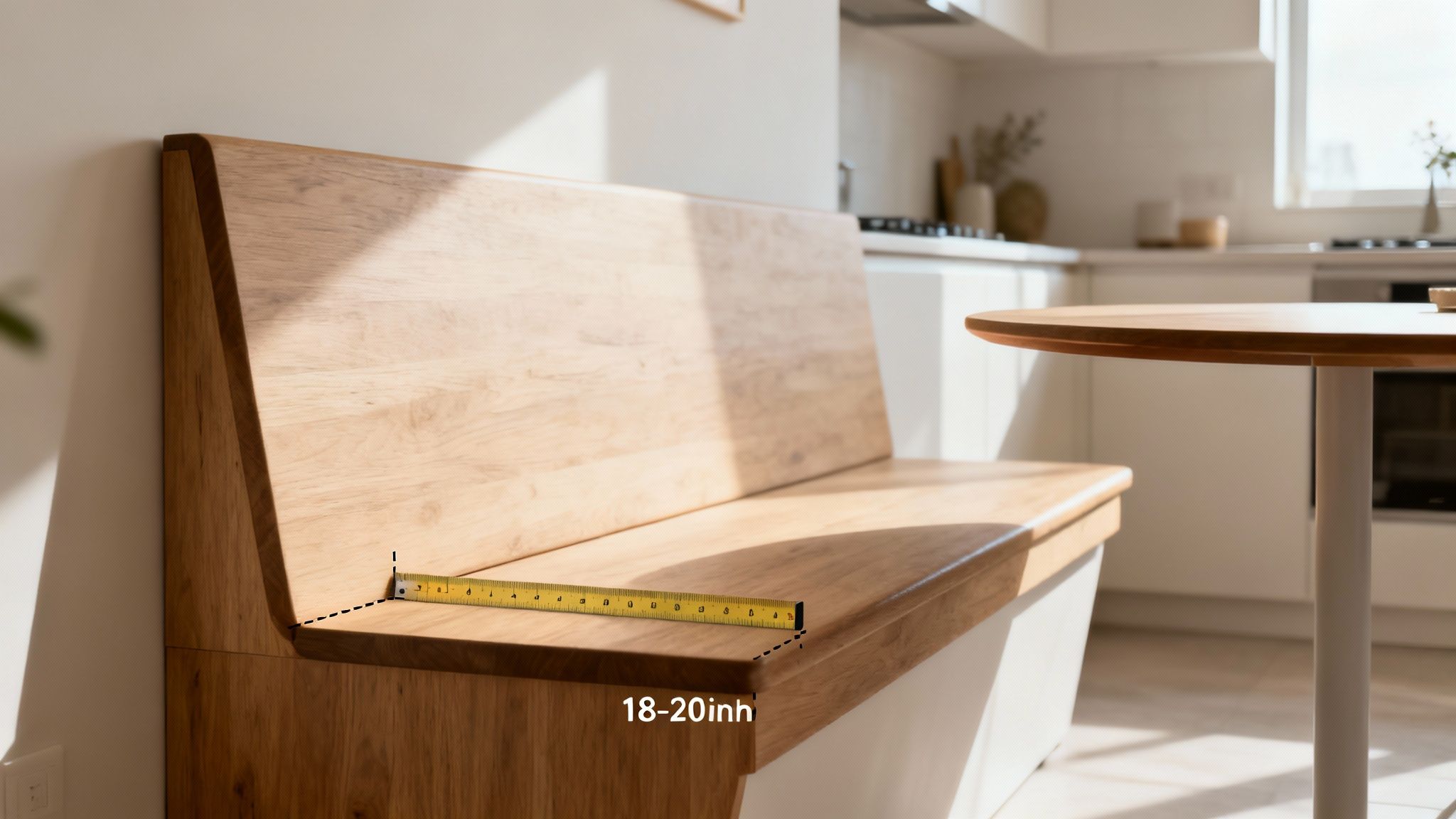
Nailing this measurement is the key to designing spaces that don't just look good in photos but feel great to live in. This is especially true when you're creating a functional, family-friendly kitchen. For a dining banquette, the sweet spot is typically 18 to 20 inches deep, with many designers considering 19 inches the gold standard for comfortable, upright seating.
Finding Your Perfect Depth
There's no single "correct" depth—it’s all about context. A bench in your mudroom is for putting on shoes, a task that takes a minute or two. A window seat, on the other hand, might be for curling up with a book on a rainy afternoon. Those two functions demand completely different dimensions.
This simple decision tree breaks it down: are you designing for dining or for lounging?
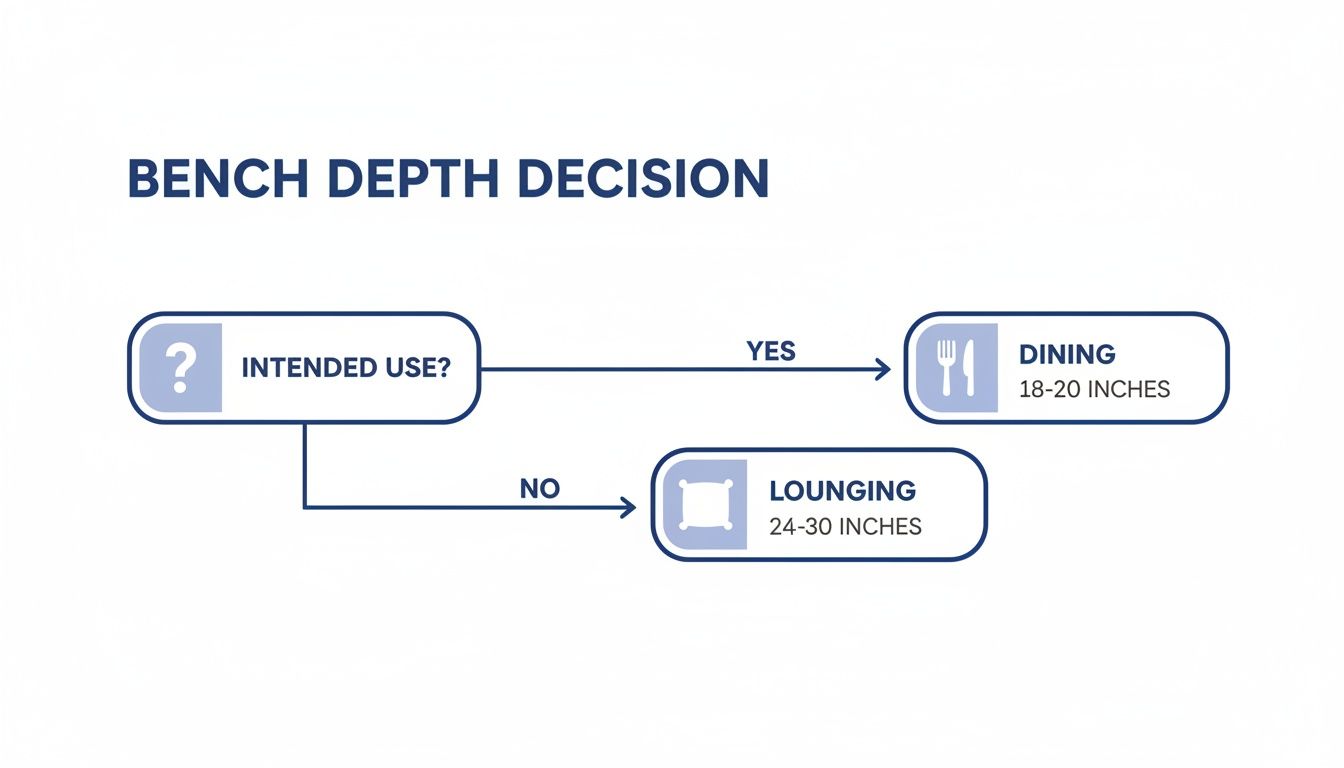
As you can see, more active, task-oriented seating calls for a shallower depth to support good posture. Benches meant for relaxation and lounging need to be deeper to give you room to lean back and get comfortable.
Figuring this out early is a vital first step when you plan your kitchen remodel, ensuring every piece serves its intended purpose perfectly. For a more detailed breakdown, check out this comprehensive guide on choosing the right bench seat depth.
To make it even easier, here's a quick reference table with my go-to recommendations for different types of benches you might be planning.
Quick Guide to Recommended Bench Seat Depths
This table provides an at-a-glance summary of recommended bench seat depths for various common applications in a home remodel, helping you find the right dimensions fast.
| Bench Type | Recommended Depth (Without Cushions) | Best For |
|---|---|---|
| Dining Banquette | 18" – 20" | Upright seating at a dining or kitchen table. |
| Entryway / Mudroom Bench | 16" – 18" | Quick tasks like putting on or taking off shoes. |
| Cozy Window Seat | 22" – 28" | Lounging, reading, and relaxing with pillows. |
| Built-in Storage Bench | 20" – 24" | Multi-purpose seating with integrated storage. |
Remember, these are starting points based on the wooden structure itself. You'll always need to account for cushions and back pillows, which we'll get into next.
The Hidden Science of Comfortable Seating
It's easy to think of bench dimensions as just numbers on a blueprint, but the ideal bench seat depth is really about ergonomics—the art and science of fitting a design to the human body. Think about it like a perfectly tailored suit versus one off the rack. Sure, both get the job done, but only one feels like it was made just for you.
Seating dimensions aren't just pulled out of thin air; they're a direct response to our anatomy. The whole point is to give you stable support along your thighs without the edge of the bench digging into the back of your knees. This is what lets your feet rest flat on the floor, which is the foundation of good, healthy posture.
When a seat is too deep, you’re left with two bad options: either slouch way back to get any back support, or sit perched on the very edge with your legs dangling. Both are a fast track to back strain. On the other hand, a seat that’s too shallow won't support your thighs properly, leaving you feeling wobbly and putting all the pressure on your lower back.
Why Ergonomics Matter for Your Bench
Getting the ergonomics right is what turns a bench from a simple piece of furniture into a genuine destination for comfort. A well-designed seat spreads your weight evenly across the surface, which gets rid of annoying pressure points and helps you maintain a natural, neutral spine. It’s a seemingly small detail that can transform a bench into your family’s favorite spot for morning coffee or long dinners.
This isn’t just a nice-to-have; it’s a principle that shapes design standards across the board. In the US, demand for kitchen furniture jumped 12% to $20.6 billion in 2022, and with that came a bigger focus on comfort. Guidelines from the American Society of Interior Designers point to 19 inches as an ideal depth specifically to avoid the kind of posture problems that made up 35% of shallow-seat complaints before 2020. You can explore more data on residential bench trends to see how these standards are influencing modern homes.
The perfect bench seat depth creates a chain reaction of comfort: your feet are flat, your spine is aligned, and your back is supported. This alignment minimizes physical stress and maximizes relaxation, making the space more inviting.
The Anatomy of a Comfortable Seat
Here’s a simple way to think about it: picture your leg, from your hip to your knee, as a lever. The bench seat is the fulcrum that supports it. To strike the right balance, that depth has to be just right.
Let's break down what we’re aiming for anatomically:
- Thigh Support: The seat needs to support at least two-thirds of your thigh. This takes the strain off your leg muscles, so they aren't working just to keep you stable.
- Knee Clearance: You want a small gap—about the width of two or three fingers—between the front edge of the seat and the back of your knees. This is crucial for preventing the seat from cutting off your circulation.
- Floor Contact: When you get the thigh support and knee clearance right, your feet should naturally rest flat on the floor. This aligns your entire posture, from the ground up.
Nailing these three elements is what makes the difference between a bench that's loved and used every day and one that just ends up collecting dust. It's the invisible science that makes a simple piece of furniture feel like it was custom-built just for you.
Designing the Perfect Kitchen Banquette
When it comes to a kitchen banquette, a few inches can make all the difference. It's what turns an ordinary corner into the go-to spot for the whole family. The sweet spot for dining bench seat depth is typically between 18 to 20 inches, but nailing that perfect number is the key to creating real, custom comfort.
Think of it just like you would a dining chair. You want to be close enough to the table to eat without leaning way over, but still have enough room to get in and out easily. That same simple logic is exactly what we need to apply here.
Finding Your Banquette's Sweet Spot
First, let's talk about your table. You'll want the edge of the tabletop to hang over the front of the bench by about two to four inches. This little overlap is surprisingly important—it keeps you from having to hunch forward and makes for a much more comfortable meal. If the bench is too shallow, you'll feel pushed away from the table. Too deep, and it becomes an awkward shuffle to get in and out.
Next, consider how you’ll actually use the space. Is this strictly a place for formal, upright dining? Or is it more of a multi-purpose nook where the kids will do homework or you'll curl up with a coffee?
- Strictly for Dining: An 18-inch depth is often ideal. It naturally encourages good posture and keeps everyone close and engaged around the table.
- Multi-Purpose Use: If you lean toward 19 or 20 inches, you'll get a bit more flexibility. This gives it a more relaxed feel without making it impractical for meals.
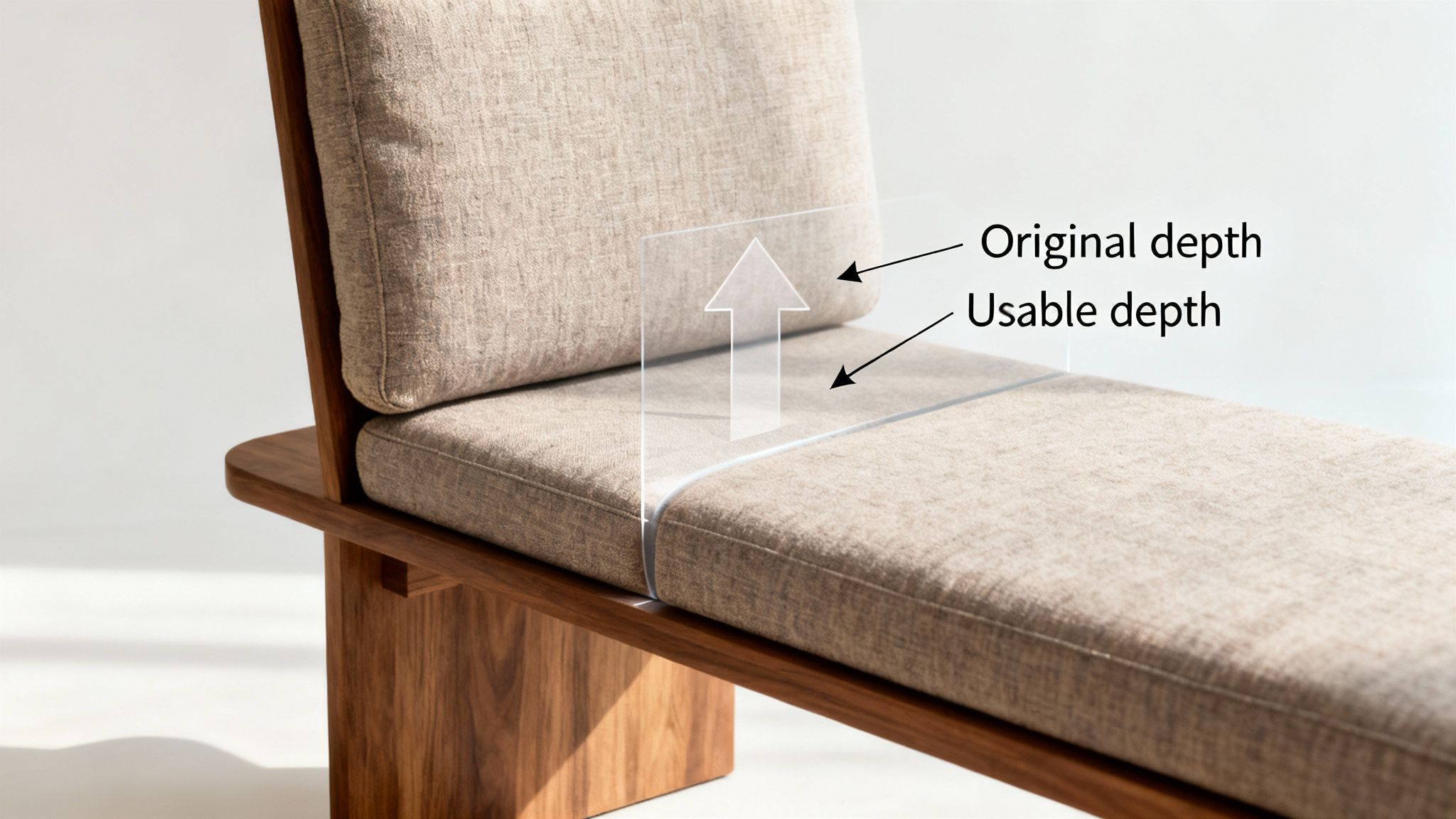
Here's a pro tip that's easy to miss: always, always account for back cushions. A thick, comfy 3-inch back cushion will steal that much usable space from your seat. Suddenly, your 18-inch bench feels like a tight 15 inches. Make sure you add the cushion thickness into your plans from the start.
The Role of the Backrest Angle
The angle of your banquette's backrest is another piece of the puzzle. A straight, 90-degree vertical back is straightforward—what you build is what you get. But for real comfort, especially if you linger after dinner, a slight recline of just 5 to 10 degrees makes a world of difference.
Of course, the moment you add that angle, you have to add a little depth back into the seat to make up for it. This ensures your thighs are still fully supported, even with the gentle recline. It's a subtle tweak, but it's one of those details that you see in high-end custom work. It makes the banquette feel truly integrated, much like how you'd map out your kitchen island design ideas to work perfectly with the surrounding space. This thoughtful planning is what takes a simple bench and turns it into a genuinely functional and beautiful piece of furniture.
Beyond the Banquette: Sizing Benches for Entryways, Mudrooms, and Window Seats
While getting a kitchen banquette just right requires a certain kind of precision, the rules change a bit when we talk about benches in other parts of the house. Not every bench is meant for long, leisurely meals. Some are for quick, practical moments, and others are built purely for kicking back. Nailing the dimensions comes down to understanding exactly how you plan to use the space.
In busy, high-traffic areas like an entryway or a mudroom, the goal is efficiency. Comfort is a factor, but it's secondary to function. These benches are the pit stops of your home—a place to tie your shoes or drop a heavy bag. So, a shallower depth isn't just okay; it's actually better.
Smart Sizing for Entryways and Mudrooms
For these transitional spaces, a bench seat depth of 16 to 18 inches is the sweet spot. It gives you just enough room to sit for a minute without jutting out and blocking the hallway. Think of it as a polite suggestion to take a seat, not a full-blown invitation to linger.
This more compact design is a lifesaver for preserving floor space, especially in narrow hallways or tight mudrooms. It keeps pathways clear for people hustling in and out, preventing the bench from turning into a clunky obstacle. Here, the focus is all on practical, task-oriented seating that helps your daily routine run smoothly.
Creating Cozy Window Nooks
Now, let's head to the other end of the spectrum: the window seat. This is a feature designed entirely for comfort and escape. It’s not a place for tasks; it's a destination for curling up with a good book, sipping a hot drink, or just watching the world go by. To get that cozy, inviting vibe, a deeper seat is an absolute must.
A generous depth of 20 to 24 inches is what I recommend for window seats. That extra space is what allows you to tuck your feet up and lean back into a pile of soft pillows without feeling like you're perched on a ledge.
A window seat's real value is measured in its comfort. A deeper bench gives you the canvas you need to layer on cushions and throw pillows, turning a simple architectural feature into a luxurious retreat you'll actually want to sink into.
This added depth encourages a more reclined, relaxed posture that would feel out of place at a dining table but is perfect for lounging. It’s those extra few inches that separate a purely decorative bench from a genuinely beloved corner of your home.
Interestingly, while global design standards have settled around 18-20 inches for about 75% of kitchen benches since the 2010s—a trend that follows the kitchen furniture market's growth from $132 billion in 2021 to a projected $156.4 billion by 2025—it’s a different story for lounge spots. You can discover more insights about indoor bench seating trends to see the data. But for spaces like window seats, where relaxation is the whole point, going deeper is always a smart, comfort-driven decision.
How Cushions Change Your Measurements
Building the perfect bench frame is just step one. Where many designs go wrong is forgetting how much cushions and upholstery can throw off your final dimensions. It's best to think of your bench's structural depth as the "raw" number and the final, cushioned depth as the real-world measurement you’ll actually sit on.
Plush back cushions and pillows are the biggest culprits for stealing space. That thick, three-inch back cushion doesn't just disappear when you lean against it. Even when compressed, it still eats up valuable real estate. Suddenly, that roomy 19-inch bench seat you planned for feels more like a cramped 16 inches, making it far less comfortable than you imagined.

The Cushion Compression Rule
To sidestep this common pitfall, you have to account for cushion compression right from the start. It’s a simple idea: the usable depth is what's left after you subtract the space your cushions take up.
Here’s a practical formula to keep in mind:
Bench Frame Depth – Compressed Cushion Thickness = Final Usable Depth
Let's say you want a final, usable depth of 18 inches. You plan on adding a back cushion that's 3 inches thick but will probably squish down to 2 inches when someone leans on it. To get that 18-inch feel, you'll need to build the bench frame itself to be 20 inches deep. Planning for this ensures the finished product is actually as comfortable as you designed it to be.
Planning for Every Member of the Household
Beyond the basic math, it’s smart to think about who will actually be using the bench. A one-size-fits-all approach doesn't always work, since ergonomics change for family members of different ages and abilities.
- For Small Children: A slightly shallower seat is often better. It allows them to sit all the way back while still letting their feet touch the floor, which is key for proper back support.
- For Older Adults: Getting up and down easily is the priority. A bench that's too deep can be a struggle to get out of. A moderate depth, somewhere in the 17-19 inch range, usually offers the right balance of stability and support without making it difficult to stand up.
By keeping the "cushion compression rule" and your family's needs in mind, you can create a bench that’s not just a beautiful piece of furniture, but a genuinely functional and comfortable spot for everyone. It's this kind of foresight that takes a good design and makes it great.
Integrating Your Bench into Your Home Design
Getting the bench seat depth right is a huge part of the puzzle, but the real magic happens when you make that bench look like it was always meant to be there. A truly great built-in doesn't feel like an add-on; it feels like part of the room's DNA. This all starts with smart planning and a good tape measure, making sure you account for how people will actually move around the space.
Think of it as planning the traffic patterns in your home. You don't want to create a bottleneck. For a dining banquette, for instance, a good rule of thumb is to leave at least 36 inches of clear space behind the bench. This gives someone enough room to comfortably walk past, even when others are seated at the table.
Blending Form with Function
A perfectly integrated bench does more than just look good—it works in harmony with everything around it. This is where custom work really proves its worth, letting you weave the bench into the fabric of the room.
Here are a few key details to nail down in the planning phase:
- Cabinetry: If your bench is next to kitchen cabinets or other built-ins, you'll want them to look like they came from the same family. Matching the toe-kick height and depth creates that seamless, high-end finish.
- Storage: Are you thinking about drawers or maybe a lift-top lid? This decision changes how the bench is built from the ground up. Drawers, for example, typically need a taller base to function properly.
- Outlets and Vents: Don't let your beautiful new bench block a crucial outlet or an HVAC vent. The best approach is to plan ahead and build them right into the base of the bench. It's a clean, practical solution that keeps everything functional.
A truly integrated bench anticipates the room's needs. It doesn't just provide seating; it enhances flow, adds storage, and works in harmony with the home's existing features, making the entire space more practical and cohesive.
Imagine you're designing a breakfast nook. You can borrow details from your kitchen to make the bench feel connected. You might find some great ideas looking at the clever use of built-ins in coastal kitchen designs, where seating is often used to make the most of a room's light and layout. For a deeper dive into design possibilities beyond just seating, this guide to upholstered ottomans and benches is a fantastic resource.
Your Bench Seat Questions, Answered
Even the most buttoned-up design plan runs into a few lingering questions. When it comes to getting your bench seat depth just right, there are always a couple of tricky details that can trip people up. Let's walk through the questions I hear most often so you can move forward with confidence.
Think of this as the final checklist for nailing the details, from minimum dimensions to the crucial relationship between your bench and the dining table.
What’s the Absolute Minimum Depth for a Functional Bench Seat?
In really tight spots, like a narrow mudroom or a tiny entryway where the bench is more of a quick landing spot than a place to linger, you can get away with a depth of 15 to 16 inches. This is just enough room for someone to sit down to tie their shoes.
But let's be clear: this isn't comfortable for any real length of time. If you're planning a dining banquette or any primary seating, you need to start with at least 17 to 18 inches of depth before you even think about adding cushions. That's the baseline for proper ergonomic support.
How Much Space Should I Leave Between the Bench and the Dining Table?
This is one of those small details that makes a huge difference in how your dining nook actually functions. As a rule of thumb, you want the edge of your dining table to overhang the front of the bench seat by about 2 to 4 inches.
Why this specific number? It's the sweet spot. It lets you slide in and out without a struggle but keeps you close enough to the table to eat comfortably. No awkward leaning, no feeling disconnected from the meal.
An ideal table overhang makes diners feel part of the conversation, not like they're sitting in a separate zone. It's a subtle tweak that completely changes the feel and usability of the space.
Does the Bench Height Change How Deep It Needs to Be?
It does, but indirectly. The standard height for a bench seat is 18 inches off the floor, which is the perfect partner for a standard 30-inch-high dining table. Sticking to these numbers keeps everything ergonomically sound.
If you start playing with that height, you throw off the balance. For instance, a lower bench might feel better with a slightly deeper seat to give your legs more support, but you have to consider how that new height feels next to your table. Get it wrong, and you've designed a recipe for discomfort.
Should a Bench with a Backrest Be Deeper?
Not automatically. The real question isn't whether it has a back, but what angle that backrest is at. If you build a straight, 90-degree back, it doesn’t eat into your seating area. The depth you build is the depth you get.
However, the moment you decide to add a slanted backrest for a more relaxed, lounge-y feel, you absolutely need to increase the overall bench seat depth. You have to compensate for the space that the angle takes up to make sure there's still plenty of flat surface left to support your thighs.
Ready to create a beautiful, functional kitchen that feels like it was made just for you? The team at Kitchen Renovations Perfected can help you navigate every detail, from planning the perfect bench to executing a full-scale remodel. Schedule your complimentary consultation today!