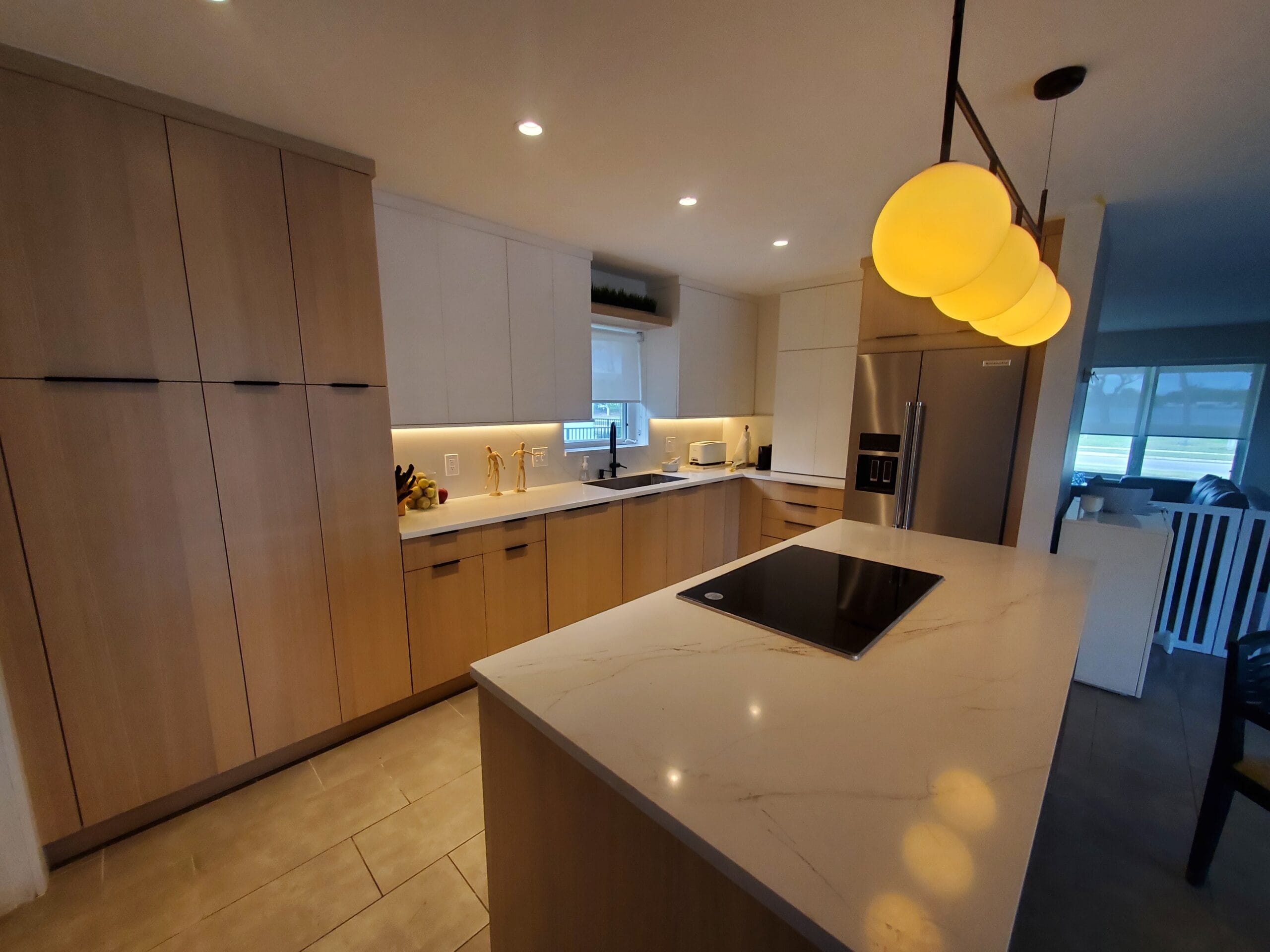
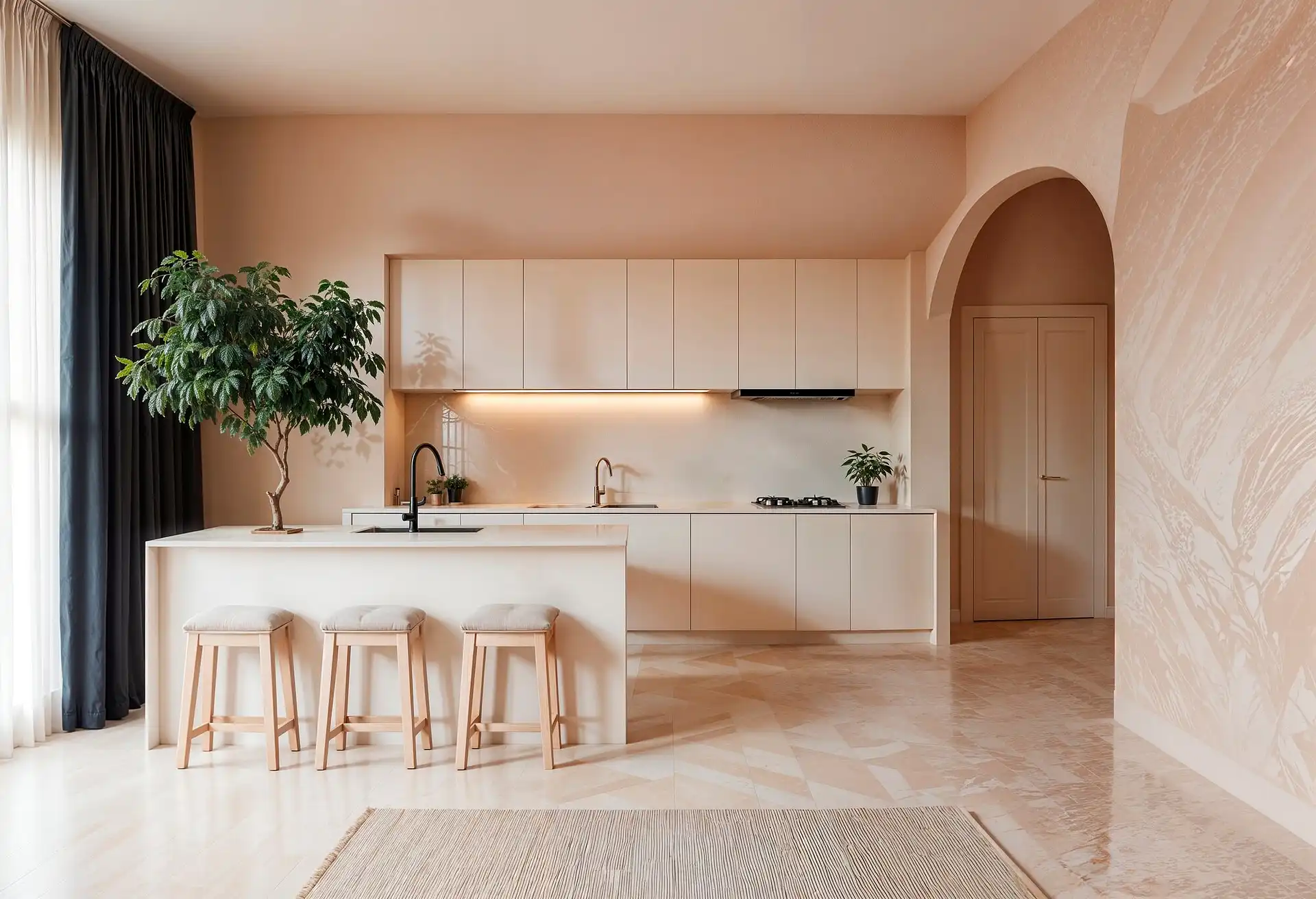
Are you tired of staring at a cluttered countertop with a microwave hogging all the prime real estate? What about that awkward, empty corner that seems to serve no purpose? A corner microwave cabinet might just be the smartest design move you can make. It’s an elegant solution that takes one of the most underutilized spots in your kitchen and turns it into a functional, stylish hub.
This single change can completely transform your kitchen's feel and flow, freeing up valuable counter space for what it's meant for: preparing meals.
The Smart Solution for Reclaiming Kitchen Space
Here in South Florida, from Boca Raton to Delray Beach, one of the most common kitchen frustrations I hear is finding a good home for the microwave. It's an essential appliance, but it often ends up being a bulky eyesore, disrupting the clean lines of a countertop and getting in the way of food prep. This is exactly where a corner microwave cabinet shines.
Think of it as finding the missing puzzle piece that finally makes your kitchen layout click. By moving the microwave into a corner, you get a few major wins all at once:
- You get your counter back. We're talking several square feet of precious workspace for chopping vegetables, rolling out dough, or just enjoying a clean, uncluttered surface.
- Your workflow improves. Creating a dedicated spot for the microwave keeps it handy but moves it out of the main "work triangle" between your sink, stove, and fridge. Everything just feels more streamlined.
- It looks fantastic. Integrating the microwave into your cabinetry gives you that seamless, high-end, built-in look. It feels intentional, not like an afterthought.
Beyond Just Storage
A well-designed corner cabinet is also a huge win for ergonomics. No more bending down to a low counter or reaching uncomfortably high over a hot stove. We can place the cabinet so the microwave sits at a perfect, easy-to-reach height. It's a small detail that makes a huge difference in daily convenience and safety, especially in a multi-generational household.
An organized kitchen isn't just about appearances; it's the foundation of a great remodel. For more ideas on this, check out our guide on how to organize kitchen cabinets to really get your space working for you.
The demand for these clever solutions is only growing. The global microwave oven market was recently valued at around USD 16.22 billion and is expected to hit USD 24.02 billion by 2034. This trend shows just how much modern homeowners value both convenience and smart design, making integrated solutions like corner cabinets more popular than ever.
By turning a dead corner into a dynamic feature, you're not just adding storage. You're fundamentally rethinking how your kitchen works. It’s all about creating a space that works smarter for you.
If you're focused on making every inch count, you might find inspiration in broader design strategies like these small room decorating ideas to maximize space. Ultimately, adding a corner microwave cabinet is a powerful, practical step toward a kitchen that is more organized, beautiful, and a true joy to work in.
What Are My Options for a Corner Microwave Cabinet?
Not all corner cabinets are built the same, and picking the right one is a bit like choosing the right tool for the job. You want to turn that awkward, hard-to-reach corner into a genuinely useful—and beautiful—part of your kitchen. Let's walk through the most common solutions to see which one fits your kitchen's layout and your family's daily rhythm.
This simple guide can help you get started, especially if your main goal is to clear up that precious counter space.
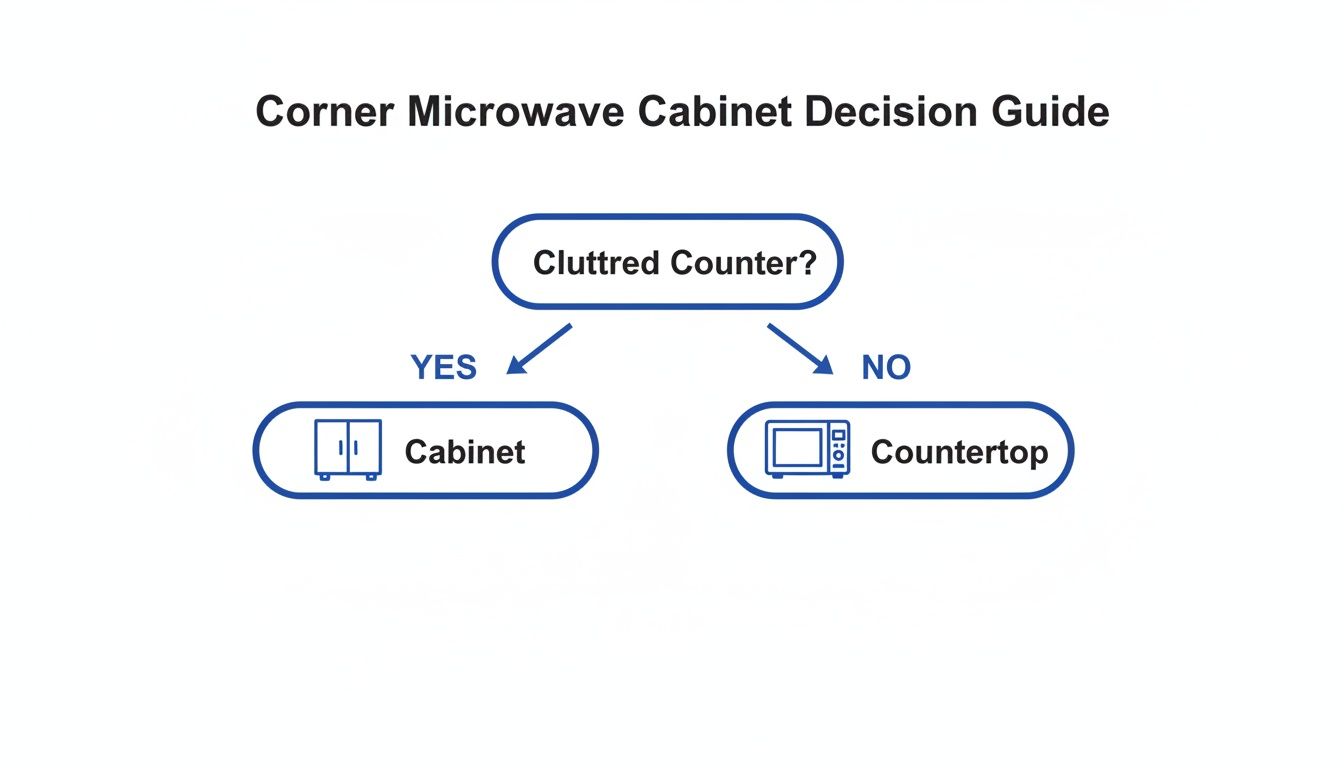
As you can see, reclaiming your countertops is a huge driver for most homeowners looking to tuck their microwave away in a dedicated cabinet.
The Classic: A Diagonal Cabinet
This is the one most people picture first. The diagonal corner cabinet has a single door set at a 45-degree angle, connecting two cabinet runs. It’s a simple, straightforward design that creates a deep, triangular shelf inside.
Think of it as the reliable workhorse. Its biggest plus is its simplicity. It gives you a perfectly sized, easy-to-access spot for most standard countertop microwaves. The angled front also helps soften the sharp 90-degree lines of your kitchen, which can be a nice visual break.
The Clever Solution: A Blind Corner Cabinet
A blind corner cabinet is a smart way to maintain a clean, uninterrupted line of cabinetry. Here, one cabinet run extends all the way into the corner, and the other stops just short. This creates a "blind" or hidden space inside, accessed by a single door on the front face.
On its own, that hidden space can feel like a black hole. But the real magic comes from today's incredible cabinet hardware. You can outfit these with swing-out shelves or pull-out systems that bring everything stored deep inside right out to you. This makes it a fantastic choice for using every last inch of storage, though it definitely requires careful planning to get the access just right.
The Sleek Upgrade: A Microwave Drawer
For a truly high-end and user-friendly option, look no further than a microwave drawer. Instead of a door that swings open, the entire microwave pulls out like a deep drawer. They're typically installed below the countertop in a base cabinet, which is a game-changer for a corner spot because it leaves your upper sightlines completely open and uncluttered.
Microwave drawers are fantastic for accessibility. It's so much easier—and safer—to lift a hot dish up and out of a drawer rather than reaching up into a traditional microwave. This makes it a perfect fit for universal design principles, accommodating everyone in the family, from kids to older adults.
A microwave drawer placed in a corner island or peninsula is a brilliant move. It not only frees up your counters but also gets the appliance out of the primary work triangle, which dramatically improves the flow in a kitchen with multiple cooks.
The Integrated Hub: An Over-the-Oven Setup
Another popular strategy is to create a dedicated cooking tower. In this design, a tall cabinet houses a wall oven with a built-in microwave placed directly above it. When you position this entire unit in a corner, you create an incredibly efficient and powerful cooking zone.
This approach brings a few key advantages to the table:
- A Centralized Cooking Zone: All your baking, roasting, and reheating happens in one convenient spot.
- A High-End, Custom Look: This configuration gives your kitchen a polished, built-in aesthetic that feels incredibly intentional and upscale.
- Smart Use of Vertical Space: You’re taking full advantage of the room's height, which is ideal for kitchens where linear wall space is at a premium.
Comparing Corner Microwave Cabinet Styles
To make the decision a bit easier, here’s a quick comparison of the different styles. Think about your kitchen's layout, how much storage you need, and the overall look you're going for.
| Cabinet Type | Best For | Space Efficiency | Ergonomics | Typical Cost |
|---|---|---|---|---|
| Diagonal Cabinet | Simplicity and direct access for a standard microwave. | Good, but can create deep, hard-to-reach areas. | Fair. Height can be an issue for some users. | $$ |
| Blind Corner Cabinet | Maximizing every inch of storage with pull-out hardware. | Excellent, when paired with the right interior mechanisms. | Good. Pull-outs bring items to a comfortable height. | $$$ |
| Microwave Drawer | Universal design, accessibility, and a minimalist look. | Excellent. Frees up upper cabinet and counter space. | Excellent. Easy and safe to access from above. | $$$$ |
| Over-the-Oven Setup | Creating a consolidated cooking zone with a high-end feel. | Good. Uses vertical space effectively. | Varies. Microwave can be high for shorter users. | $$$$ |
Ultimately, each of these solutions tackles the challenge of corner microwave placement in a different way. While you're thinking about function, don't forget form—exploring the aesthetic range of options, like modern corner curios, can inspire you to find a style that truly elevates your kitchen's design. The perfect choice will be one that seamlessly blends with your layout, lifestyle, and design vision.
Getting the Dimensions and Clearances Right
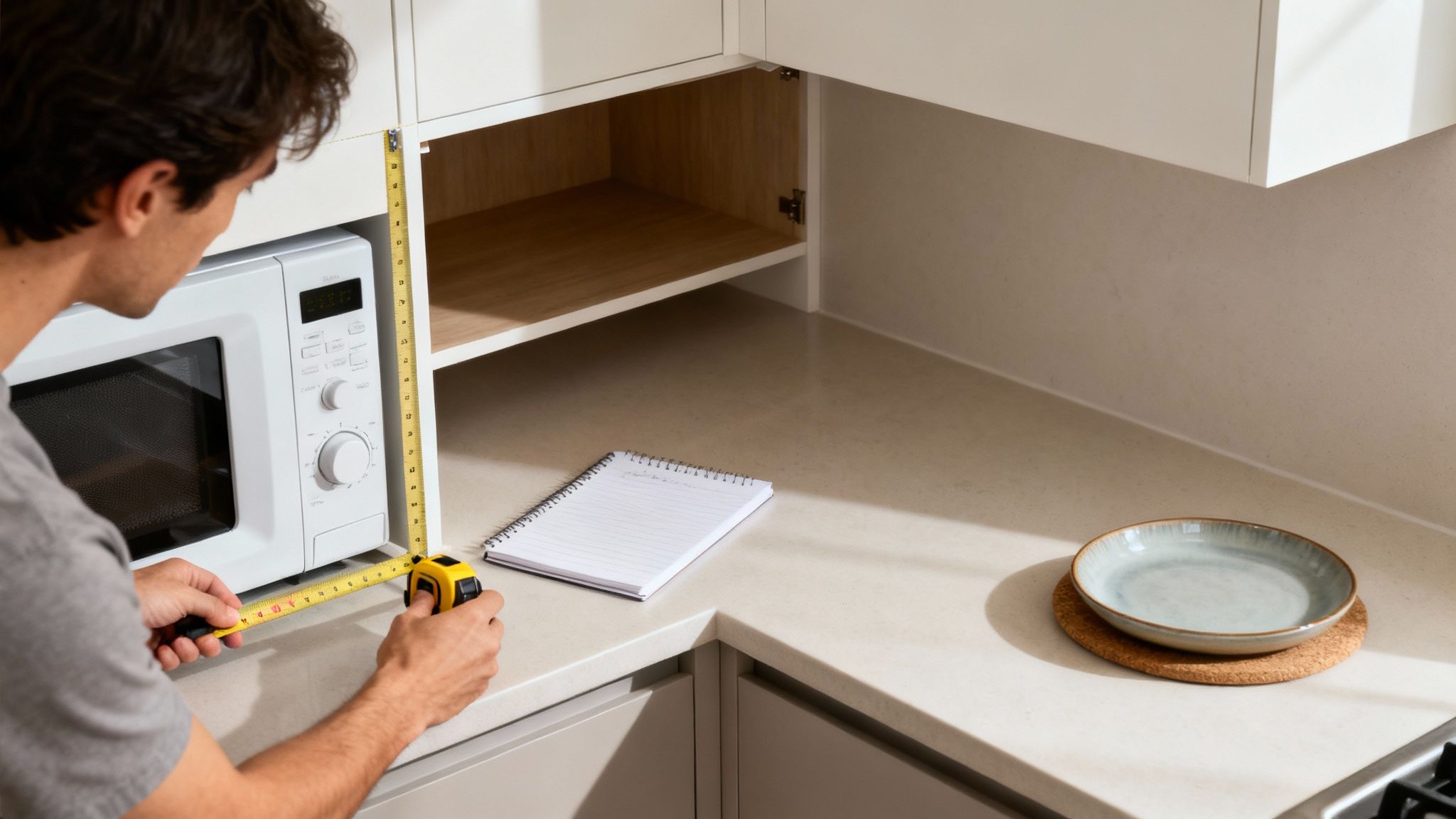
When it comes to a corner microwave cabinet, precision is everything. This is a game of inches, and getting the measurements right from the get-go is the difference between a seamless fit and a costly mistake. It’s about more than just making sure the microwave fits inside the box; it's about creating a truly functional part of your kitchen that’s safe and easy to use.
Think of it as designing a mini-workstation. Every single measurement—from the cabinet's footprint to the space around the appliance—has a purpose.
Standard Cabinet and Appliance Dimensions
While we can always go custom, most corner cabinet solutions are designed around a few standard sizes. A typical diagonal upper corner cabinet will eat up 24 inches of wall space on either side of the corner. This configuration gives you a cabinet face that's usually around 30 to 36 inches wide.
The depth is what often catches people by surprise. Your other upper cabinets might be 12 inches deep, but a corner unit can easily be 24 inches deep or more at its center. This is why you must choose your microwave before you finalize your cabinet order. You have to guarantee a perfect fit.
Here’s what you’ll be working with for the appliance itself:
- Microwave Width: Most countertop models land between 20 and 24 inches.
- Microwave Depth: You're usually looking at 15 to 18 inches.
- Microwave Height: These are typically 10 to 14 inches tall.
Always, and I mean always, check the manufacturer's spec sheet for their required clearances and add those to your dimensions before picking a cabinet.
The Non-Negotiable Landing Zone
This is one of the most frequently overlooked details, but it's critically important for safety and convenience: the landing zone. It’s simply a designated, heat-resistant spot on your countertop right next to the microwave where you can safely set down a hot bowl of soup or a fresh cup of coffee.
The National Kitchen & Bath Association (NKBA) isn't just making suggestions here; they recommend a clear landing area of at least 15 inches wide and 16 inches deep. For a corner setup, this means the countertop directly below or to the side of the cabinet must be kept accessible. Without it, you're setting yourself up for awkward juggling acts with hot food, which can lead to spills and burns.
Ventilation and Electrical Clearances
A microwave puts out a surprising amount of heat. Proper ventilation isn't optional—it's essential for the safety of your home and the lifespan of your appliance. If you suffocate the microwave by boxing it in too tightly, you're risking overheating, malfunctions, and even a potential fire.
A common mistake is treating a microwave cabinet like a simple storage shelf. You must account for airflow. The manufacturer's installation manual is your ultimate guide, as clearances can vary widely between models.
As a rule of thumb, here are the minimum clearances you need to build into your plan:
- Top Clearance: Leave at least 1 to 2 inches of open space above the microwave.
- Side Clearance: Plan for 1 to 3 inches of breathing room on each side.
- Rear Clearance: You’ll need at least 1 to 2 inches at the back for air to circulate.
The electrical outlet is just as important. Your microwave needs its own dedicated 20-amp circuit to avoid tripping the breaker every time you make popcorn. The outlet itself should be installed inside the cabinet, but placed strategically so the plug doesn’t push the microwave forward and block that crucial rear clearance space.
These technical details can get tricky if you have existing architectural features to work around. For kitchens with a dropped-down ceiling section, for instance, knowing what a kitchen soffit is is vital for planning your upper cabinets and running the wiring. Nailing down these elements with your designer and electrician early on will save you from major headaches and ensure your new corner microwave is as safe as it is beautiful.
Navigating Local Codes and Installation in South Florida
Putting in a new corner microwave cabinet is about more than just a perfect fit. You've got to think about what's going on behind the drywall, and that means getting familiar with local building codes. It's easy to see these rules as a hassle, but they’re really just a set of safety standards designed to protect your home and family. Skipping this step can lead to big headaches, from failed inspections and expensive do-overs to genuine safety risks.
Here in our local communities—from Boca Raton to Delray Beach and Parkland—the building codes are especially thorough. They're in place to ensure high-end renovations are built to last, covering everything from the cabinet's structural support to the electrical and ventilation work needed for your new appliance. A true professional isn't just hanging cabinets; they're making sure your project is safe, functional, and up to code.
Your Microwave Needs Its Own Power Line
Let’s talk electricity. This is one area where you absolutely can't cut corners. A modern microwave pulls a lot of power, and it must have its own dedicated 20-amp circuit. This isn't a friendly suggestion; it's a strict requirement in nearly every building code, and for a very good reason.
Trying to run a microwave on the same circuit as your coffee maker or refrigerator is a recipe for disaster. Think of it like a tiny country road suddenly having to handle rush-hour traffic—it just can't keep up. The result? Breakers that trip all the time or, even worse, wiring that overheats and creates a serious fire hazard.
A dedicated circuit gives your microwave a direct, stable source of power. This simple step prevents electrical problems and also safeguards the appliance's sensitive electronics, helping extend its lifespan.
Don't Underestimate the Importance of Ventilation
Proper airflow is another critical piece of the puzzle, especially for a microwave tucked neatly into a corner cabinet. Microwaves produce a surprising amount of heat and steam. If that has nowhere to go, it gets trapped inside the cabinet enclosure.
That trapped moisture and heat can cause a cascade of issues:
- Cabinet Damage: Over time, it can warp the wood, peel away the finish, and become a breeding ground for mold inside your beautiful new cabinetry.
- Appliance Overheating: Without proper airflow, the microwave itself can run too hot, which can shorten its life and even become a fire risk.
- Poor Air Quality: If you have a model designed to vent cooking fumes, a bad installation might just blow smoke and odors right back into your kitchen.
Every microwave manufacturer provides detailed clearance specs—the minimum empty space you need on the top, sides, and back. Following these instructions is non-negotiable if you want to keep your warranty valid and your home safe. With around 90% of households in North America owning a microwave, a professional, code-compliant installation has become the standard. It's what homeowners expect, and it's essential for protecting your home's value. You can dive deeper into the microwave market data on Fortune Business Insights.
Ultimately, getting the details right is what separates a good renovation from a great one. When you work with an experienced team, you can rest easy knowing that everything—from the wiring in the wall to the airflow around the unit—is handled correctly. That peace of mind is what turns a project into a finished kitchen you'll love for years to come.
Choosing Materials and Finishes for Your Kitchen
Alright, we've nailed down the practical stuff—the layout and the technical needs. Now comes the fun part: making your kitchen look and feel like you. This is where you choose the materials and finishes that give your space its personality. Your corner microwave cabinet isn't just a utility piece; it's a major player in your kitchen's overall design, and your choices here will set the tone for years.
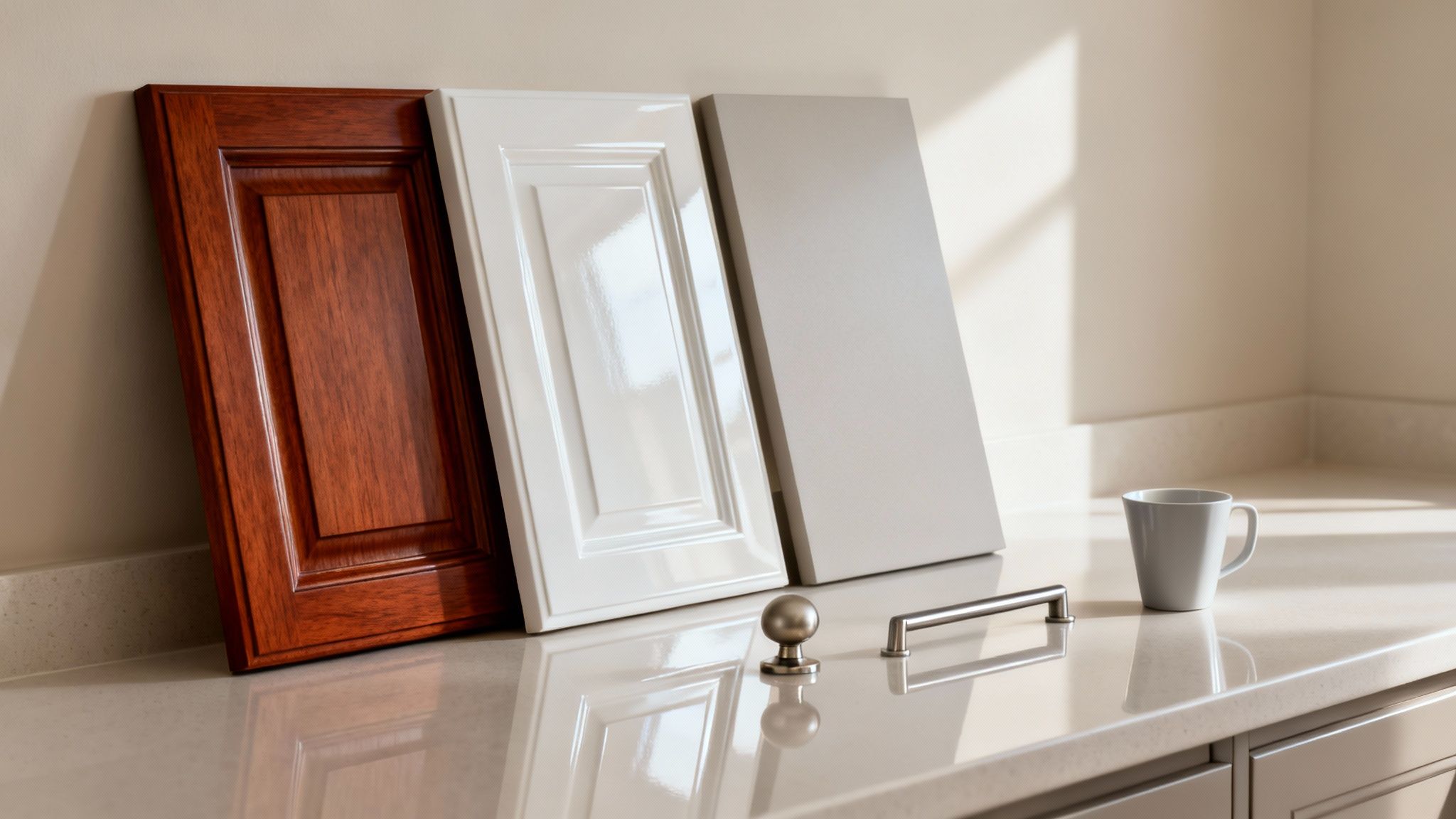
The material is your starting point. Think of it as the canvas for your masterpiece. It dictates the texture, durability, and character of your cabinets. If you want to really get into the weeds on this, our guide to the best kitchen cabinet materials is a great resource.
Selecting the Right Cabinet Material
The core material of your cabinet affects everything from its sturdiness to how well it takes paint or stain. Each has its own distinct personality.
- Solid Wood: You just can't beat the natural warmth and beauty of real wood. Options like cherry, maple, and oak bring a timeless, classic feel to any kitchen. You can stain them to let that beautiful grain shine through or paint them for a more uniform look. Just be mindful that they can react to humidity.
- Medium-Density Fiberboard (MDF): This is an engineered wood product that’s loved for its super smooth and stable surface. If you're planning on a painted finish, MDF is your best friend. It won’t warp or crack with temperature changes, giving you a flawless, lasting coat of paint.
- Laminates and Thermofoil: Looking for something modern, tough, and often easier on the wallet? These are fantastic choices. A decorative layer is fused to an MDF or particleboard core, opening up a huge world of colors and textures—from realistic wood grains to sleek, high-gloss sheens.
Think of your material choice as a balancing act between style, durability, and budget. A warm, stained cherry cabinet gives off a cozy, traditional vibe, while a high-gloss white laminate feels clean, modern, and can make the whole kitchen seem bigger and brighter.
Defining Your Style with Finishes and Hardware
After picking the material, the finish is what really brings the style to life. A painted finish gives you limitless color options, whether you're dreaming of a bold navy or a soft, calming greige. Stains, on the other hand, are all about enhancing the natural beauty of the wood, turning the unique grain into a design feature itself.
And finally, the hardware—the knobs and pulls. This is the jewelry of your kitchen. It's that final, crucial detail that pulls the whole look together.
- Knobs: Small, simple, and perfect for a classic or minimalist aesthetic.
- Pulls: These offer a more solid feel and tend to make a bigger design statement.
- Finishes: Choices like brushed nickel, matte black, or champagne bronze can either match your faucet and light fixtures for a unified look or create an eye-catching contrast.
It’s amazing how much these little details matter. Pair sleek, matte black pulls with white shaker cabinets, and you instantly get a modern farmhouse vibe. Use ornate bronze knobs on stained cherry cabinets, and you're reinforcing a timeless, elegant style. Getting these elements right ensures your corner microwave cabinet doesn't just fit in—it helps create a kitchen that feels beautifully complete.
Your Corner Cabinet Project Planning Checklist
A great kitchen remodel doesn’t just happen—it’s built on a foundation of smart, upfront planning. When you break a big project down into a manageable checklist, what once felt overwhelming becomes a clear, step-by-step process.
This roadmap is designed to walk you through everything from the initial spark of an idea to the final, professional installation of your corner microwave cabinet. Following these steps helps ensure no detail gets overlooked, paving the way for a smooth and rewarding renovation.
1. Measure Your Appliance and Space
Before you even start looking at cabinet styles, you need to get your measurements right. Precision is everything here; it’s the single best way to avoid expensive mistakes down the road. First, get the exact dimensions of the microwave you plan to use—that’s width, depth, and height.
With those numbers in hand, measure the actual corner space in your kitchen. Don't forget to factor in the ventilation clearances required by the microwave manufacturer. This is usually 1-3 inches on the top, back, and sides, and it's absolutely critical for safety and keeping your appliance running properly.
2. Define Your Realistic Budget
Think of your budget as the most important tool in your toolbox. It guides every decision and helps you focus on what really matters. Remember, the total cost is always more than just the price tag on the cabinet itself.
You'll want to account for all these moving parts:
- The Cabinet Unit: The cost here can swing dramatically depending on whether you go with stock, semi-custom, or fully custom cabinetry.
- The Microwave Appliance: Prices range from simple, functional models to high-end, feature-rich microwave drawers.
- Professional Installation: This covers the labor for fitting the cabinet, handling the electrical work, and any touch-ups like drywall repair.
- Hardware and Finishes: The knobs, pulls, and any custom paint or stain will also add to your final cost.
- Contingency Fund: This is a big one. Always, always set aside an extra 10-15% of your total budget for those little surprises that inevitably pop up.
With a comprehensive budget in place, you can have a much more productive conversation with your design team. It helps you decide where to invest and where to save, ensuring you get a result you absolutely love without any financial stress.
A well-planned budget isn’t about limiting your vision; it’s about empowering it. Knowing your numbers from the start allows you to invest confidently in the features that will bring you the most joy and functionality.
3. Select Your Cabinet Style and Materials
Now for the fun part—bringing your vision to life. Think about how you use your kitchen. Does the clean, direct angle of a diagonal cabinet fit your workflow? Or would the seamless, integrated look of a microwave drawer better suit your style?
Your material and finish choices are just as important for the final look and feel. Solid wood can bring a timeless warmth to a space, while MDF is a fantastic, stable base for a flawless painted finish. For a more modern vibe, you might consider a sleek, high-gloss laminate. This is also the perfect time to pick out the hardware—the "jewelry" that gives your cabinetry its personality.
4. Plan for Electrical and Ventilation
This step is all about safety and making sure everything is up to code. Your microwave needs its own dedicated 20-amp circuit to avoid tripping breakers or creating a fire hazard. You’ll need a licensed electrician to run a new line and install an outlet safely inside the cabinet.
Next, lock in your ventilation plan. If your microwave vents to the outside, you’ll need to coordinate with your contractor to make sure the ductwork is routed correctly through the walls or ceiling. For recirculating models, just double-check that you’ve left enough clearance for proper airflow, as specified by the manufacturer.
5. Consult a Professional Designer
Bringing a professional kitchen designer into the process is an investment that pays for itself. A good designer can spot potential issues you might miss, help you navigate the endless style choices, and ensure your new cabinet is both beautiful and perfectly functional. They bring a wealth of knowledge on space planning, material durability, and creating that cohesive, polished look that ties the whole room together.
6. Schedule Your Installation
Once your design is finalized and all your materials are on order, it’s time to get the installation on the calendar. Professional installation is non-negotiable for a truly high-end result. A skilled team will make sure your corner cabinet is mounted securely, the microwave fits like a glove, and all electrical work is done safely and to code, whether you're in a Boca Raton high-rise or a Parkland family home.
Common Questions About Corner Microwave Cabinets
When you're knee-deep in a kitchen remodel, even the best plans can leave you with a few nagging questions. That’s perfectly normal. Getting straight answers to these common concerns is what helps you move forward with confidence, so let's tackle the questions we hear most often about corner microwave cabinets.
These are the real-world things people wonder about, from how it will look to how it will actually work in their day-to-day life.
Will a Corner Microwave Cabinet Make My Kitchen Look Smaller?
It's a fair question, but surprisingly, the answer is almost always no. A well-placed corner microwave cabinet actually tends to make a kitchen feel bigger and more streamlined. Think about it: you're taking a clunky, often awkward corner and turning it into a functional hub.
By doing this, you reclaim long, clean runs of countertop elsewhere. This creates better sightlines and gives you a much more expansive work area, making the whole room feel more open and less cluttered. A good designer knows how to scale the cabinet and choose a finish that enhances your kitchen's flow, not cramp it.
What’s the Ballpark Cost for a Corner Microwave Cabinet?
This is where "it depends" is the honest answer. The cost can swing pretty widely based on the cabinet style, the materials you choose, and how much work is involved in the installation. A basic, off-the-shelf diagonal cabinet, for instance, might start in the low thousands once you factor in professional installation.
On the other hand, if you're looking at a custom-built unit with high-end wood, clever pull-out features, or the electrical work needed for a microwave drawer, you’re talking about a more significant investment. That’s why we always provide a detailed, itemized estimate based on your specific layout and choices—no surprises.
The best way to think about it is as an investment in both function and form. The right corner cabinet doesn't just solve a design puzzle; it elevates the entire look of your kitchen and adds real, lasting value.
Can I Just Stick Any Microwave in a Corner Cabinet?
Definitely not—this is one area where you need to plan ahead. You have to think of the microwave and the cabinet as a single unit. While many corner cabinets are built for common microwave sizes, it’s far from a one-size-fits-all situation. You need the microwave's exact dimensions (width, height, and depth) plus the manufacturer's required clearance space on all sides for proper ventilation.
Our advice is always the same: pick out your microwave before you order the cabinets. This simple step guarantees a perfect, safe, and functional fit, and it saves you from the headache and expense of last-minute changes on site.
Is It Awkward to Get to a Microwave in the Corner?
It shouldn’t be, and we make sure it isn't. Good design is all about ergonomics. A standard diagonal corner cabinet is usually very easy to access. For those deeper corner solutions where reaching could be an issue, we turn to smart hardware like pull-out shelves or a smooth-gliding microwave drawer to bring the appliance right to you.
The whole point is to position the microwave at a comfortable height for you. It shouldn't be so high you're on your tiptoes or so low you're bending down. We'll talk through your family's needs to make sure the final setup isn't just beautiful, but truly practical for everyday use.
Ready to transform that awkward corner into the smartest spot in your kitchen? The team at Kitchen Renovations Perfected is here to help you design a space that is both beautiful and functional. Schedule your complimentary consultation and receive a practical budget estimate today.